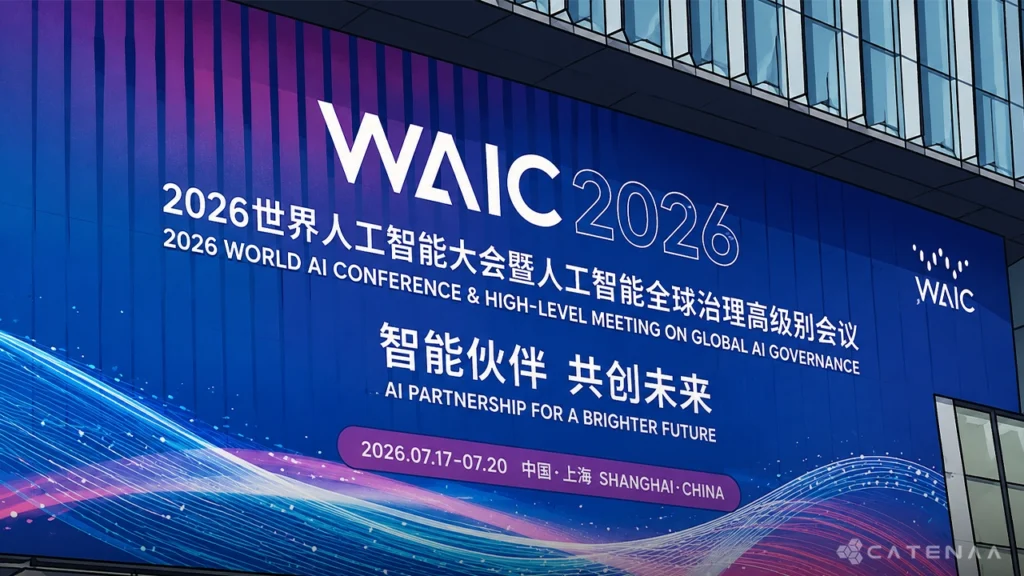


Catenaa, Tuesday, July 24, 2026- China has moved beyond competing in artificial intelligence technology to building an alternative global AI governance system, launching a new international cooperation organization alongside 29 countries during the 2026 World Artificial Intelligence Conference (WAIC) in Shanghai.
The creation of the World Artificial Intelligence Cooperation Organization (WAICO) marked the conference’s most significant outcome, positioning Beijing not only as a developer of AI technologies but also as an architect of international rules governing their adoption, deployment and cross-border collaboration.
Held from July 17 to July 20 across three major venues in Shanghai, the conference brought together more than 1,100 companies, over 3,000 AI exhibits and delegates from more than 80 countries, highlighting China’s growing ambition to lead the next phase of global artificial intelligence development.
Chinese President Xi Jinping opened the conference by outlining Beijing’s vision for greater international cooperation in artificial intelligence, placing global governance at the centre of China’s AI strategy.
On the sidelines of the event, representatives from 29 countries, primarily across Asia, Africa, Latin America and Eastern Europe, signed an agreement establishing WAICO.
The new organization, headquartered in Shanghai, aims to promote international AI standards, cross-border research, technology transfers and broader collaboration among participating nations.
The conference also showcased China’s rapidly expanding AI ecosystem, with domestic companies presenting next-generation large language models, humanoid robots, advanced AI chips and intelligent computing platforms.
Among the major technology demonstrations was Moonshot AI’s Kimi K3 model alongside hardware developed by Chinese semiconductor companies including Moore Threads and Iluvatar CoreX, reflecting continued innovation despite US export restrictions on advanced chips.
The conference exposed an increasingly divided global AI landscape.
Major Western governments and leading US technology companies were largely absent from the event, highlighting widening geopolitical tensions surrounding artificial intelligence.
Washington has tightened export controls on advanced semiconductor technologies while promoting its own approach to frontier AI governance and safety standards.
China, meanwhile, has responded by accelerating domestic AI development, investing in hardware-efficient models and expanding partnerships with developing economies seeking affordable access to artificial intelligence technologies.
The establishment of WAICO represents Beijing’s latest effort to institutionalize that strategy through a formal international organization.
The significance of WAICO extends beyond research cooperation.
It reflects China’s broader effort to shape the institutions that will govern artificial intelligence over the coming decades.
Rather than focusing exclusively on competing with Western AI models, Beijing is constructing an alternative ecosystem encompassing governance, technical standards, talent development and technology distribution.
That strategy mirrors earlier Chinese initiatives such as the Asian Infrastructure Investment Bank and the Belt and Road Initiative, which combined infrastructure investment with long-term geopolitical influence.
For many developing countries, China’s emphasis on technology transfer, open-source collaboration and capacity building may present an attractive alternative to Western frameworks that increasingly emphasize export controls, security restrictions and advanced AI safety regulation.
If participation expands, WAICO could emerge as a significant platform for countries seeking AI partnerships outside traditional Western alliances.
Conference discussions focused on international AI governance, embodied intelligence, computing infrastructure and ethical development.
Chinese authorities outlined new initiatives supporting international collaboration, data sharing and cross-border industrial innovation while emphasizing responsible AI development.
International participants highlighted the importance of human oversight, privacy protection and transparent governance as artificial intelligence becomes more deeply integrated into economies and public services.
The discussions reflected growing recognition that the future of AI will be shaped not only by technological breakthroughs but also by the institutions that establish global rules and standards.
The 2026 World Artificial Intelligence Conference will likely be remembered less for the products unveiled than for the institution it created.
By launching WAICO, China has demonstrated that its ambitions extend beyond producing competitive AI models or overcoming semiconductor restrictions.
It is seeking to shape the global governance architecture surrounding artificial intelligence itself.
As AI increasingly influences economic growth, national security and international competitiveness, the contest may no longer be limited to who builds the most advanced models, but also to who writes the rules under which those models operate.
The World Artificial Intelligence Conference has become China’s flagship international AI event, bringing together governments, technology companies, researchers and investors to showcase advances in artificial intelligence and discuss global policy. Since the United States imposed restrictions on exports of advanced semiconductor technologies to China, Beijing has accelerated efforts to strengthen domestic AI capabilities while expanding partnerships with countries across the Global South. The newly established World Artificial Intelligence Cooperation Organization (WAICO) represents the latest phase of that strategy by creating a permanent institution dedicated to AI cooperation, standards development and technology exchange. The initiative reflects a broader geopolitical trend in which competing blocs are increasingly building parallel institutions to shape the future governance of emerging technologies.