

One October, a failed copper gamble set off a chain of bank runs that nearly broke the American financial system. With no central bank to call, the job of stopping the panic fell to a 70-year-old private banker and his library.
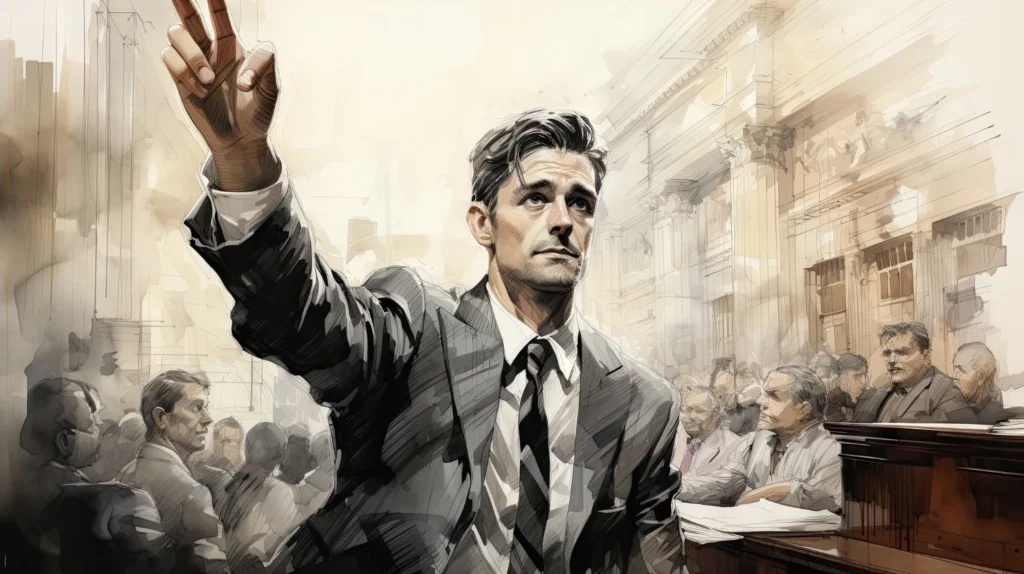
Picture New York on the night of Sunday, November 3, 1907. Inside a marble library on Madison Avenue, the heads of the city’s biggest trust companies argue over a rescue fund. The host, John Pierpont Morgan, has quietly locked the front doors. Nobody leaves until the money is pledged. The United States had no central bank in 1907. Therefore, when panic struck, one private citizen had to play the role himself. This story explains how that happened. Along the way, it demystifies the concepts that still drive every financial crisis: bank runs, liquidity, and systemic risk.
In Summary
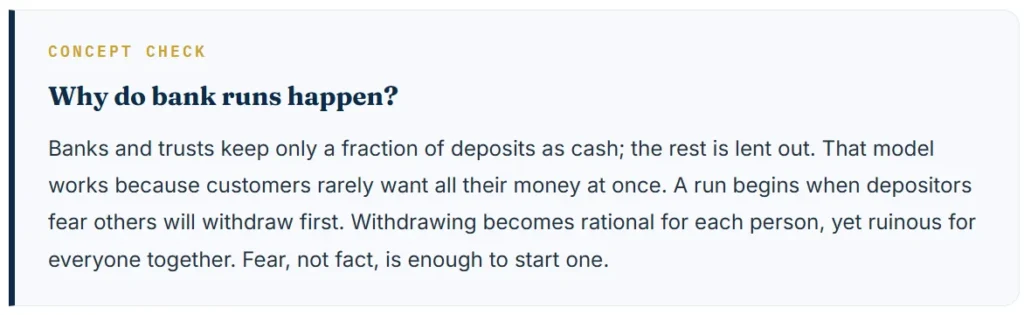
Bank runs are self-fulfilling. Once depositors fear others will withdraw first, withdrawing becomes individually rational and collectively destructive.
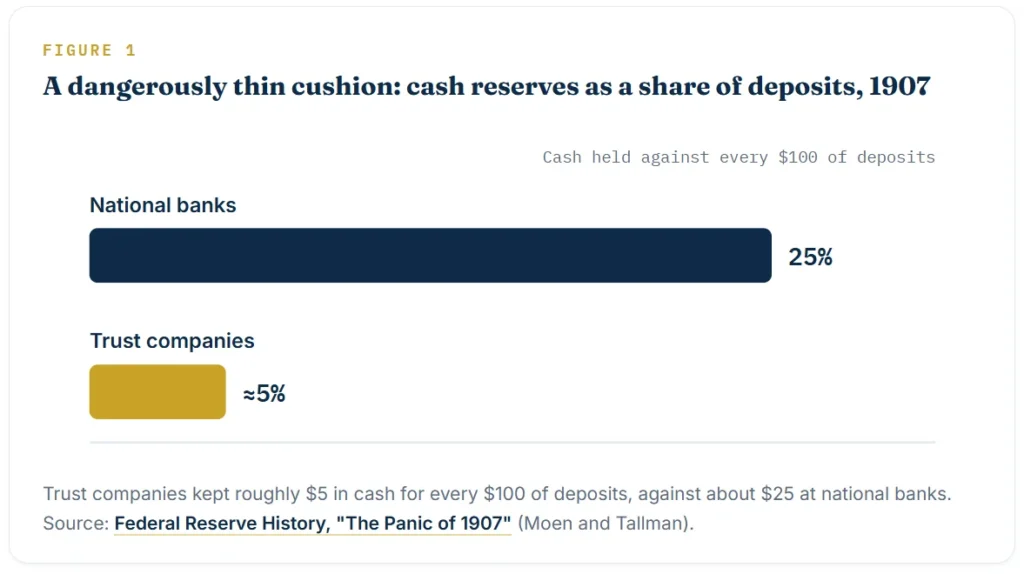
Thin cash cushions invite disaster. Trust companies held roughly 5 percent reserves against 25 percent at national banks, leaving no margin for fear.
Liquidity has a price, and panic sends it vertical. Overnight call money jumped from 9.5 percent to 100 percent in three days.
Systemic risk travels through connections. A copper corner ended up cutting U.S. industrial output by 17 per cent.
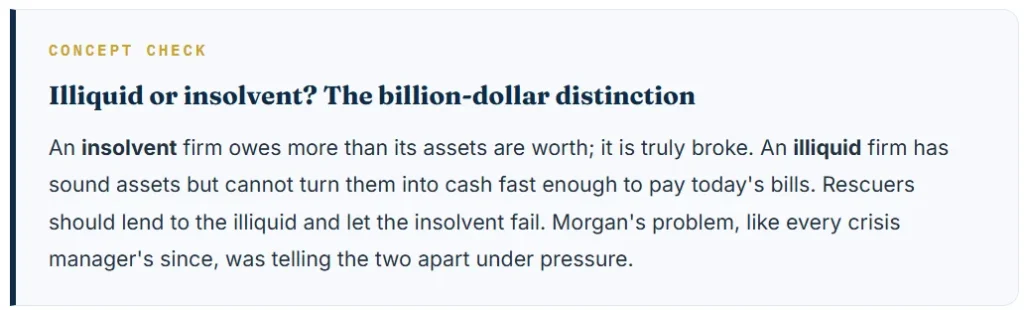
A lender of last resort must separate the illiquid from the insolvent. Morgan let Knickerbocker fail but defended the Trust Company of America.
1907 built the Fed. The panic led directly to the Aldrich-Vreeland Act of 1908 and the Federal Reserve Act of 1913.
A Banking System Without a Safety Net
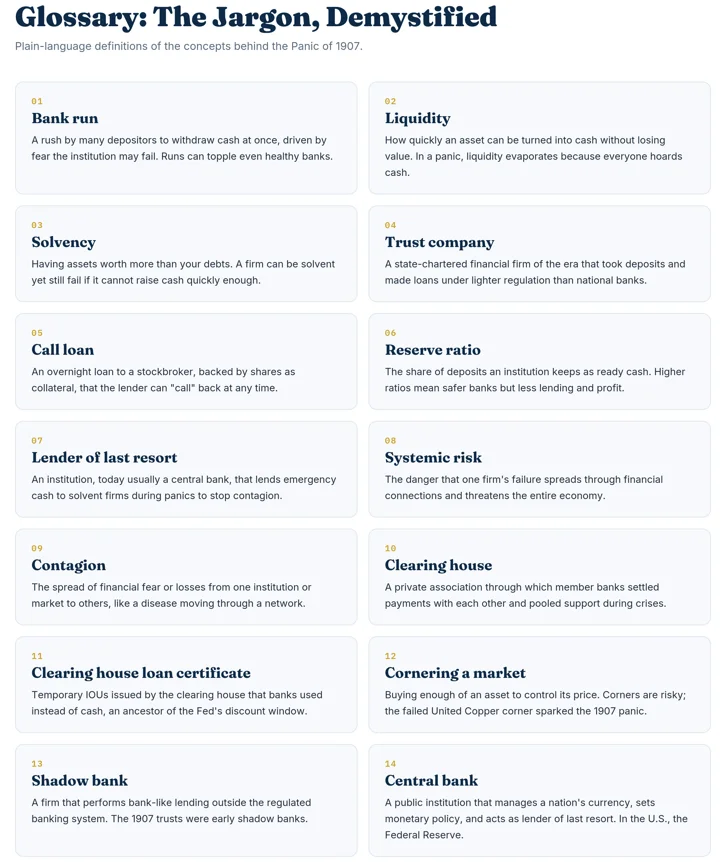
To understand 1907, start with the institutions at its center. Alongside ordinary banks, New York had “trust companies.” These were state-chartered firms that competed with banks for deposits but faced lighter rules. Economists at the New York Fed later compared them to the “shadow banks” of 2008. They were less regulated, more leveraged, and outside the safety net of their day.
The key difference sat in their cash cushions. According to the Federal Reserve History project, trusts held cash reserves of around 5 per cent of deposits. National banks, by contrast, held about 25 per cent. In calm times, a thin cushion meant more money out on loan and higher profits. In a storm, it meant the till could empty within hours.
Trusts also mattered far beyond their vaults. They lent huge sums to stockbrokers each morning, without collateral, and were repaid by evening. Brokers used that money to buy shares, then pledged those shares for overnight “call loans” from banks. Consequently, the trusts sat at the very start of Wall Street’s daily funding chain. If they ever stopped lending, the stock market’s plumbing would seize.
The Spark: A Failed Copper Corner
Every panic needs a spark. This one arrived on October 16, 1907, when two speculators, F. Augustus Heinze and Charles W. Morse, lost a fortune trying to corner the stock of United Copper. A “corner” is an attempt to buy up so much of something that you control its price. The scheme collapsed, and the price crashed instead.
On its own, a botched copper bet should not threaten a nation. However, Heinze and Morse were also bank directors. Depositors reasoned that banks run by reckless gamblers might be unsafe, so they rushed to move their money to more trusted institutions. The New York Clearing House, a private association of banks, stepped in. It examined the affected members, declared them solvent, forced out their managers, and lent support. That firewall held. Unfortunately, the fear had already jumped somewhere else.
The Knickerbocker Moment
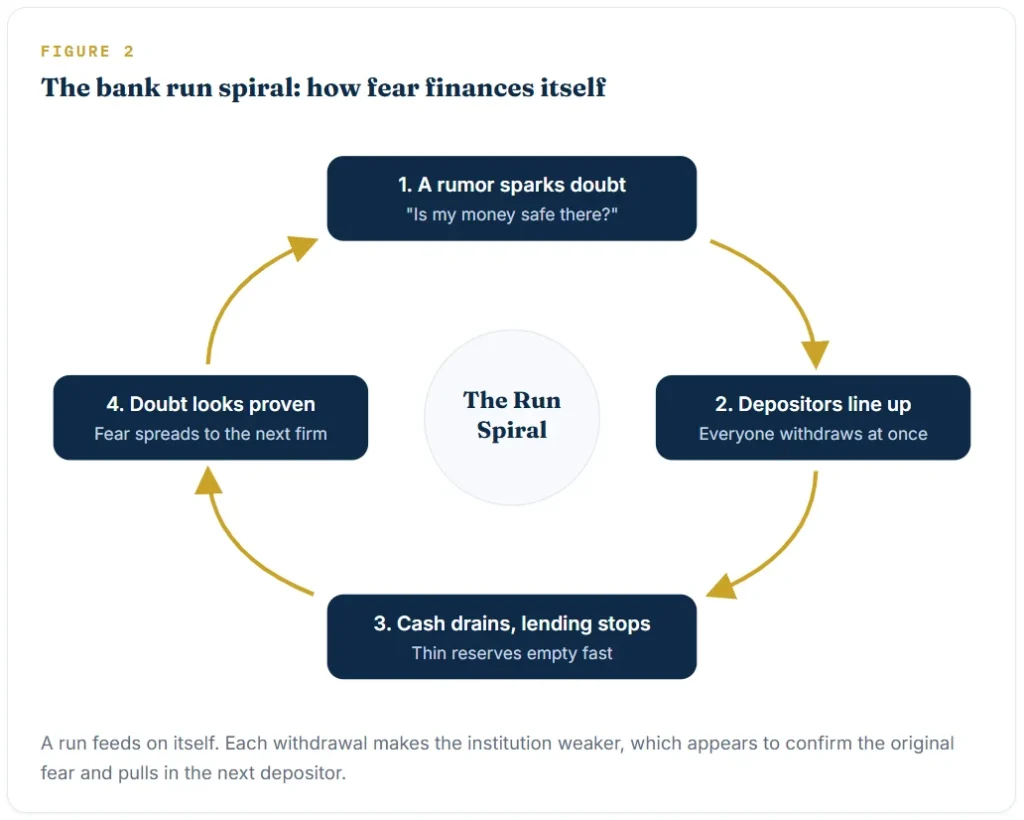
On October 18, newspapers revealed that Charles T. Barney, president of the Knickerbocker Trust Company, was an associate of Morse. Knickerbocker was the city’s second-largest trust, and its depositors did not wait for details. A run began. Because Knickerbocker was not a Clearing House member, the association refused to lend to it. Its resources were reserved for members only.
That left one door: J.P. Morgan. Morgan asked a young banker named Benjamin Strong, who would later lead the Federal Reserve Bank of New York, to inspect Knickerbocker’s books overnight. Strong could not confirm the trust was solvent in the time available. Morgan therefore refused to help. On October 22, after depositors pulled nearly $8 million, Knickerbocker shut its doors. The New York Fed later called it the era’s “Lehman moment.”
When Liquidity Vanished
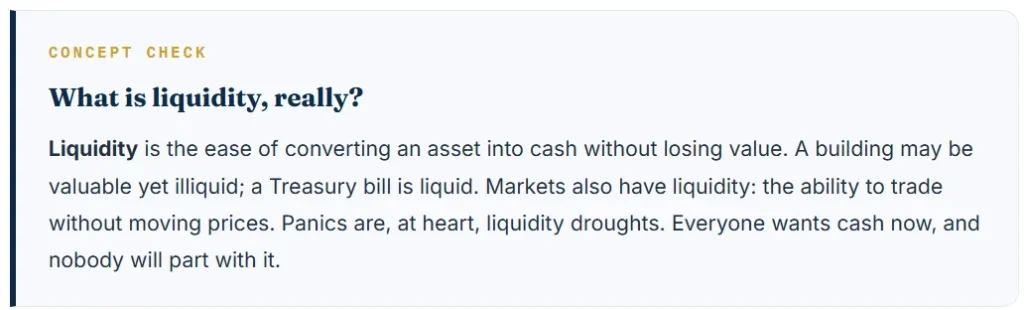
Knickerbocker’s collapse turned localized fear into a citywide scramble for cash. That scramble showed up instantly in the price of money itself. The “call money rate,” the interest charged on overnight loans against stock collateral, became the crisis’s fever chart. On the day Knickerbocker closed, the annualized rate leapt from 9.5 percent to 70 percent. Two days later it touched 100 percent, and at times no lender would offer credit at any price.
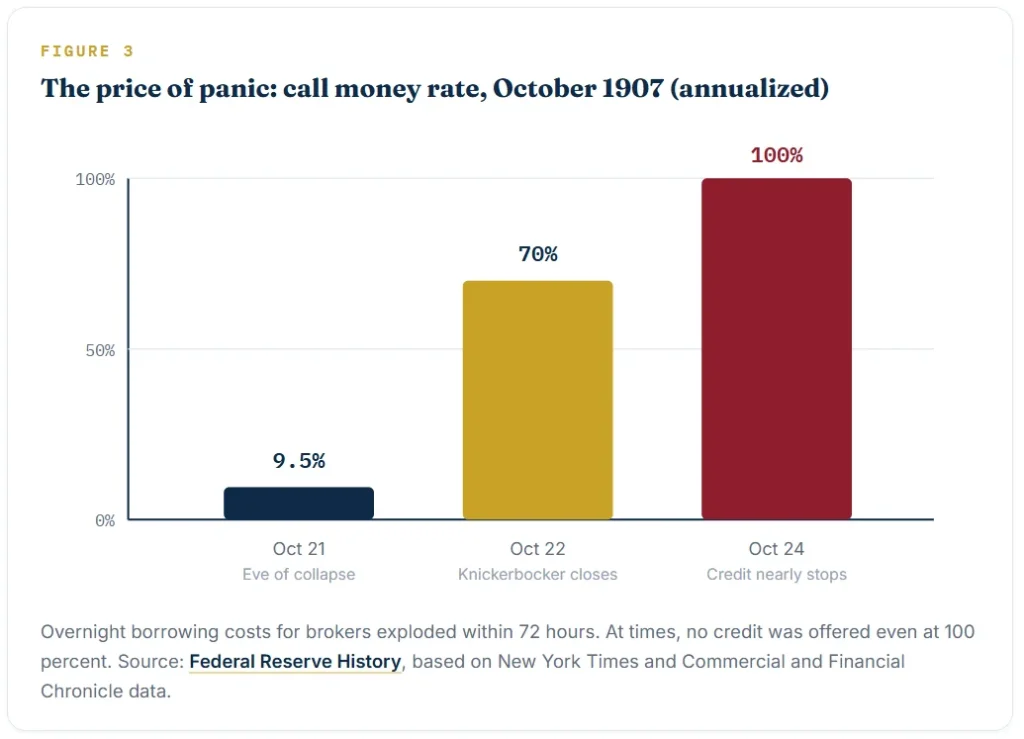
Why did the rate explode? Remember the funding chain. Trusts under siege stopped lending to brokers so they could pay fleeing depositors. Brokers then had to bid desperately for scarce overnight money elsewhere. The interest rate is simply liquidity’s price tag. When cash becomes the only thing anyone trusts, its price goes vertical.
Morgan Becomes a One-Man Central Bank
With Knickerbocker gone, the run swarmed the Trust Company of America. This time Morgan drew the line and released aid quickly, alongside the Clearing House banks. He was now performing, privately, the job economists call the lender of last resort. That job means supplying emergency cash to solvent institutions so that temporary illiquidity does not become permanent failure.
The rescue ran on several fronts at once. The stock exchange itself nearly ran out of loanable funds. In response, Morgan gathered cash from major banks and industrial firms. He had it delivered straight to the exchange’s loan post. The Clearing House, meanwhile, issued loan certificates, a temporary substitute for cash that historians consider a forerunner of the Fed’s discount window. Finally came the famous library night of November 3. That evening, Morgan locked the trust presidents inside until they pledged a mutual rescue fund of their own.
One last domino required Washington’s blessing. The brokerage Moore & Schley was sinking under $25 million of debt, secured by shares of the Tennessee Coal, Iron and Railroad Company. Morgan proposed that U.S. Steel absorb the company, and President Theodore Roosevelt’s administration signaled it would not sue under antitrust law. The deal steadied the market. It also handed critics lasting proof of how much power one banker now held.

Systemic Risk: When One Failure Threatens Everyone
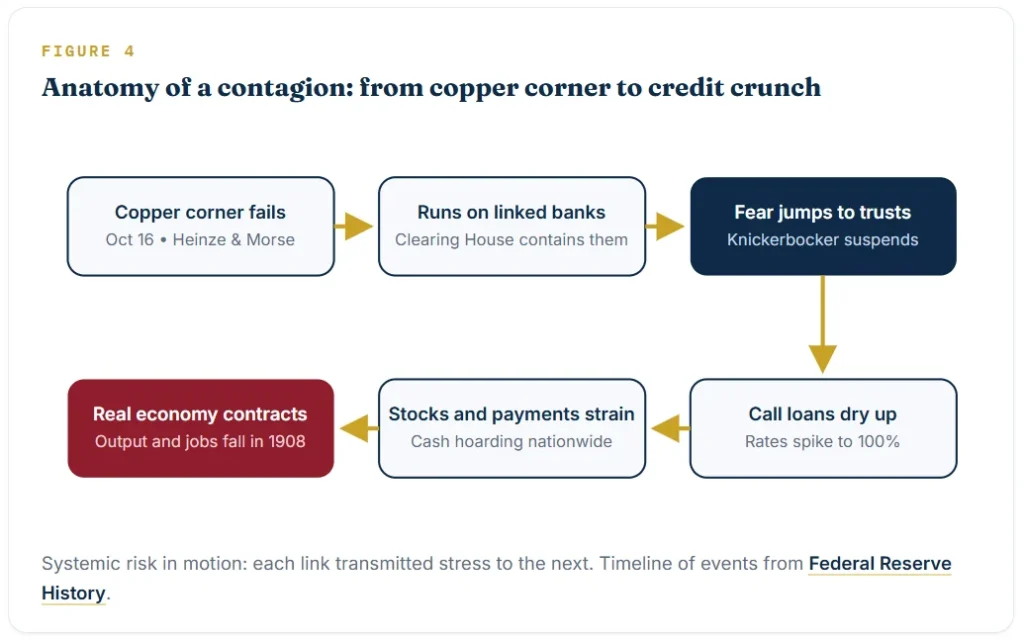
Notice the path the fire travelled. A copper gamble burned a few banks, then the trusts, then the stock market’s funding, and finally factories and jobs nationwide. That is systemic risk. It is the danger that trouble in one corner of finance cascades through institutional connections until the whole system falters. No single firm on that chain thought it was gambling with the national economy. Together, they were.
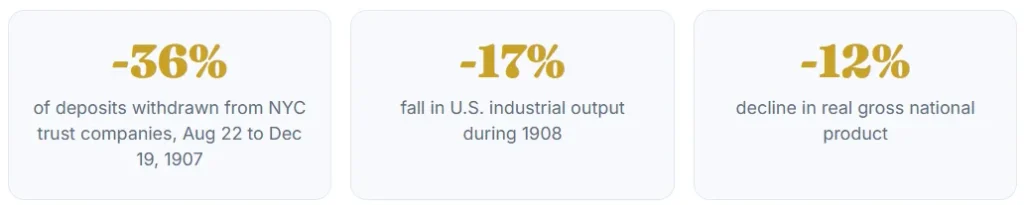
The numbers show how far the damage spread. Between August 22 and December 19, 1907, depositors pulled over 36 percent of deposits from New York City trust companies. To conserve cash, Clearing House banks even restricted the conversion of deposits into currency, which drew emergency gold in from abroad. The pain then left Wall Street for Main Street. Industrial output fell 17 percent in 1908, and real GNP dropped by 12 percent. Only the Great Depression would prove more severe.
From One Man to an Institution: The Road to the Fed
The system recovered quickly; Knickerbocker itself reopened in March 1908 after a $2.4 million capital infusion. Yet the lesson unsettled everyone. As the Federal Reserve’s own historians put it, Congress recognized that the nation “could not continue to rely on wealthy individuals” to stop financial crises. Morgan was 70. Who would lock the library doors next time?
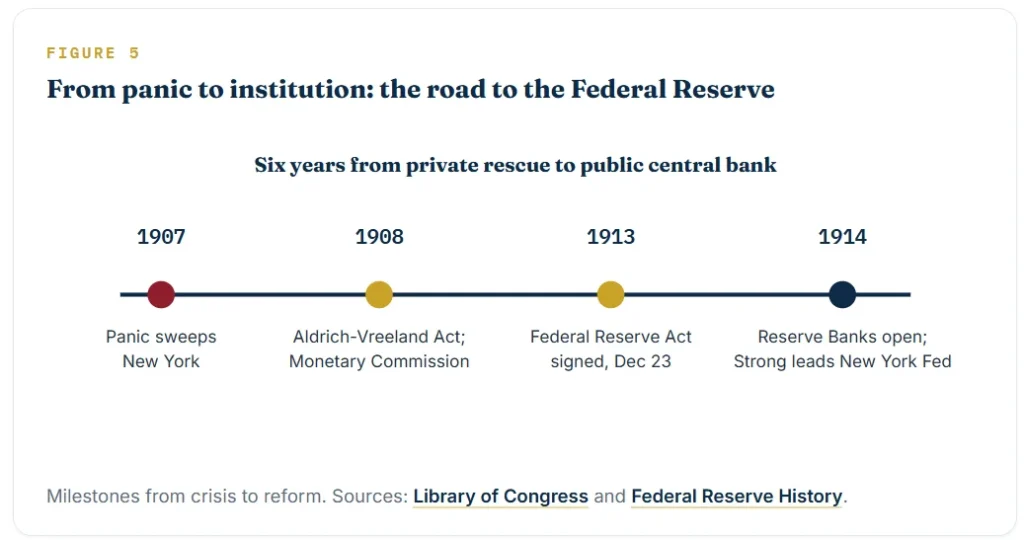
Reform came in stages. In May 1908, Congress passed the Aldrich-Vreeland Act, which created an emergency currency and a National Monetary Commission to study banking reform. After years of study and fierce political debate, President Woodrow Wilson signed the Federal Reserve Act on December 23, 1913. America finally had a permanent, public lender of last resort. Fittingly, the first head of the new Federal Reserve Bank of New York was Benjamin Strong, the same man Morgan had sent to audit Knickerbocker’s books by lamplight.
So did the Panic of 1907 make J.P. Morgan America’s central banker? For three weeks, yes, and brilliantly. But the deeper legacy runs the other way. The episode proved that a modern economy cannot outsource financial stability to any individual’s judgment, balance sheet, or lifespan. Every time the Federal Reserve floods markets with liquidity today, it is doing, at national scale, what one man once did behind locked library doors.