

Digital money failed for decades because data can be copied perfectly. Here is the flaw that blocked electronic cash and the nine-page paper proposing a way around it.
In Summary
Money is defined by what it does, not what it is made of. Economists test it against three functions: exchange, account and value storage.
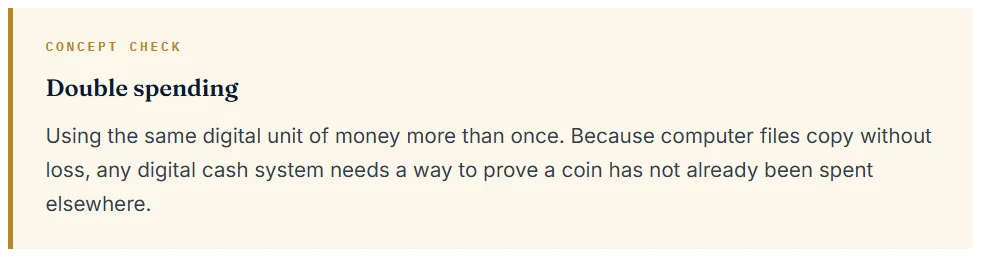
Digital cash failed for decades because data can be copied perfectly. That flaw is the double-spend problem.
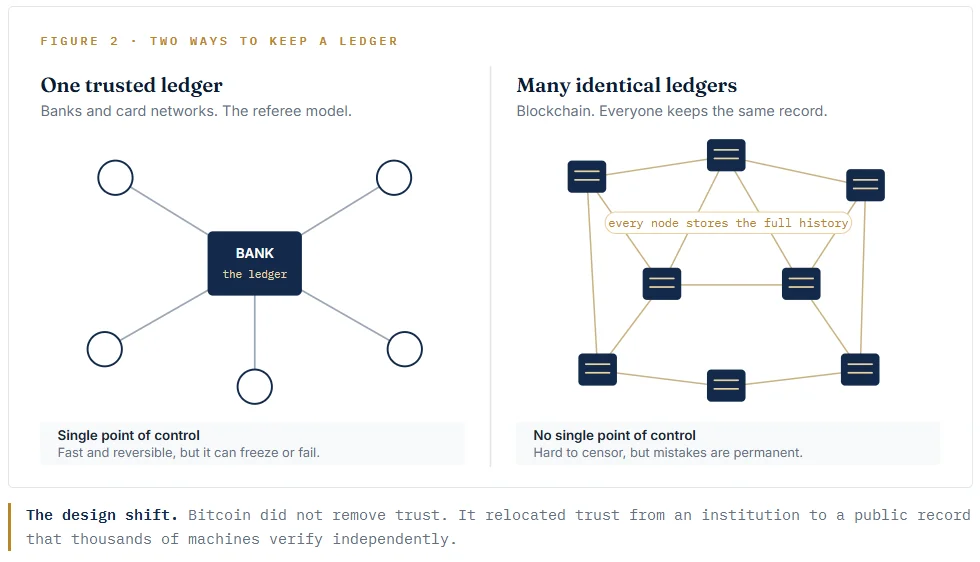
Traditional finance solves it with a referee. Banks keep the master ledger and reject repeat spends.
Bitcoin’s 2008 proposal removed the referee. Thousands of computers keep identical copies instead, and computation secures the record.
Trust was relocated, not eliminated. You now trust a public record rather than an institution, which brings different risks.
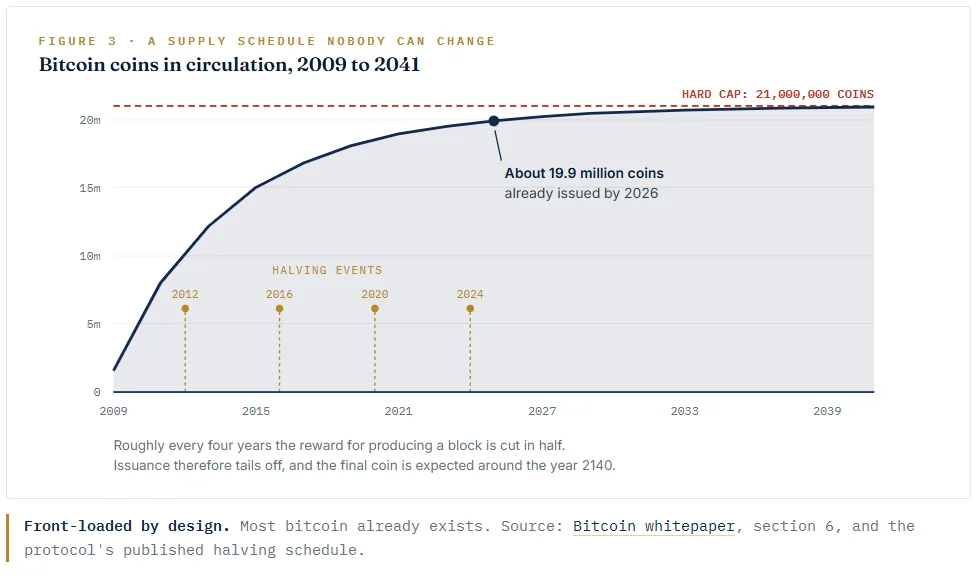
Bitcoin’s 21 million cap is enforced by code, not policy. About 19.9 million coins already exist.
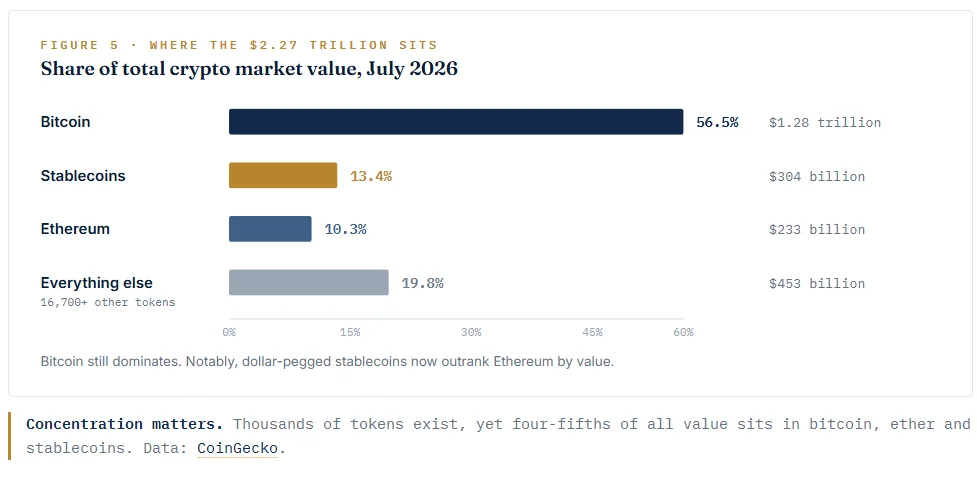
The market remains volatile and concentrated. Bitcoin, ether and stablecoins hold roughly 80% of all value.
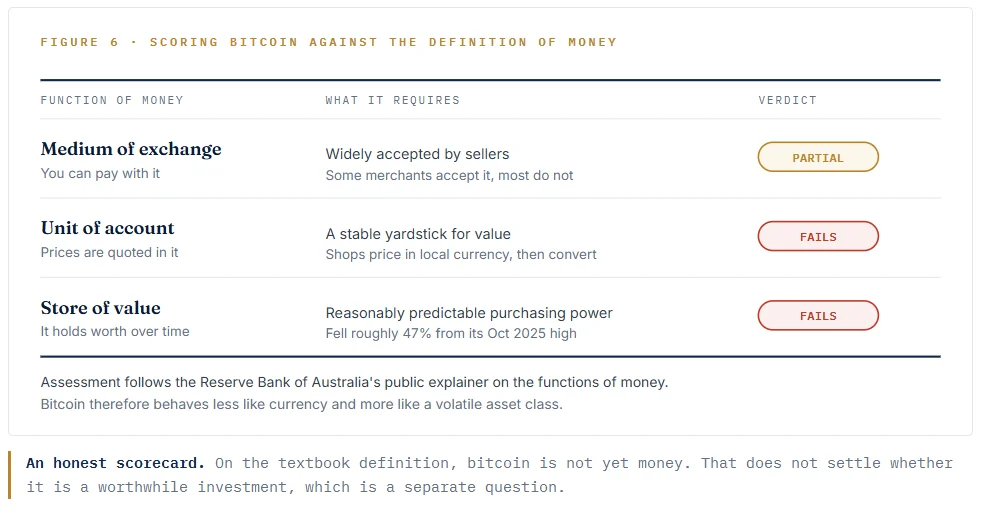
On the textbook test, bitcoin still fails as a unit of account and a store of value.
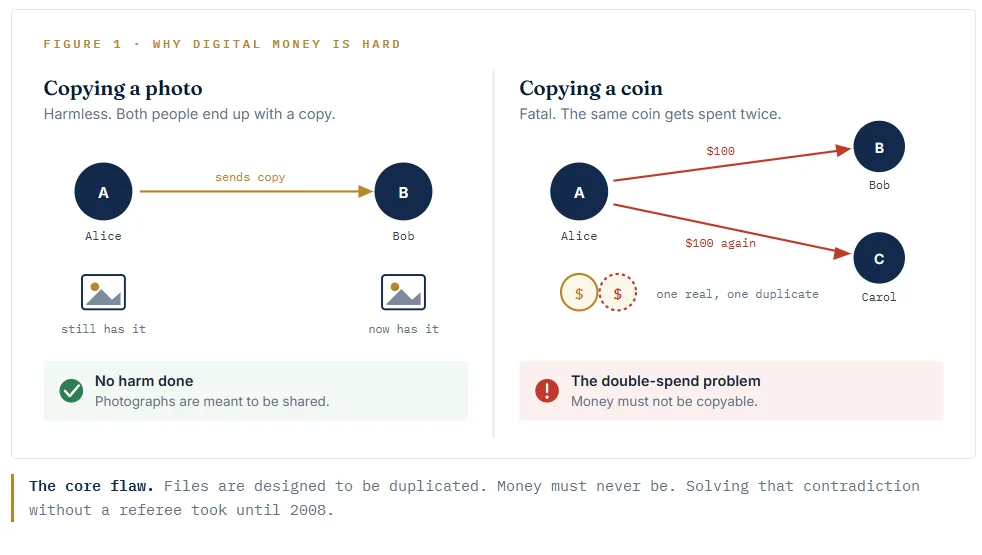
Send a friend a photograph. Now you both have it. Nothing was lost, and nothing was taken from you.
That is how digital files behave. Copying costs nothing, happens instantly and leaves no trace.
Now imagine money worked the same way. You send someone $100. Then you send the same $100 to somebody else. Both payments look genuine, and neither can be reversed.
For decades, this flaw blocked every attempt to build digital cash. Cryptographers called it the double-spend problem.
Then, on 31 October 2008, an anonymous author published a short paper proposing a fix. This series begins there.
Money Is a Record, Not a Thing
Start with a question that sounds simple. What actually is money?
Economists answer with three jobs. Money must serve as a medium of exchange, a store of value and a unit of account. The Reserve Bank of Australia sets out these functions plainly.
Notice what that list leaves out. Nothing requires money to be metal, paper or physical at all.
Indeed, most money today is simply a record. The Bank of England notes that most UK money now sits as bank deposits rather than cash.
Your salary arrives as a number in a database. Card payments shift numbers between databases. Banks maintain those records, and the state stands behind them.
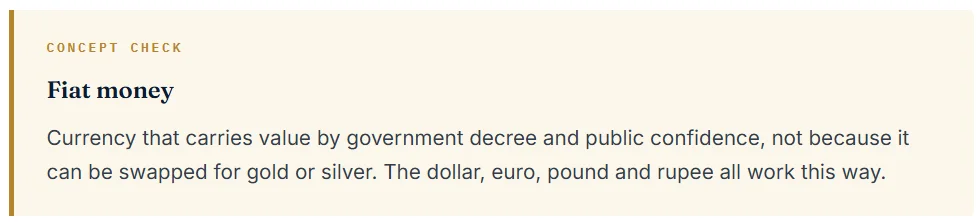
Furthermore, that value rests entirely on trust. Britain left the gold standard in 1931, so banknotes have since been fiat money with no backing asset.
So money went digital long ago. Making it electronic was never the hard part. The hard part was making it work without a trusted record-keeper.
Why Digital Cash Kept Failing
Physical cash prevents double spending on its own. Hand over a note and it leaves your pocket. You simply cannot spend it again.
Digital tokens offer no such protection, because a token is only data. Data copies perfectly, every time.
Early designers therefore named a referee. A bank, a card network or a central “mint” would keep the master ledger and reject any repeat spend.
That approach works well, and it powers global finance today. However, it carries real costs.
Every payment depends on one institution staying honest, solvent and online. Fees also add up, access can be cut off, and whoever holds the ledger can change it.
October 2008, Nine Pages
On 31 October 2008, an author using the name Satoshi Nakamoto posted to a cryptography mailing list. The message linked to a paper titled “Bitcoin: A Peer-to-Peer Electronic Cash System”.
Timing sharpened the appeal. Lehman Brothers had collapsed six weeks earlier, and trust in banks and brokers sat near a record low.
Satoshi’s identity has never been established. Yet the plan itself was clear and exact.

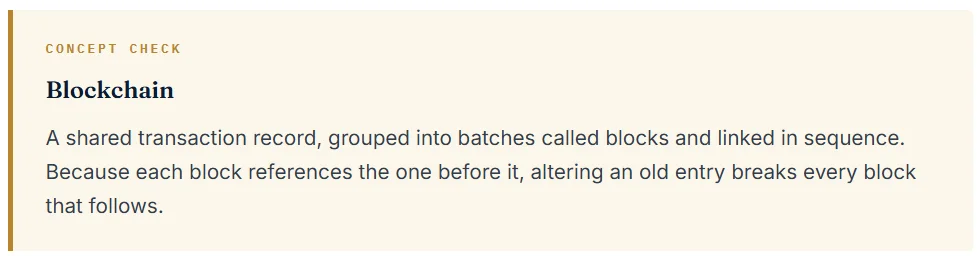
Instead of trusting a single ledger-keeper, the network would let thousands of computers maintain identical copies. Transactions would be broadcast publicly, bundled into blocks, and then chained together in order.
To rewrite that history, an attacker must redo a vast amount of computing work. So fraud becomes costly rather than impossible. That turns out to be enough.
What Happens When You Send Bitcoin
Picture the steps in plain terms.
First, you sign the payment with a secret key. That signature proves the coins are yours to spend.
Next, your payment is sent to the entire network. Computers around the world hear about it within seconds.
They then check two things. Do you own the coins? And have you spent them already?
If both answers look correct, your payment is added to a batch with others. Miners race to seal that batch onto the chain.
Once sealed, the payment is public and very hard to undo. Anyone can look it up, yet nobody can quietly change it.
Notice what is missing. No bank sat in the middle, and no clerk approved it. The rules did the work instead.
That is the whole trick, stripped of jargon. Part 02 will slow down each step.
Trust Replaced by Arithmetic
Consider how that shift changes your position as a user.
Under the old model, you trust a bank because rules govern it and courts can hold it to account. In the new model, you verify a record because thousands of independent copies agree.
Neither approach wins outright. Each simply relocates the risk.
Banks can freeze your account, yet they can also reverse a fraudulent charge. Blockchains cannot block a valid payment, but they cannot recover a stolen one either.
Part 02 of this series opens up the mechanics: hashing, mining, blocks and what “consensus” really means in practice.
Scarcity Written Into Code
Bitcoin introduced a second break with tradition. Its total supply is capped at 21 million coins.
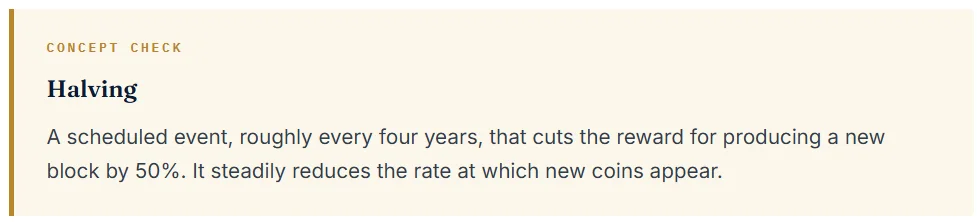
New coins enter circulation as a reward for processing transactions. Critically, that reward halves roughly every four years.
As a result, issuance slows on a fixed schedule that no committee can override. Around 19.9 million coins already exist, so most of the supply has been created.
Compare that with fiat currency. Central banks raise or lower supply on purpose. They do so to steer inflation and jobs.
Supporters read the cap as a guard against debasement. Critics reply that a fixed supply strips away a useful policy tool.
What Crypto Actually Became
Seventeen years on, the experiment has spread far beyond a single coin.
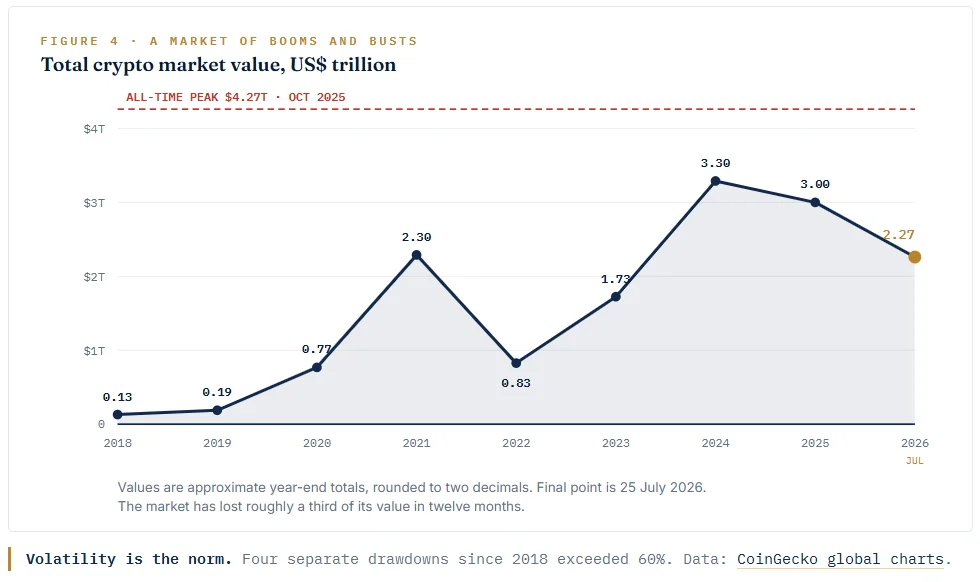
CoinGecko tracks more than 16,700 cryptocurrencies across roughly 1,500 exchanges. Together they were worth about $2.27 trillion in late July 2026.
That number needs context, however. The market peaked above $4.2 trillion in October 2025, so trillions in value have since evaporated.
Bitcoin itself traded near $65,000 in late July 2026, according to Fortune. A year earlier, it sat roughly $53,000 higher.
Ownership estimates vary widely by method. Triple-A counted 562 million holders in 2024, while Crypto.com put the figure at 741 million for 2025.
Treat every such number as a range rather than a fact. Wallets are not people, and one person may control several.
Does It Pass the Money Test?
Now return to those three functions of money.
Bitcoin partly functions as a medium of exchange because some merchants accept it. As a unit of account, it clearly fails, because shops still price goods in local currency.
Its record as a store of value remains contested. The RBA judges that bitcoin fails on both counts, and 2026 price movements support that caution.
Stablecoins, by contrast, now hold roughly 13% of the market. These tokens track the dollar, so they behave far more like money in daily use.
That tension defines the whole sector. Crypto was designed as cash, yet most owners treat it as an asset.

Why Start Here
Most crypto coverage begins with prices. This series begins with the problem because it explains the design.
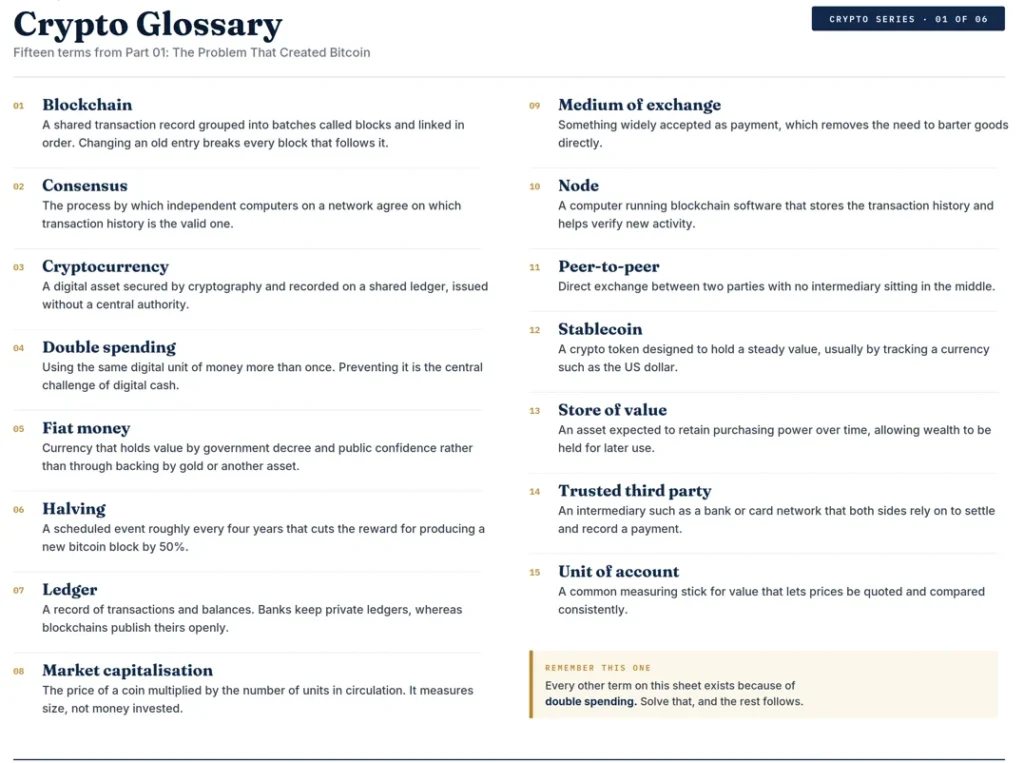
Every feature you meet later traces back to double spending. Mining exists to order transactions. Wallets exist to prove ownership. Smart contracts extend the same shared ledger.
Grasp the flaw, therefore, and the rest follows.