

September 13, 2026 – Four companies cleared $1bn each. AI coding, tunnels, and rockets took the biggest cheques, and valuations moved again.

In Summary
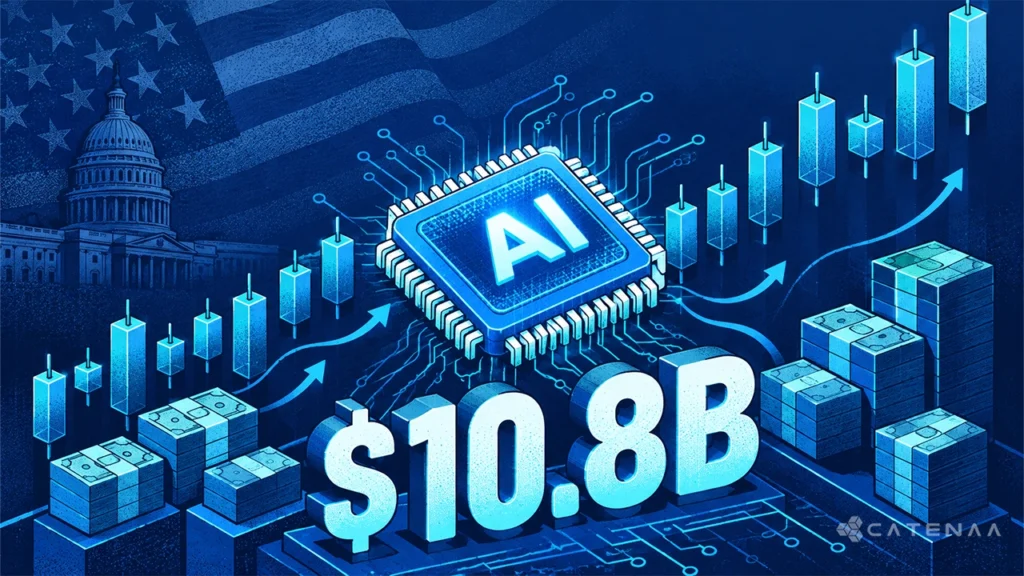
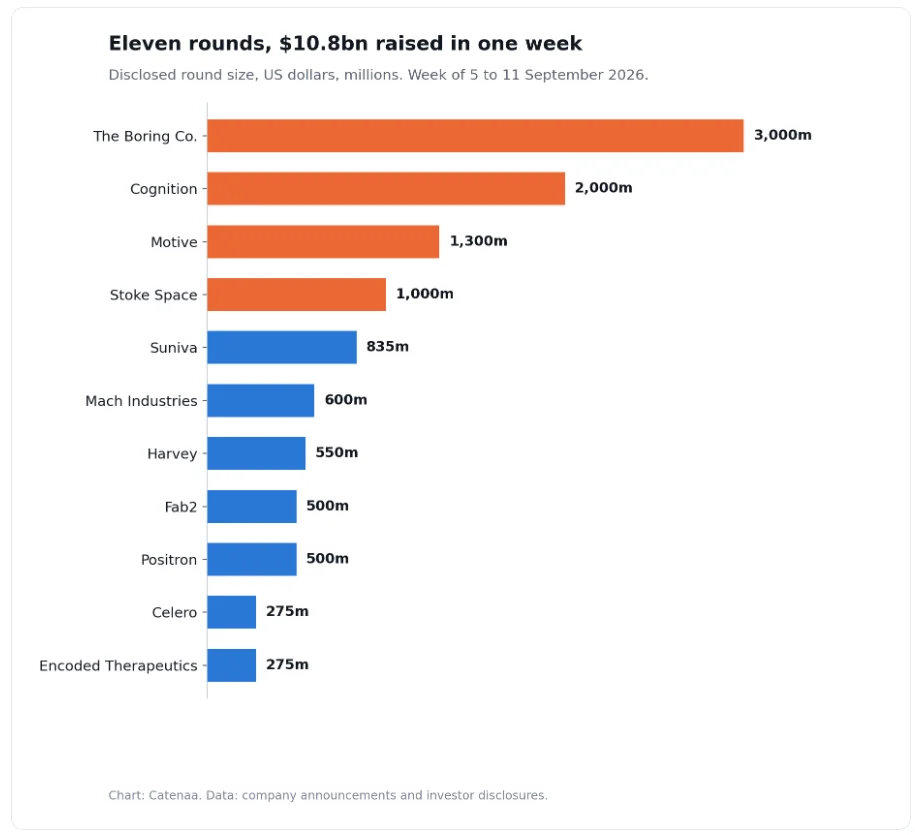
Eleven disclosed rounds raised about $10.8bn between 5 and 11 September.
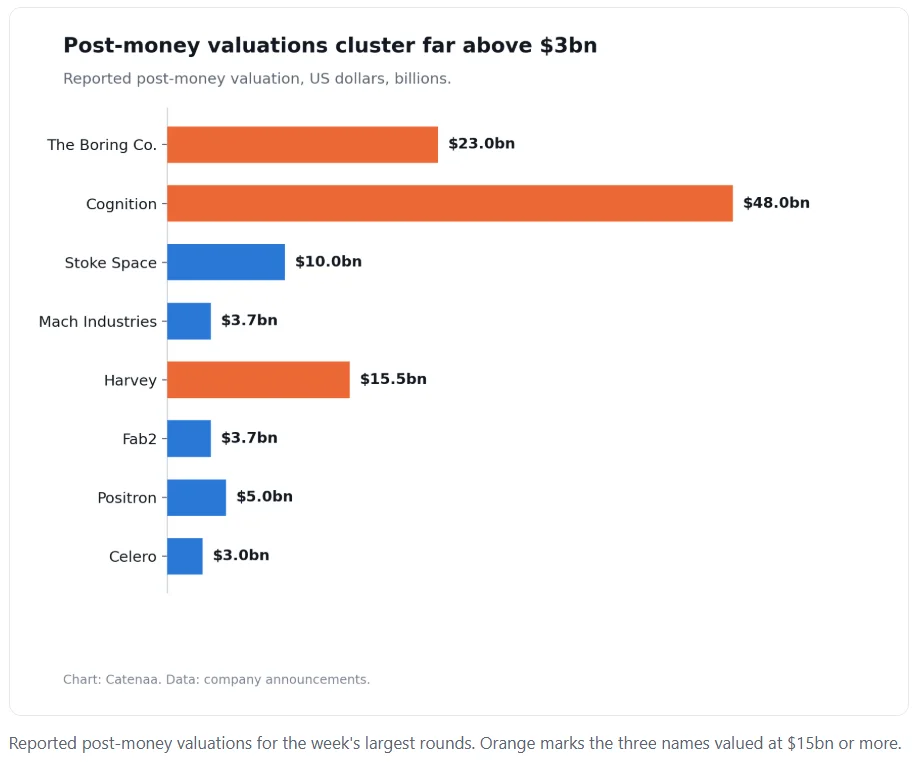
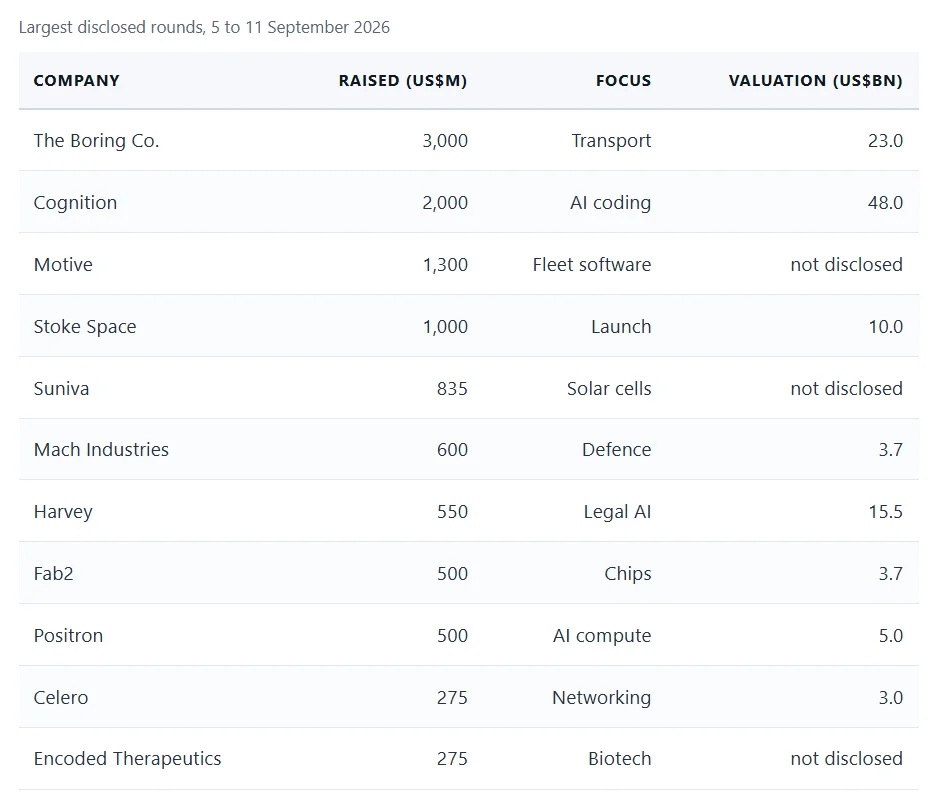
Cognition took $2bn at a $48bn valuation and cited a $900m run rate.
The Boring Company raised $3bn at $23bn, with the UAE leading.
Harvey reached $15.5bn, up from $11bn only months earlier.
Late-stage capital now crowds into a handful of very large names.
US startup funding just delivered one of its loudest weeks of 2026. Eleven disclosed rounds raised roughly $10.8bn between 5 and 11 September. Moreover, four of those deals cleared $1bn on their own. The pattern looks familiar. Capital keeps concentrating in a short list of very large private names.
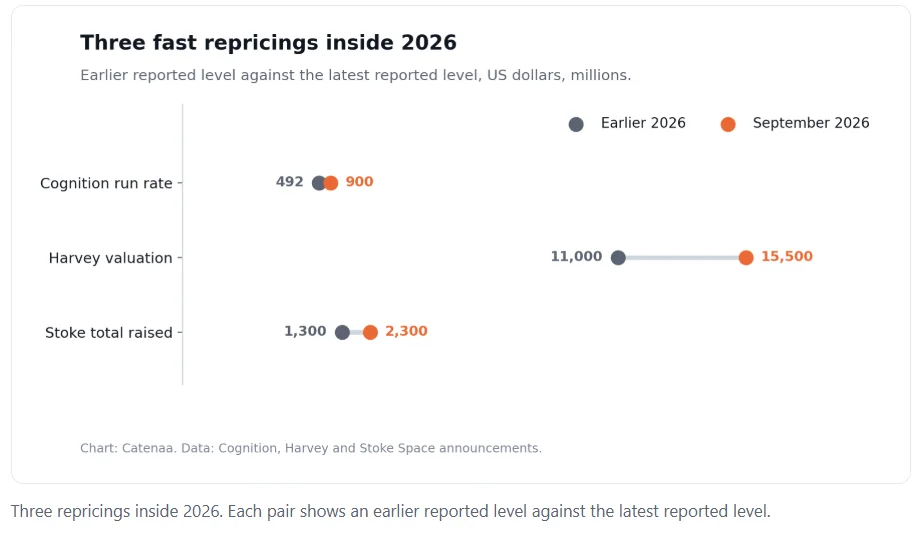
Cognition sat at the centre of the week. The AI coding company raised $2bn at a $48bn valuation. Its blog put run rate revenue near $900m in September, against $492m in May. That is a steep climb in four months. Furthermore, the investor list ran to dozens of firms, which signals broad demand rather than one anchor cheque.
Why this startup funding week stands out
Weekly tallies rarely matter on their own. Yet this one shows how the market now splits. Big rounds land on companies with visible revenue or hard assets. Meanwhile, smaller teams still fight for attention. The PitchBook and NVCA Venture Monitor put US venture activity at $412.7bn across the first half of 2026. Consequently, the direction of travel was already clear before this week landed.
Concentration also changes how founders plan. A company with a $2bn cheque can hire, buy compute, and wait out a slow exit window. Rivals without that buffer must show discipline instead. Therefore, the gap between funded and underfunded widens with every mega round.
The Boring Company provided the largest single cheque. It raised $3bn at a $23bn valuation, with the United Arab Emirates leading. Tunnelling is capital-heavy work, so the raise buys physical capacity rather than headcount. Similarly, Stoke Space took $1bn for reusable rockets and lifted its total funding to $2.3bn.
Valuations moved again, and fast
Harvey shows the speed. The legal AI firm raised $550m at $15.5bn in September. Months earlier, its reported valuation stood near $11bn. Therefore, the step up arrived in under half a year. Harvey says 80% of Am Law 100 firms now use its product. That adoption claim carries weight with buyers of private paper.

Defence and space also drew serious money. Mach Industries took $600m at $3.7bn. Positron raised $500m at $5bn for AI compute. In addition, Fab2 collected $500m at $3.7bn in semiconductors. These are not small experiments. Instead, they read as bets on physical infrastructure behind the AI build-out.
What the sector split reveals
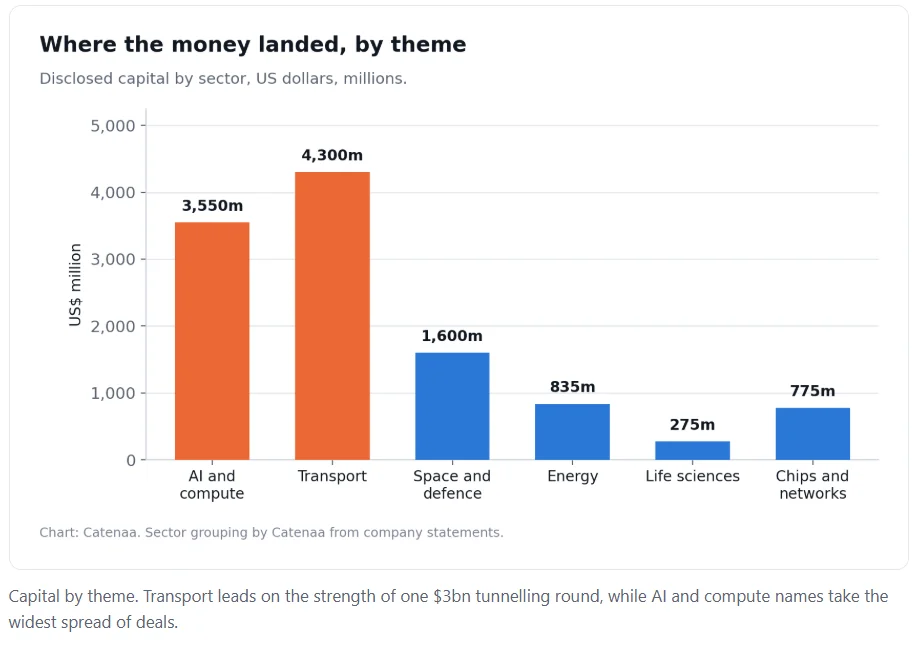
Transport tops the table, but one deal drives it. Strip out the tunnelling round, and AI plus compute leads comfortably. Energy still shows up, thanks to an $835m raise by solar cell maker Suniva. Life sciences trials, with a single $275m round for Encoded Therapeutics. So the balance stays tilted toward software and silicon.
Risks behind the startup funding surge
Concentration cuts both ways. When a few names absorb most of the capital, exit markets carry more weight. Furthermore, valuations set in private rounds rarely face daily testing. Public comparables can reprice quickly, while private marks lag. That gap creates awkward moments for late investors.
Revenue quality matters too. Cognition disclosed run rate, not audited annual revenue. Run rate can flatter fast-growing businesses. Similarly, customer logos prove interest rather than durable spend. Readers should treat both measures as signals, not proof.
Sovereign money adds a second question. The United Arab Emirates led the largest round of the week. State-backed investors bring patience and scale. However, they also bring political scrutiny, especially in infrastructure and defence. Founders now weigh that trade-off carefully.
Capital intensity is the third issue. Rockets, tunnels, and solar lines all burn cash before they earn it. Stoke Space still targets its first orbital launch in early 2027. Suniva must build cell capacity at scale. So timelines here run in years, not quarters.
What to watch next
Three things will settle the argument. First, watch whether AI revenue converts into gross margin. Second, track how many of these companies file to list. Third, follow the quarterly Venture Monitor series because quarterly data smooths weekly noise.
Exit routes matter most of all. Private marks only become real at a sale or a listing. Until then, the trend holds. Big money keeps chasing a narrow field, and that field keeps getting more expensive.