

August 31, 2026 – The reserve was still draining at roughly five million barrels a week when the announcement landed. Venezuela’s heaviest grades also sit outside published storage specifications.
In Summary
SPR stocks stood at 289.7 million barrels on 21 August, a 44-year low.
The reserve fell by roughly 22 million barrels over the five weeks to 21 August.
Authorised capacity is 714 million barrels, and the 2009 peak was 726.6 million.
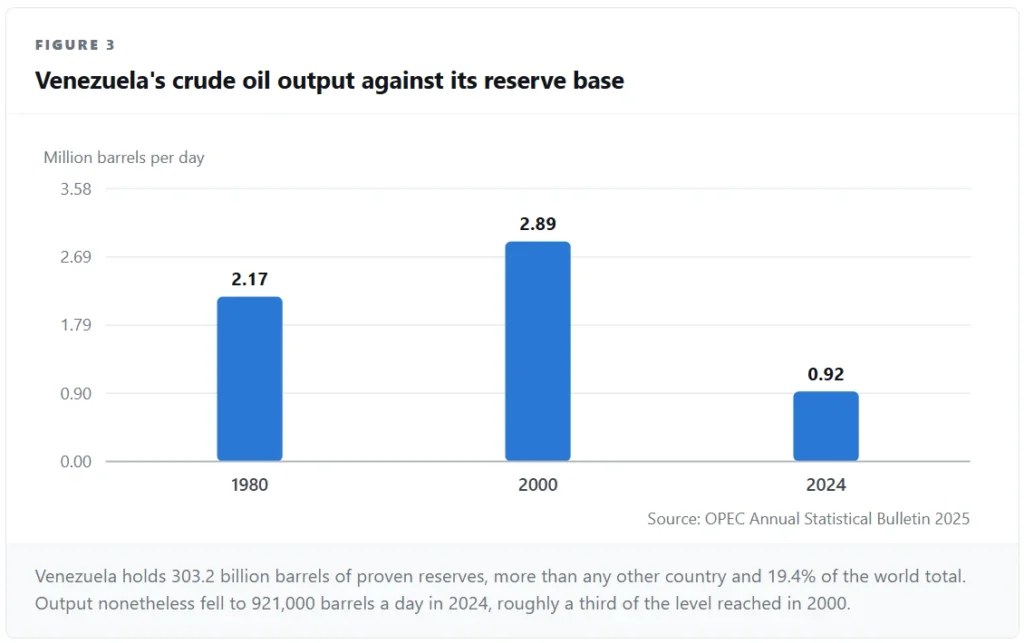
Venezuela holds 303.2 billion barrels of proven reserves, the world’s largest.
Yet Venezuela produced only 921,000 barrels a day in 2024.
SPR specifications cap viscosity at 32 cSt, which excludes Orinoco extra-heavy crude.
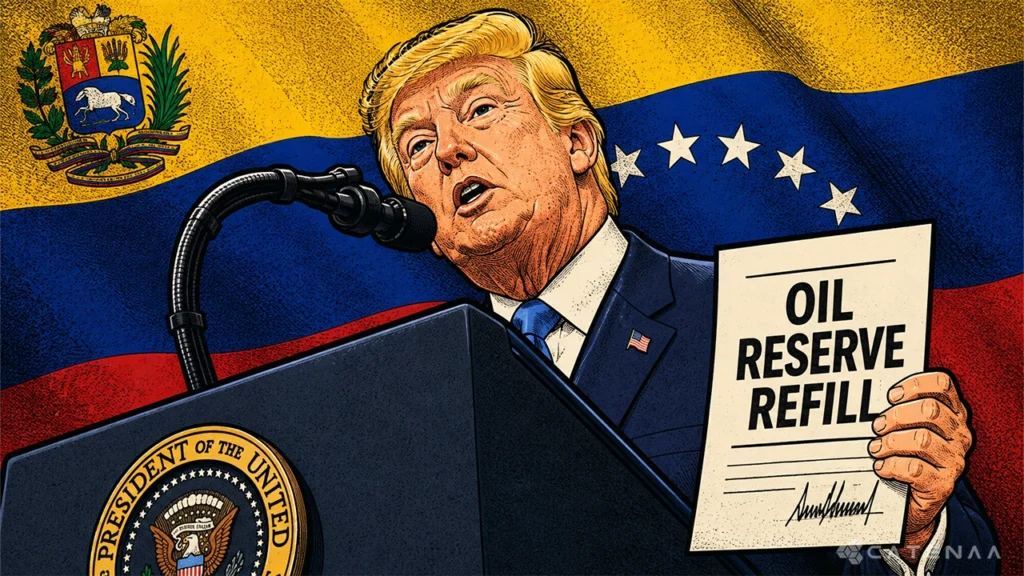
President Donald Trump said on Sunday that Venezuelan crude will refill America’s emergency oil store. He wrote that the “topping out” process would start soon. He called the barrels a gift to the American people.
The aim is clear. But three sets of federal data complicate the plan. Each one points the other way.
The reserve is still emptying
Official figures show the store shrinking, not growing. Stocks fell to 289.7 million barrels in the week to 21 August. Five weeks earlier, they stood at 311.4 million.
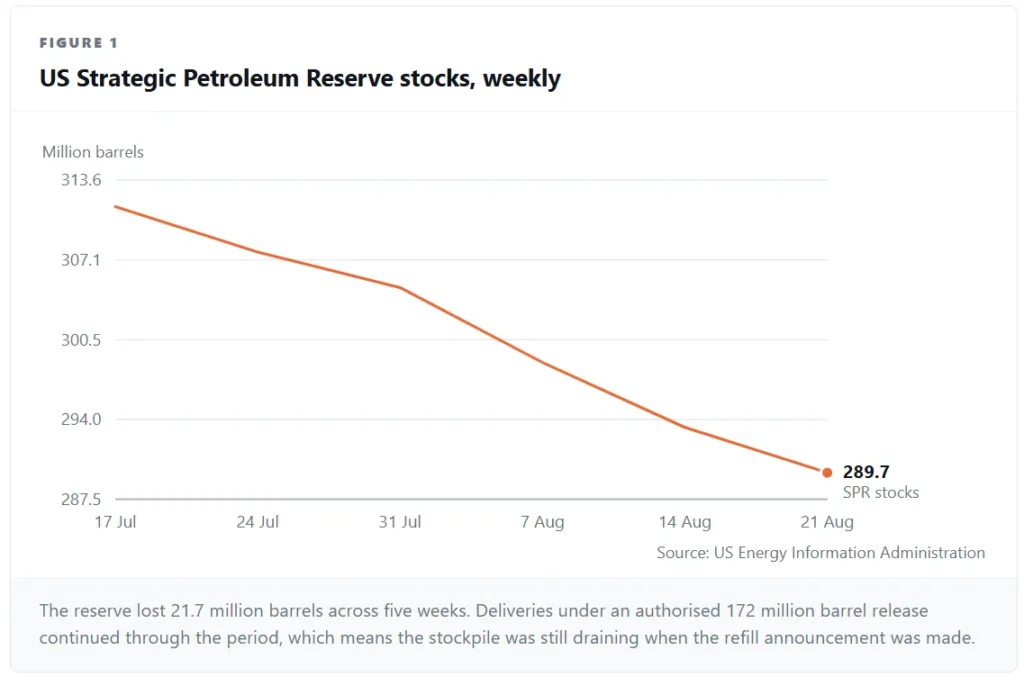
That pace works out at four to six million barrels a week. Moreover, the level itself is very low. Year-end stocks last sat at 290 million barrels in 1982.
The cause is a recent policy, not an old policy. The Energy Department is running a 172-million-barrel release. It forms the US share of a wider 400 million barrel action by IEA members. So the drawdown is deliberate, and it is not finished.
How far the store has fallen
Scale helps here. Approved capacity is 714 million barrels. The peak was 726.6 million, reached in December 2009.
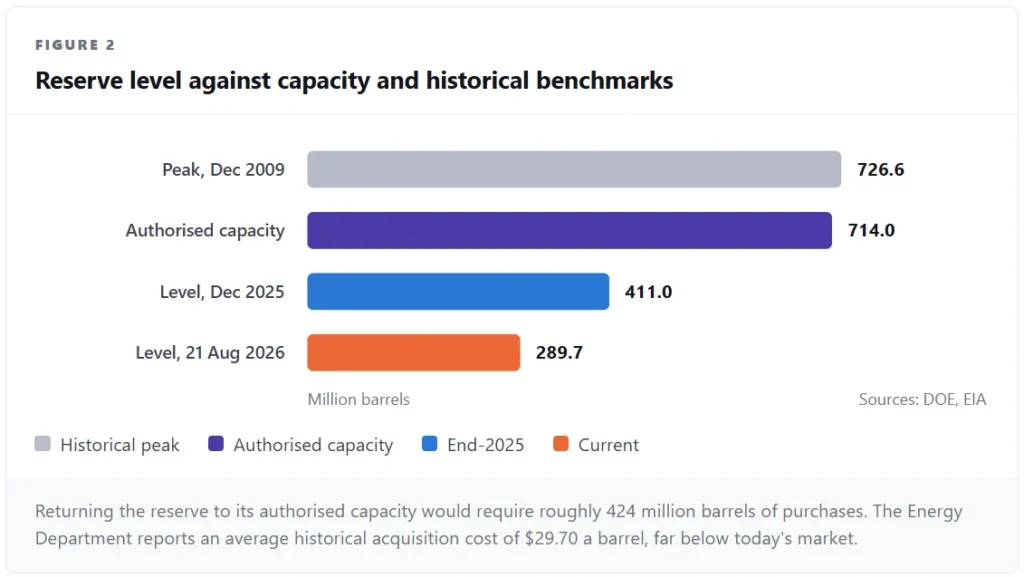
Refilling to capacity would need about 424 million barrels. Even at brisk past rates, that would take years. It would also cost tens of billions of dollars. Therefore, any credible plan needs years, not weeks.
Price adds to the problem. The store paid an average of $29.70 a barrel over its life. Brent closed near $90 on 27 August. So any refill now looks dear.
Venezuela’s paradox
Trump is pointing at a huge resource. OPEC puts Venezuelan proven reserves at 303.2 billion barrels. That is the world’s largest pool, ahead of Saudi Arabia.
Output tells a different story. Venezuela pumped 921,000 barrels a day in 2024. In 2000, it pumped 2.9 million. Years of thin investment hollowed out the industry. Also, skilled staff left in large numbers.
Flows to the US have picked up fast, though. American imports of Venezuelan crude hit 14.6 million barrels in May 2026. That is more than triple the December 2025 level. Still, the base was very low.
The sanctions framework
Washington has eased curbs by licence, not by repeal. The State Department set out a run of general licences from late January. They allow the sale of Venezuelan oil, the supply of diluent and oilfield services.
Treasury then amended eight of those licences on 27 August. One covers dealings with PDVSA itself. So the whole structure stays revocable at short notice. Because licences can lapse, buyers price in policy risk.
The engineering constraint
Here lies the sharpest snag. The Energy Department publishes crude specs for its caverns. However, heavy Venezuelan grades struggle against them.
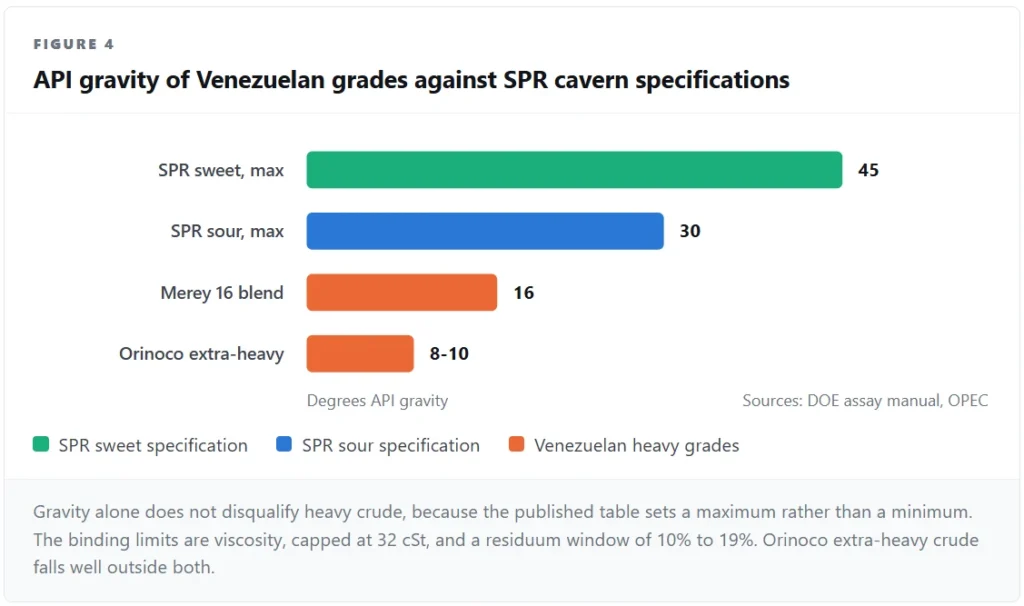
The assay manual caps viscosity at 32 cSt. It also sets a residue window of 10% to 19%. Moreover, the manual says only two specs are used, “both of medium gravity”.
Merey 16 blend sits at about 16 degrees API. Orinoco extra-heavy crude sits near 8 to 10. Both fall outside those bounds. Thus, the heaviest barrels cannot go straight into a cavern.
Blending could bridge the gap. Indeed, Washington already plans to ship US light crude south as diluent. Even so, the manual lets staff refuse any cargo judged unfit for existing stocks.
Some Venezuelan oil is already stored in Texas and Louisiana. Santa Barbara, Mesa 30, and Lagotreco appear in the site records. But those are light and medium grades. They form a thin slice of what Venezuela holds. Most of the 303 billion barrels sit in the Orinoco Belt. That crude is the hardest to store.
What to watch
No 2026 purchase notice has appeared from the Office of Petroleum Reserves. So until one does, this remains an aim rather than a programme.
Terms are unclear too. Officials in Caracas have described a large, long-term deal. Yet no US government document confirms those figures. Traders should treat them with care. Meanwhile, the market has barely moved on the news.
Three markers will show real progress. First, a formal purchase notice. Second, a halt to the weekly drawdown. Third, cargo grades that match the published specs. None of the three has appeared yet.




