


September 03, 2026 – Twenty-one banks and asset managers will build a shared dollar token. The company arrives in 2026, the coin in 2027.
In Summary
Twenty-one institutions across ten countries agreed to issue one dollar stablecoin together.
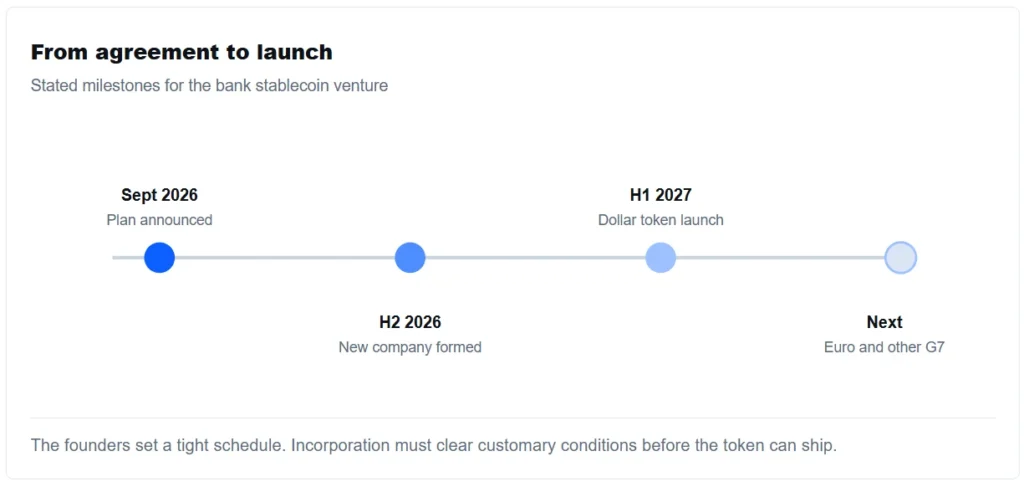
The founders plan a new company in late 2026 and a token launch in the first half of 2027.
Reserves will back the coin one-to-one, and the token will settle on public blockchains.
The design targets compliance with the United States GENIUS Act and Europe’s MiCA rulebook.
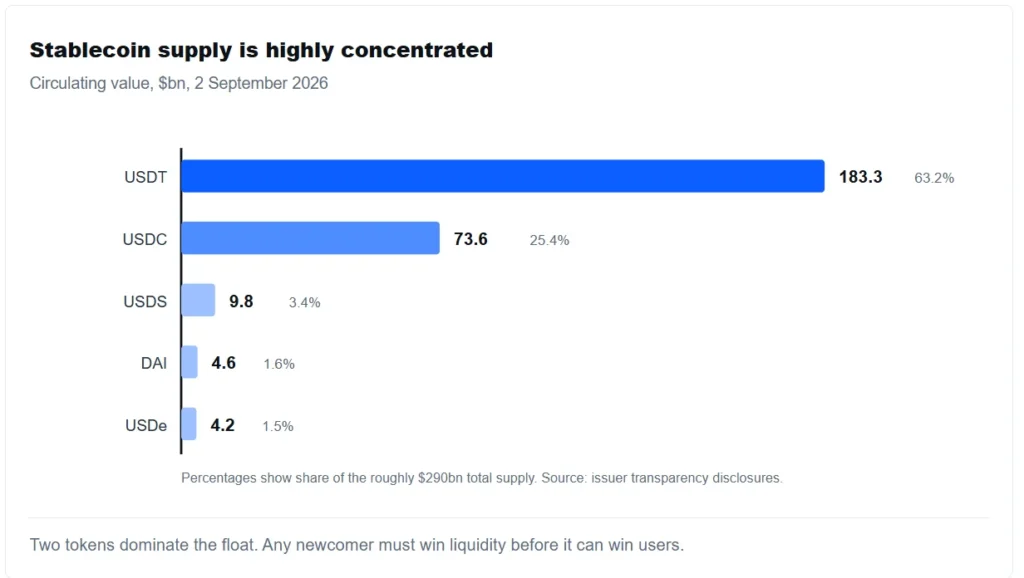
Two incumbents already control close to 89 percent of a market worth about $290bn.
Twenty-one names, ten countries, one token
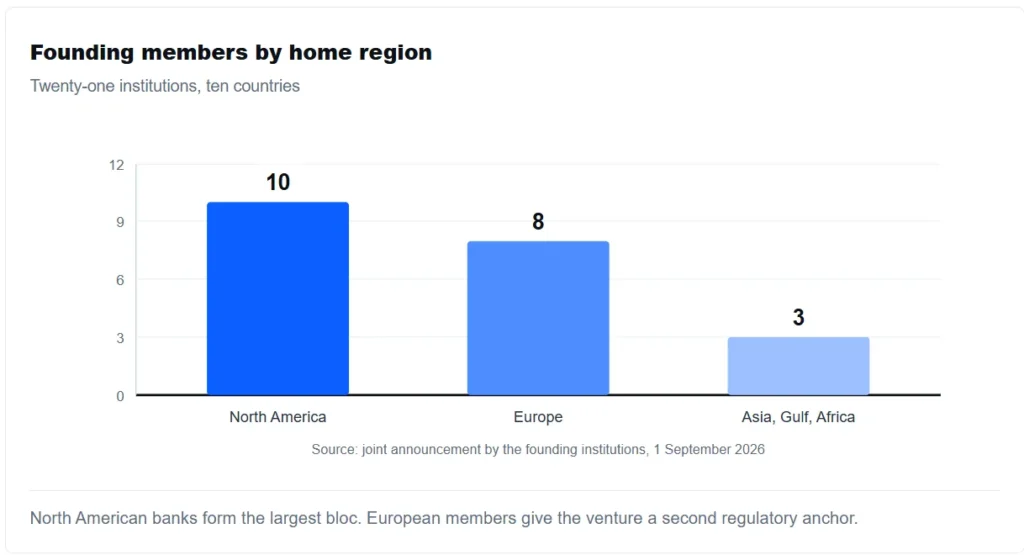
Twenty-one banks and asset managers intend to issue a dollar stablecoin together. They confirmed the venture on 1 September 2026. Members span ten countries across North America, Europe, Asia, the Middle East and Africa. The group will form a new company during the second half of 2026. Launch of the token should follow in the first half of 2027.
North America supplies ten founders. Bank of America, Capital One, Citi, Fidelity Investments and Goldman Sachs sit on that list. PNC Financial Services, Scotiabank, TD Bank Group, Wells Fargo and WisdomTree complete it. Europe contributes eight members. Santander, BBVA, Commerzbank and Crédit Agricole join Deutsche Bank, Lloyds Banking Group, Rabobank and UBS. MUFG Bank, Sirius International Holding and Standard Bank extend the reach into Asia, the Gulf and Africa.
Reserves will back every unit one-to-one. What is more, the coin will run on public blockchains rather than closed bank rails. A euro version ranks first among the additional G7 currencies on the roadmap. Boston Consulting Group and Brunswick Group advise the founding members.
The regulatory window finally opened
Banks avoided public-chain money for years. Legal uncertainty explained most of that caution. Two rulebooks then changed the calculation. The GENIUS Act created a federal licensing regime for payment stablecoins in the United States. Meanwhile, the Markets in Crypto-Assets Regulation set reserve, disclosure and redemption standards across the European Union.
The consortium says its design will meet both regimes where they apply. That dual-track ambition matters for settlement. One instrument that satisfies American and European supervisors can move between the blocs without fresh documentation. As a result, corporate treasurers gain a single rail for two of the world’s largest currency zones.
A crowded market with two dominant names
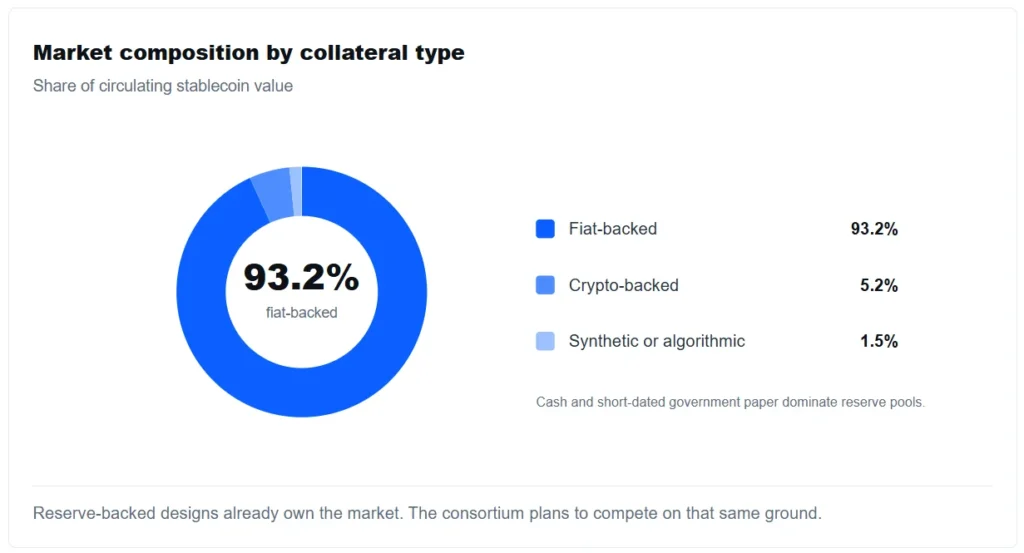
The commercial challenge looks steeper than the legal one. Stablecoins in circulation totalled roughly $290bn on 2 September 2026. Tether’s USDT alone accounted for about $183bn of that total. Circle’s USDC held close to $74bn. The pair therefore controlled almost 89 percent of supply. Fiat-backed designs made up 93 percent of the market.
Bank-issued tokens have barely registered so far. Société Générale’s digital-asset arm pioneered regulated bank coins in Europe. Its dollar token still carried only about $12.5m in circulation. Distribution, not credibility, has proved the binding constraint. Twenty-one large firms can attack exactly that weakness.
What the banks actually gain
Deposits sit at the centre of the calculation. Stablecoin balances currently drift away from bank ledgers toward specialist issuers. A shared token keeps that money inside the regulated perimeter. Reserve income also stays within the consortium instead of funding a rival.
Payments offer the second prize. Cross-border transfers still crawl through correspondent chains at meaningful cost. A programmable dollar can settle in seconds on any day. The founders cite wholesale, institutional and retail uses, including cross-border payments. Treasury operations and collateral movement should benefit first.
Execution risk is the real story
Banking consortia carry a mixed record. Governance disputes and slow decisions have sunk earlier joint ventures. Twenty-one shareholders will need an unusually clear operating agreement. Moreover, each member must decide how aggressively to push a token that competes with its own products.
Technical choices invite scrutiny as well. Public chains deliver reach and composability. However, they also introduce congestion, front-running and finality debates. Reserve custody will face the questions supervisors already put to incumbents. Auditors, custodians and redemption windows all need naming before launch.
Who moves first inside the group
Not every member will push equally hard. Custody banks want a settlement asset for tokenised funds. Retail lenders care more about remittance corridors. Asset managers, meanwhile, want cash legs for tokenised money market products.
Those motives can pull in different directions. A single token still serves them all, though. Shared plumbing lowers the cost for each participant. That logic built card networks decades ago, and it may work again here.
A quiet policy dimension
Stablecoin reserves buy short-dated government paper in size. Growth in the sector therefore feeds demand for Treasury bills. Washington has noticed that link. Regulated bank issuance strengthens it further, because supervised reserves must sit in high-quality liquid assets.
Europe views the same trend differently. Policymakers there worry about dollar tokens circulating inside the single market. A euro version, promised as the next step, may soften that concern. Yet the sequencing tells its own story about where demand sits today.
What to watch next
Three markers will show whether the plan is working. Watch first for the incorporation notice due before December 2026. Look next for a named chief executive and a chosen settlement chain. Finally, track early distribution deals with payment processors and corporate treasurers.
Regulators will keep shaping the field. GENIUS Act rulemaking continues, and European supervisors keep refining MiCA guidance. Tighter reserve or redemption standards would squeeze incumbents harder than newcomers. That asymmetry could become the consortium’s quietest advantage.