


July 19, 2026 – Etched is seeking a $20 billion valuation before its first large commercial rollout. The talks show how strongly investors value specialized AI inference hardware.
In Summary
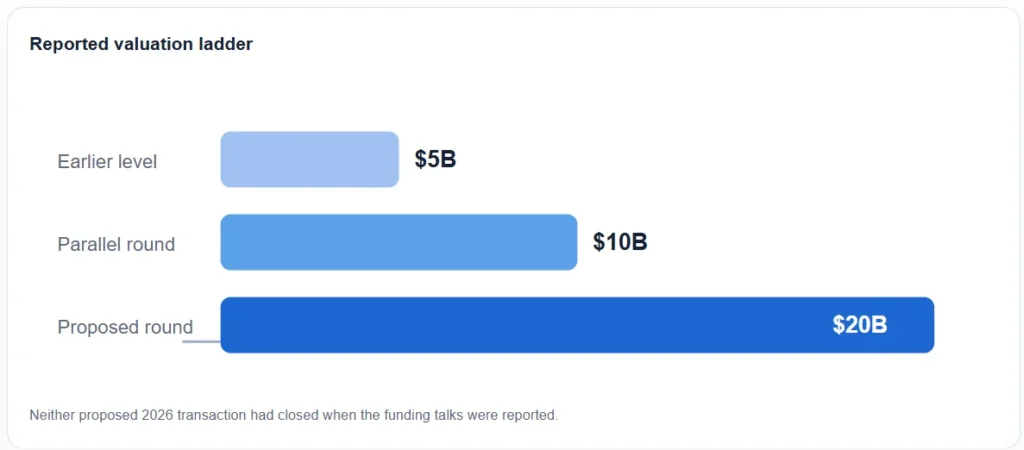
Etched’s proposed valuation is four times its earlier reported level.
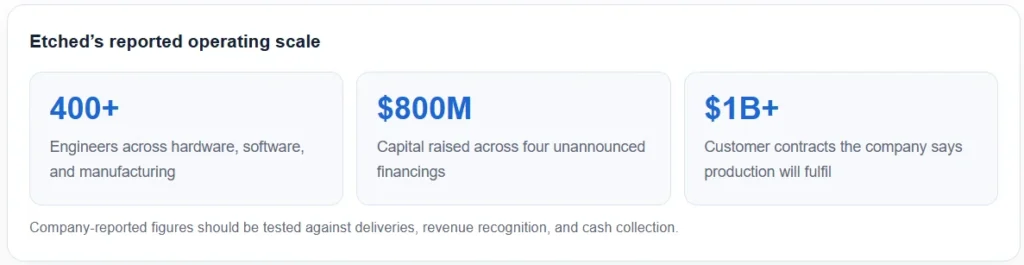
The company says it has raised $800 million and secured over $1 billion in customer contracts.
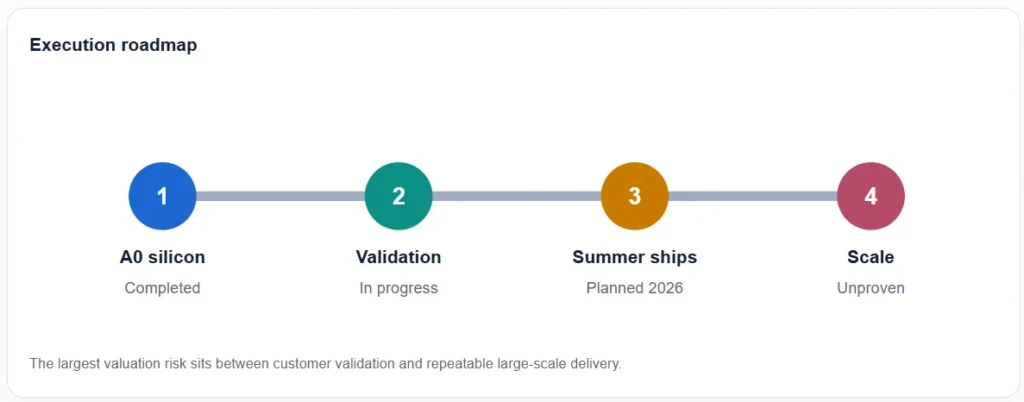
Execution risk remains high because production, software adoption, and customer validation still need proof.
AI chip startup Etched is discussing new funding at a valuation near $20 billion. The proposed price would quadruple its earlier reported valuation of about $5 billion.
A separate financing is also being discussed at a $10 billion valuation. However, neither transaction has closed, and final terms may change.
The higher round would value Etched at 20 times its stated customer contract value. That ratio highlights both investor confidence and substantial execution risk.
Why inference economics matter
Etched is targeting a narrow but valuable segment. Its systems focus on inference, which runs trained artificial intelligence models for users.
Inference demand rises as chatbots, coding agents, search tools, and enterprise applications process more queries. Therefore, customers increasingly care about cost per token, latency, and power efficiency.
General-purpose graphics processors can handle training and inference. Etched instead designs hardware around large transformer workloads and rack-scale inference.
This specialization could improve economics when workloads remain predictable. However, it may reduce flexibility if model architectures change quickly.
Commercial proof is the key test
Etched says its first A0 silicon returned from TSMC’s N4P process earlier in 2026. The company is now validating its first rack-scale product with customers.
It also reports more than 400 engineers and $800 million raised across four unannounced financings. Furthermore, it says production has started for over $1 billion in customer contracts.
Those figures offer early commercial evidence. Yet contracts do not equal recognized revenue, cash collection, or sustainable gross profit.
Investors must therefore assess cancellation terms, delivery milestones, manufacturing yields, and customer concentration. These details will determine the quality of the reported demand.
What the valuation implies
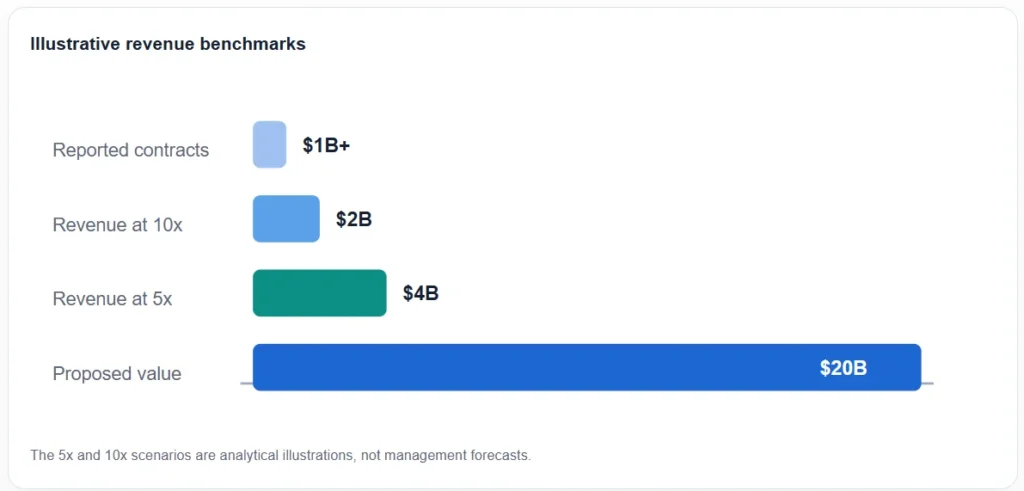
The valuation also sets a demanding revenue benchmark. At ten times sales, $20 billion implies $2 billion of annual revenue.
At five times sales, the same valuation implies $4 billion. These examples are valuation scenarios, not company forecasts.
Both levels exceed the current contract figure. Moreover, recognized sales could arrive slowly as customers complete testing and deployment.
Capital needs may remain heavy during that transition. Chip production requires wafer commitments, packaging capacity, testing equipment, inventory, and customer support.
Rack-scale systems add networking, cooling, power delivery, and installation costs. Therefore, fresh funding can protect the launch schedule and supply chain.
However, more capital does not remove product risk. It can also delay making hard decisions if customer adoption falls short of expectations.
A booming market raises the stakes
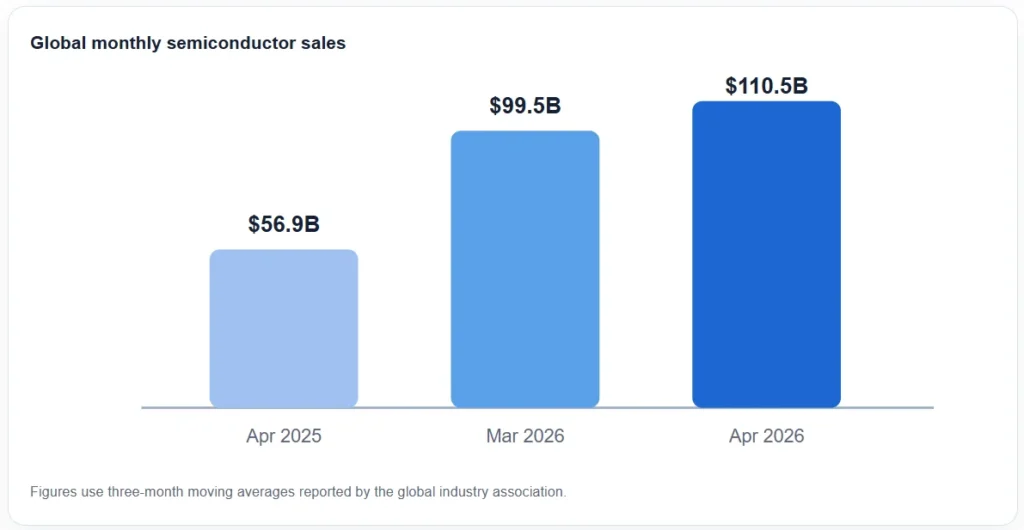
The market backdrop explains the enthusiasm. Global semiconductor sales reached $110.5 billion in April 2026, according to industry data.
That total increased 93.9% from April 2025. The same forecast expects global chip sales to reach $1.5 trillion during 2026.
Meanwhile, Nvidia reported $81.6 billion in quarterly revenue for its latest fiscal first quarter. Data center revenue alone reached $75.2 billion.
These numbers show the depth of AI infrastructure spending. They also reveal the scale Etched must confront.
A $20 billion private valuation equals only a fraction of the leading supplier’s quarterly data center revenue. Still, Etched needs meaningful market share to justify that price.
Manufacturing advantage needs system proof
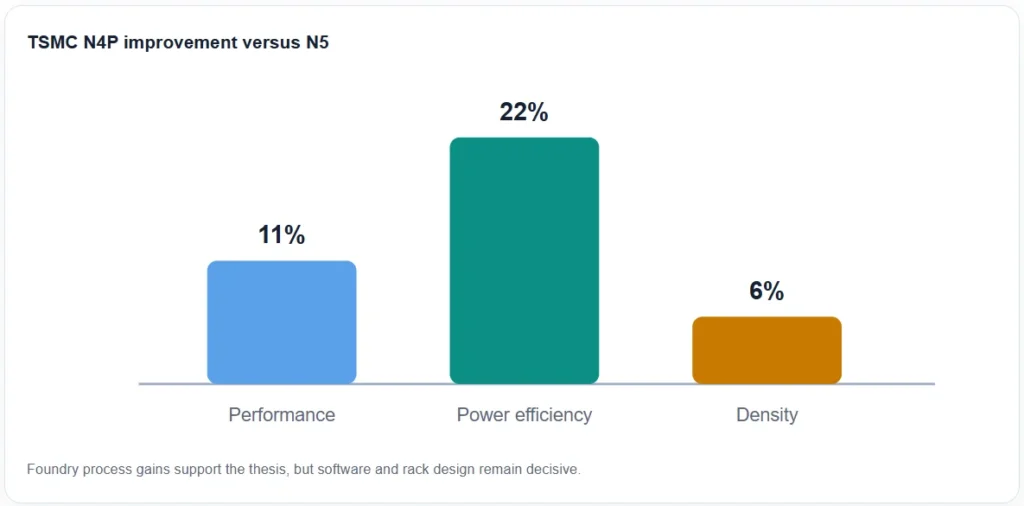
Manufacturing creates another test. TSMC says N4P offers 11% higher performance than N5 and 22% better power efficiency.
The process also provides a 6% density improvement. Those gains support Etched’s efficiency thesis, but process technology alone cannot secure success.
Packaging, memory, networking, software tools, cooling, and system reliability will shape real-world performance. Supply agreements will also influence delivery speed and unit economics.
What comes next
The proposed round prices Etched as a potential platform, not a normal pre-revenue chip startup. Investors appear to expect rapid deployment and strong demand for inference.
Nevertheless, the next milestones matter more than the headline valuation. Customers need successful validation, reliable shipments, and competitive total ownership costs.
If Etched meets those tests, specialized inference chips could weaken dependence on general-purpose accelerators. If delays emerge, the valuation could compress quickly.
For now, the funding talks signal intense demand for credible alternatives. They do not yet prove that Etched can convert technical promise into durable profits.