


July 22, 2026 – Crypto capital remains active in July. However, fewer rounds now absorb larger checks, while DeFi loses ground to scalable infrastructure.
In Summary
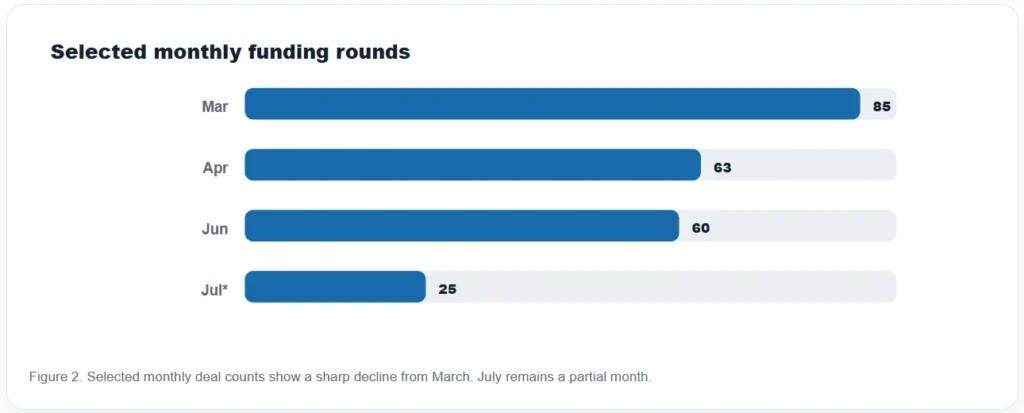
July funding reached about $1.2 billion through July 20, across roughly 25 disclosed rounds.
Monthly capital peaked at $3.89 billion in May, then cooled during June and July.
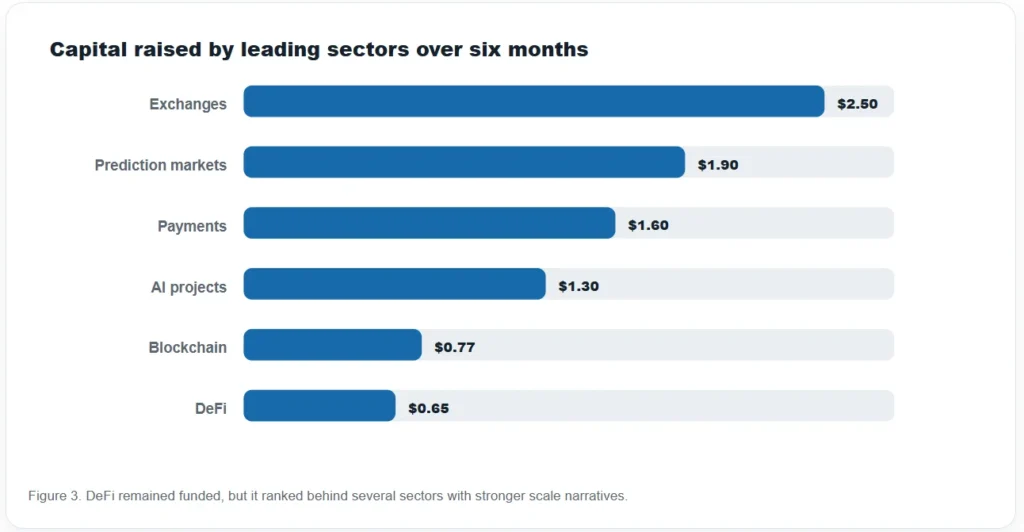
DeFi attracted about $654 million over six months, trailing five larger funding categories.
Investors increasingly favor infrastructure, revenue visibility, regulation, and AI-linked use cases.
Crypto venture funding remains active in July 2026, yet the market now rewards fewer and larger deals. Capital is flowing, but investors have tightened selection across early-stage projects. DeFi faces the strongest pressure, despite continued funding across the wider digital asset economy.
Capital remains available, but concentration rises
Fundraising analytics show $1.14 billion in January. February fell to about $896 million. March then rebounded to $2.2 billion, supported by around 85 rounds.
April reversed that momentum, with funding falling below $700 million. However, May jumped to $3.89 billion, the year’s highest monthly level. June eased to $1.44 billion, while July reached about $1.2 billion by July 20.
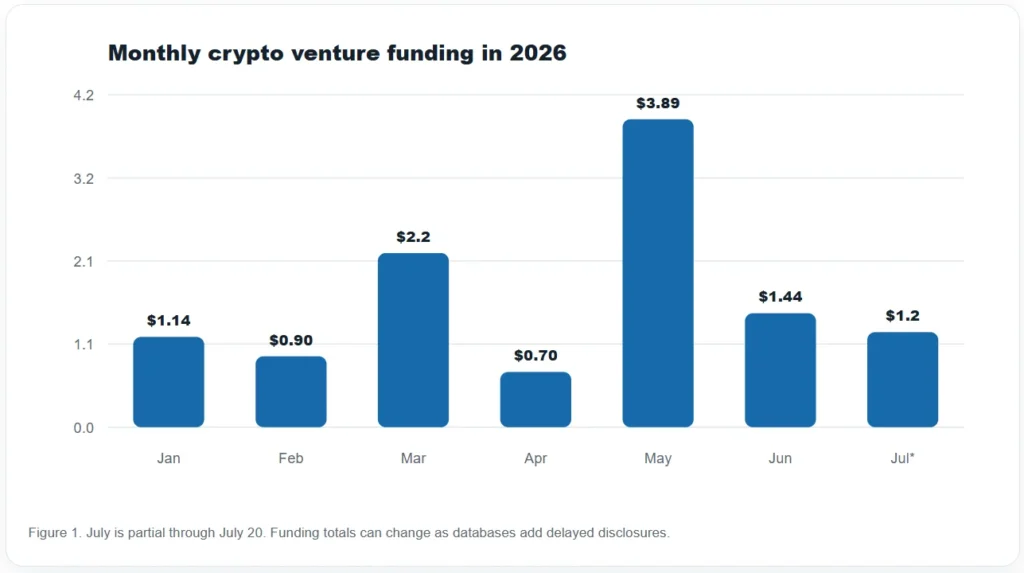
These figures show that total capital can remain strong when several large transactions close. However, the falling deal count tells a different story. July’s average disclosed capital per round approached $48 million, based on the partial monthly figures.
That average does not represent a typical startup cheque. Large strategic rounds can heavily distort monthly totals. Therefore, headline funding can look healthy while smaller founders face tougher conditions.
A second funding database also lists several large July transactions. Its records include a $400 million strategic exchange investment and a $135 million infrastructure round. Differences reflect disclosures, classifications, and update schedules.
DeFi loses ground to scalable models
DeFi secured about $654 million during the latest six-month period. That placed it below exchanges at $2.5 billion and prediction markets at $1.9 billion. Payments attracted around $1.6 billion, while AI-linked projects collected about $1.3 billion.
Blockchain companies raised roughly $767 million during the period. Infrastructure projects secured another $533 million. These areas offer clearer enterprise demand, transaction revenues, or strategic value for financial platforms.
DeFi funding has now declined for three consecutive quarters. Furthermore, quarterly deal volume reached its lowest level since 2020. Funding also fell to its weakest level since late 2023.
The decline does not imply that DeFi has stopped developing. Lending, trading, stablecoin, and tokenized asset protocols still generate activity. However, investors now expect stronger security, durable fees, and defensible distribution.
Investors are backing convergence themes
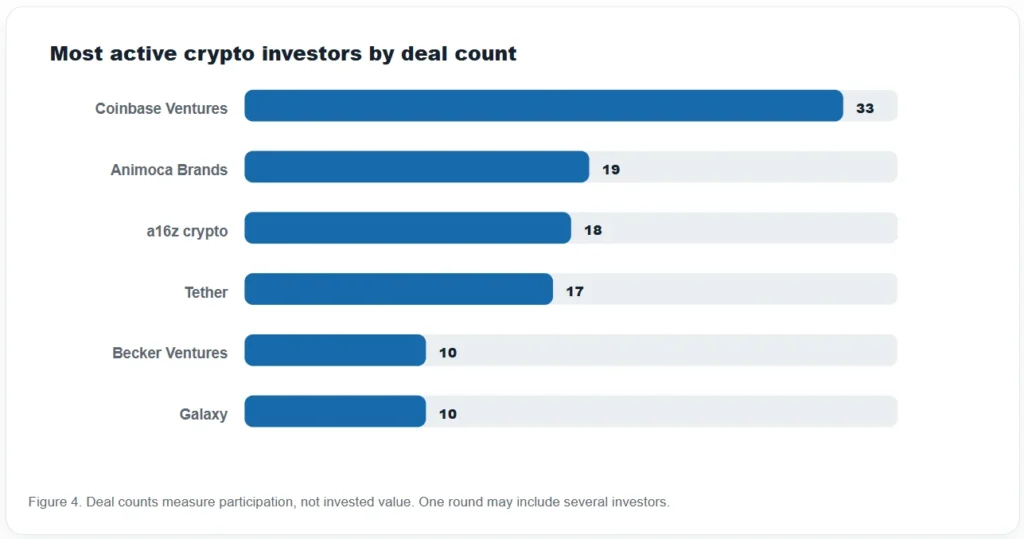
The most active investor completed 33 deals during the measured six-month period. The next three firms completed 19, 18, and 17 investments. This pattern confirms that experienced funds remain engaged, despite weaker broader activity.
Investor strategy is also widening. One venture platform highlighted tokenization, specialized exchanges, next-generation DeFi, AI, and robotics as priorities for 2026.
Another investment firm now describes its mandate across crypto, AI, robotics, and frontier technologies. Meanwhile, a separate manager announced $1 billion for financial infrastructure, tokenized markets, and agent-driven commerce.
These strategies share a common thesis. Blockchains may support automated payments, programmable assets, identity, and settlement for AI agents. Therefore, the strongest projects may sit between sectors, rather than inside a narrow DeFi category.
The United States keeps a wide lead
The United States hosted 249 funded crypto projects during the six-month period. The United Kingdom followed with 67, while Singapore recorded 57. China and Japan registered 32 and 30 projects, respectively.
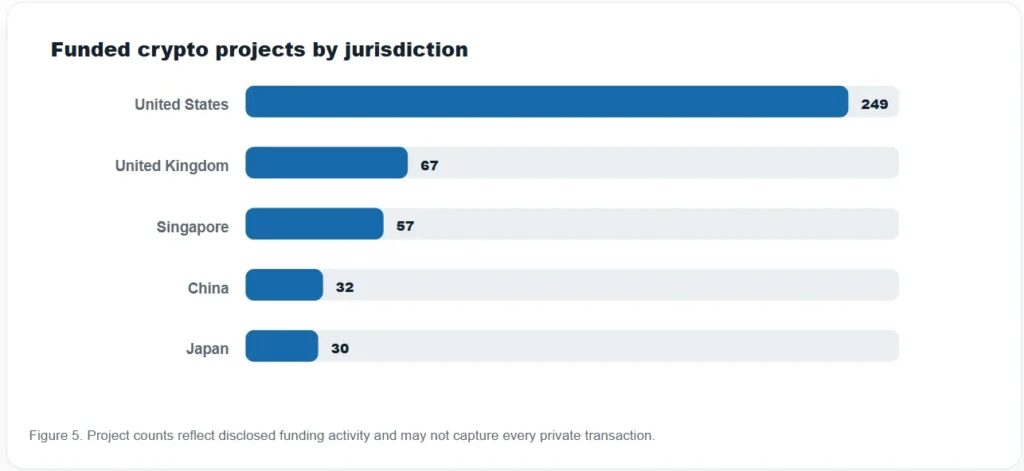
This gap reflects deeper venture networks, larger capital pools, and stronger links between technology founders and financial markets. However, Singapore and the United Kingdom remain important hubs for payments, trading, and cross-border infrastructure.
What comes next for founders
Crypto venture funding should remain uneven during the second half of 2026. Large rounds may keep monthly totals elevated. However, seed-stage teams will face sharper competition and longer diligence processes.
DeFi founders must now prove more than technical innovation. They need secure products, measurable demand, sustainable economics, and credible regulatory planning. Investors will also test whether incentives create lasting users or temporary activity.
The market has not abandoned crypto. Instead, it has raised the standard for receiving capital. DeFi remains investable, but it no longer commands automatic priority.
The core signal is selectivity. Capital still moves, but investors increasingly demand scale, revenue, security, and strategic relevance.