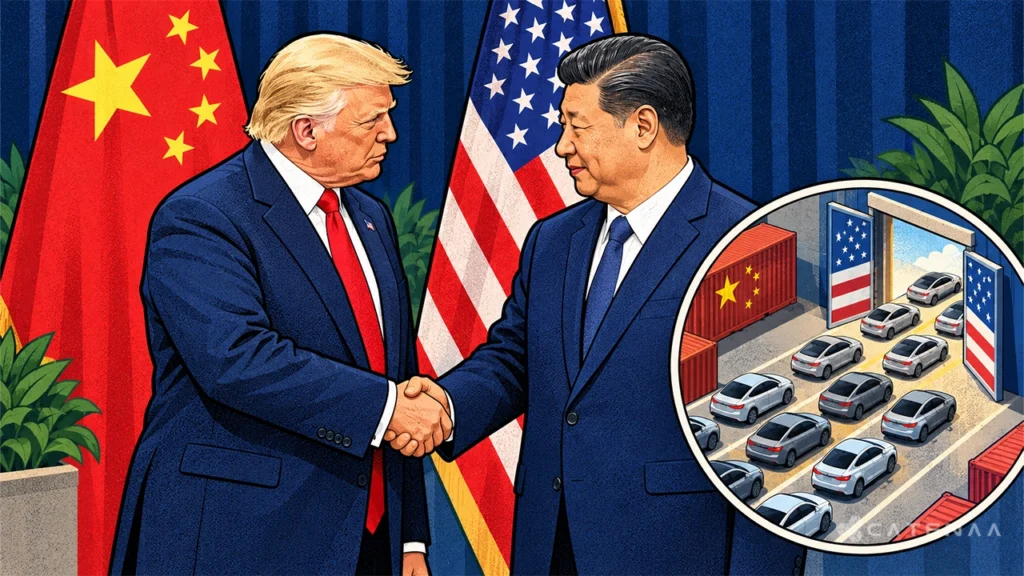


September 13, 2026 – The president said he would accept Chinese plants that hire US workers. Existing rules still keep those cars off American roads.

In Summary
Trump said he would accept Chinese car plants that hire American workers.
He also rejected Chinese plants in Mexico that ship to the US market.
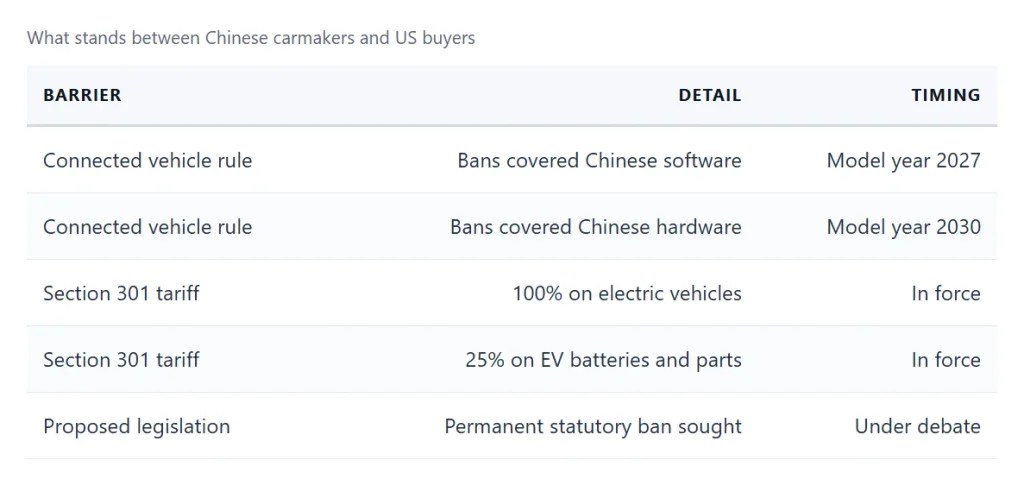
A Commerce rule bars Chinese connected vehicle software from model year 2027.
Section 301 tariffs on Chinese electric vehicles stand at 100%.
US carmakers want Congress to make the ban permanent this year.
Chinese carmakers just heard something new from Washington. President Donald Trump said he would accept Chinese plants on American soil. His condition was simple. Those plants must hire American workers. He pointed to Japanese brands, which build here and hire here.
Trump made the remarks on a Fox News programme on 12 September. He added that he does not object to Chinese cars as products. However, he rejected the idea of Chinese plants in Mexico shipping north. That distinction matters for anyone reading the trade signal.
That model has a real history. Japanese brands faced fierce US anger in the 1980s. They answered by building plants in Ohio, Kentucky, and Tennessee. Today, those plants employ tens of thousands of Americans. So the offer follows a known path.
What still blocks Chinese carmakers today
Rhetoric moved, yet the rulebook did not. A Commerce Department rule bars Chinese-connected vehicle software from model year 2027. Hardware limits follow from the model year 2030. The rule names China and Russia. Therefore, a Chinese badge cannot simply appear in a US showroom next year.
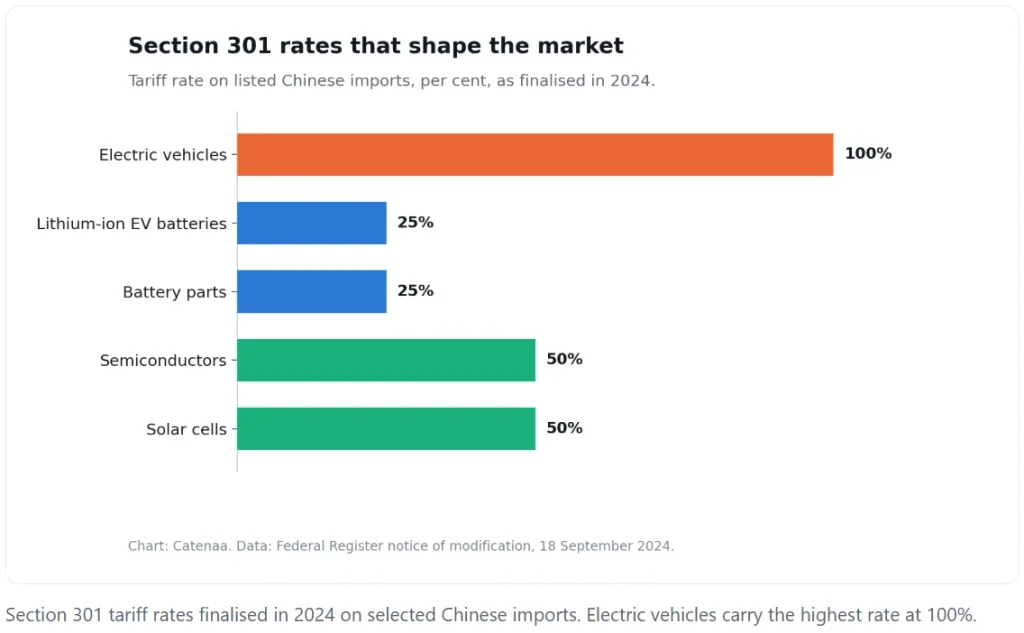
Tariffs form the second wall. The United States applies a 100% tariff on Chinese electric vehicles. Lithium-ion EV batteries carry 25%. Chips and solar cells sit at 50%. In short, the price gap that makes Chinese cars attractive disappears at the border.
Local assembly would dodge the tariff, but not the software rule. A car built in Ohio still needs cleared tech inside it. Therefore, any Chinese-owned plant would need new software. That is a design problem, not a form to file.
Why the timing looks deliberate
Trump is due to meet President Xi Jinping in Washington within weeks. Trade talks usually need an opening gesture. Moreover, foreign direct investment plays well politically when it comes with jobs. So the comment reads as a negotiating card rather than a policy change.
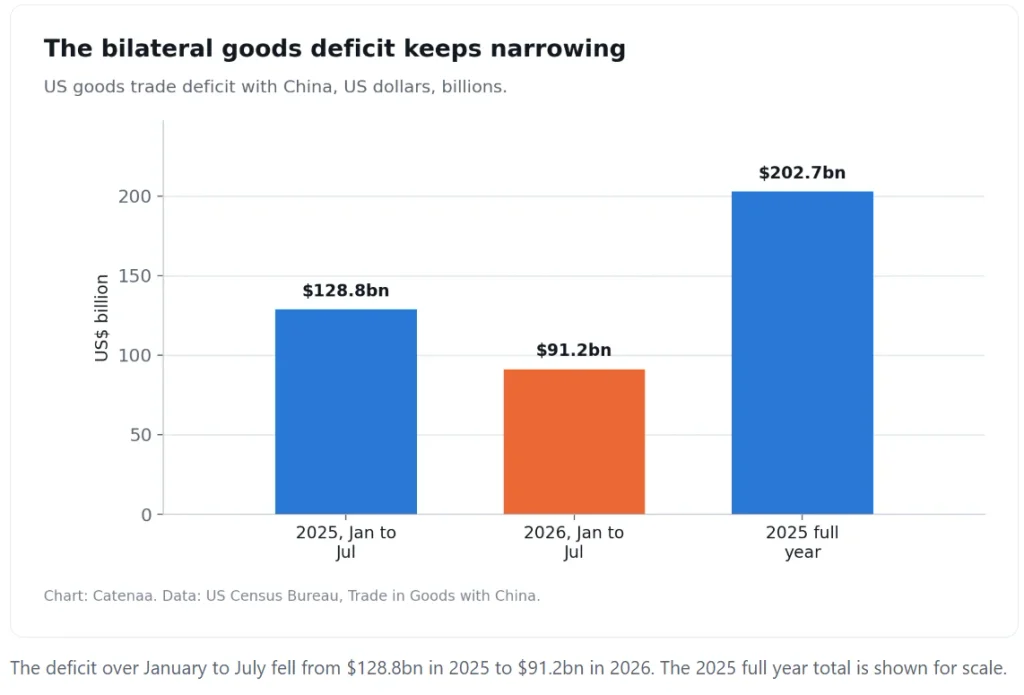
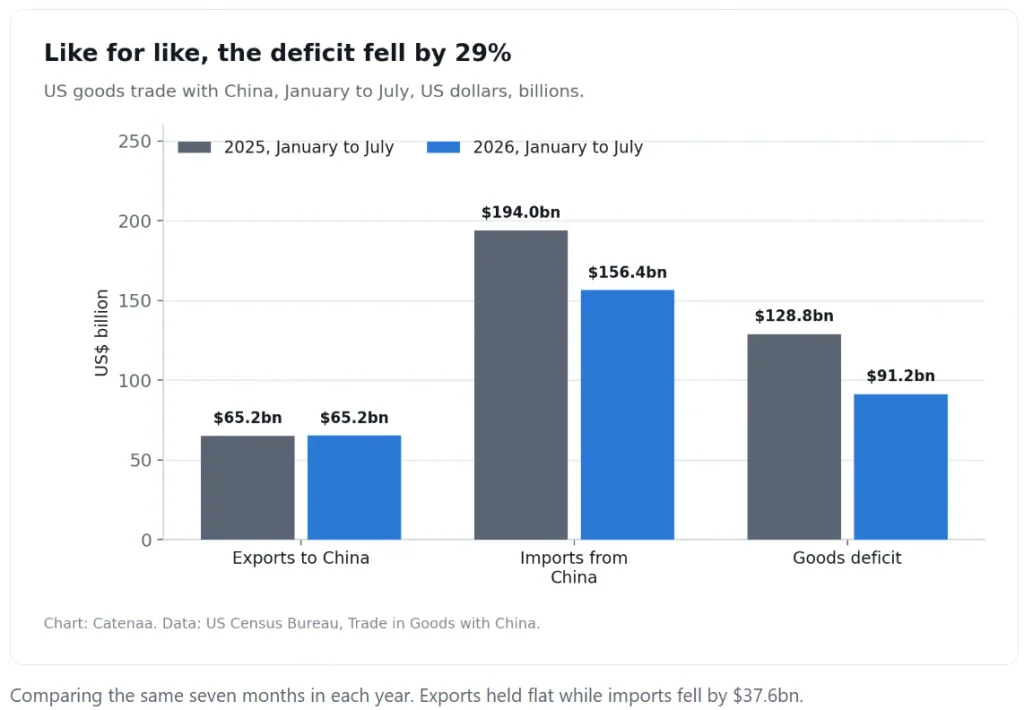
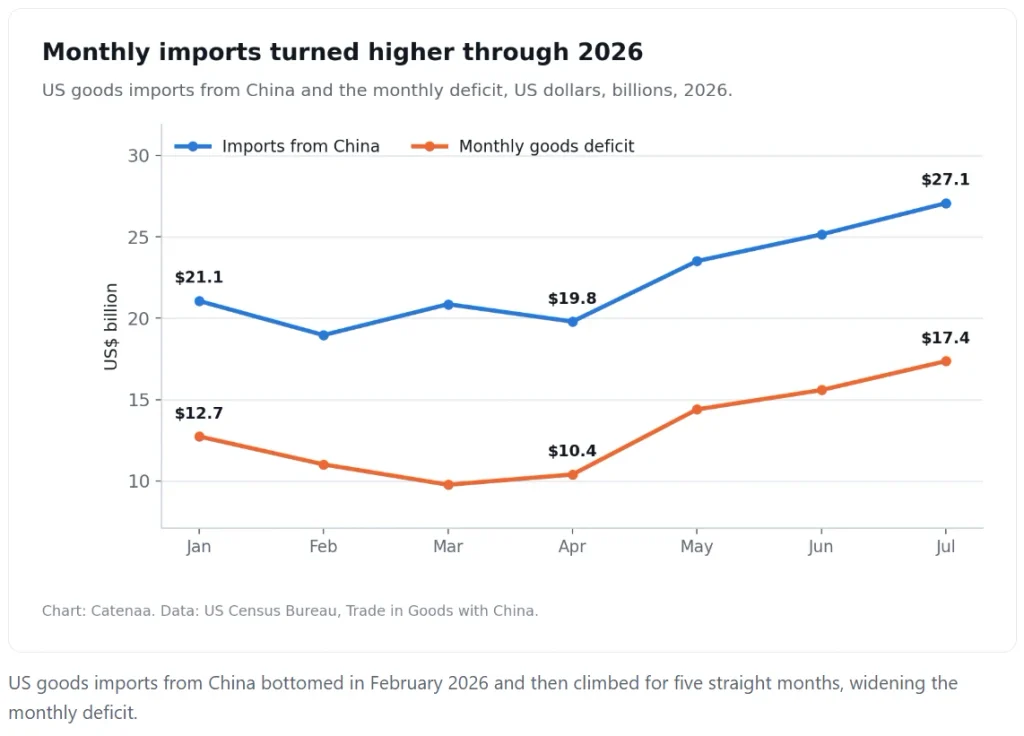
The trade backdrop gives him room. US goods imports from China ran at $156.4bn through July. Exports reached $65.2bn. Hence, the deficit stood at $91.2bn in the first seven months of 2026. The same seven months of 2025 produced a $128.8bn gap, so the shortfall narrowed by 29%.
Exports did not drive that change. They came in at $65.15bn last year and $65.17bn this year. Imports did all the work, falling by $37.6bn. Therefore, tariffs, not export gains, explain the shift.
The industry pushes the other way
Detroit wants the door shut, not opened. The Alliance for Automotive Innovation asked Congress for a permanent ban in this Congress. Its members include General Motors, Ford, Toyota, Volkswagen, Hyundai, Honda, and Stellantis. That is not a fringe group.
John Bozzella, who leads the alliance, framed the issue as national security. He argued that China’s push for global auto leadership needs a policy answer. In addition, he warned about subsidised vehicles carrying connected software. The group wants action before the current Congress ends.
Their worry is staying power, not today’s rules. An agency rule can change with a new White House. A law cannot shift so fast. Hence the push for a statute rather than trust in the current order.
Scale explains the anxiety
China shipped about 7.2m vehicles abroad in the first eight months of 2026. August marked the third straight month above one million units. Those cars are now sold in Europe, Australia, Mexico, Southeast Asia, and South America. Only the US market stays shut.
Trade flows tell a related story. US imports from China bottomed near $19.0bn in February. They then rose for five straight months to $27.1bn in July. Hence, the monthly deficit widened from $9.8bn in March to $17.4bn in July.
What to watch next
Three signals will show whether anything real changes. First, watch the Xi meeting for any tariff language. Second, follow the Commerce Department programme page for rule amendments. Third, track whether Congress moves a bill before the session closes.
Readers should not read too much into one interview. Trade policy here runs through rules and law, not remarks. Consequently, a change needs a Federal Register notice, not a TV clip. Until then, the walls hold.
One scenario still deserves thought. A joint venture that licenses Chinese tech to a US partner could dodge some issues. Similarly, battery plants face fewer hurdles than finished cars. So the first opening, if it comes, may arrive in parts rather than vehicles.
For investors, the read-across stays narrow but real. Battery and parts makers gain the most from any thaw. Meanwhile, US assemblers gain while the walls hold. Accordingly, the two camps will push in opposite ways all autumn.