

August 24, 2026 – Most of the consideration would be paid in Anthropic stock. That turns a cash exit into a leveraged bet on a looming public listing.
In Summary
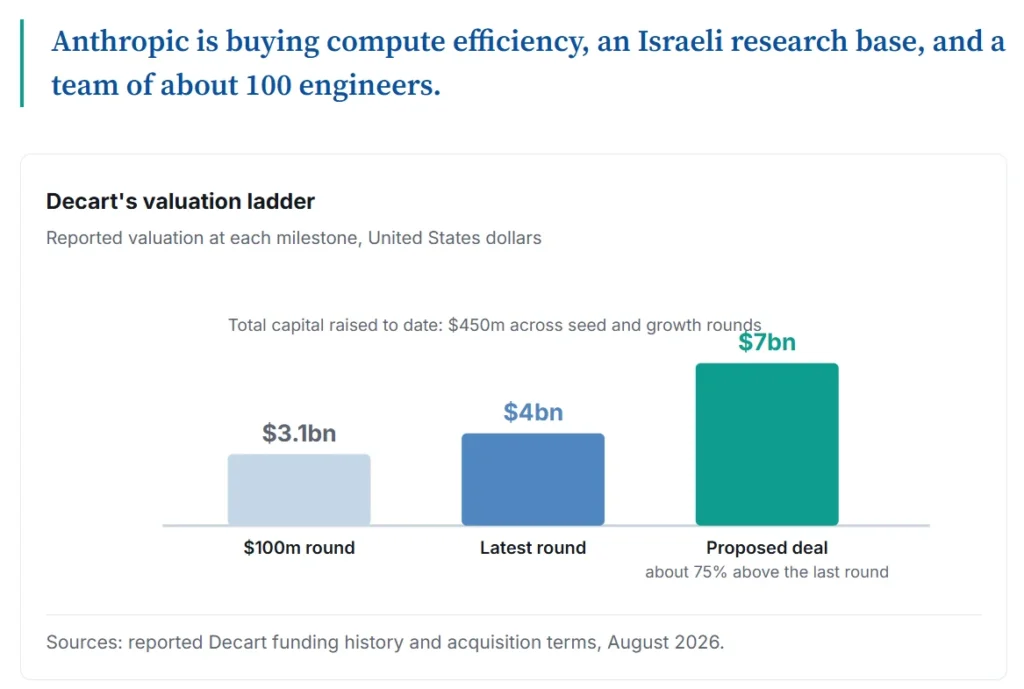
Anthropic is closing on a roughly $7 billion purchase of Israeli AI lab Decart.
Most of the consideration would be paid in Anthropic shares rather than cash.
Decart last raised at a $4 billion valuation and has raised $450 million overall.
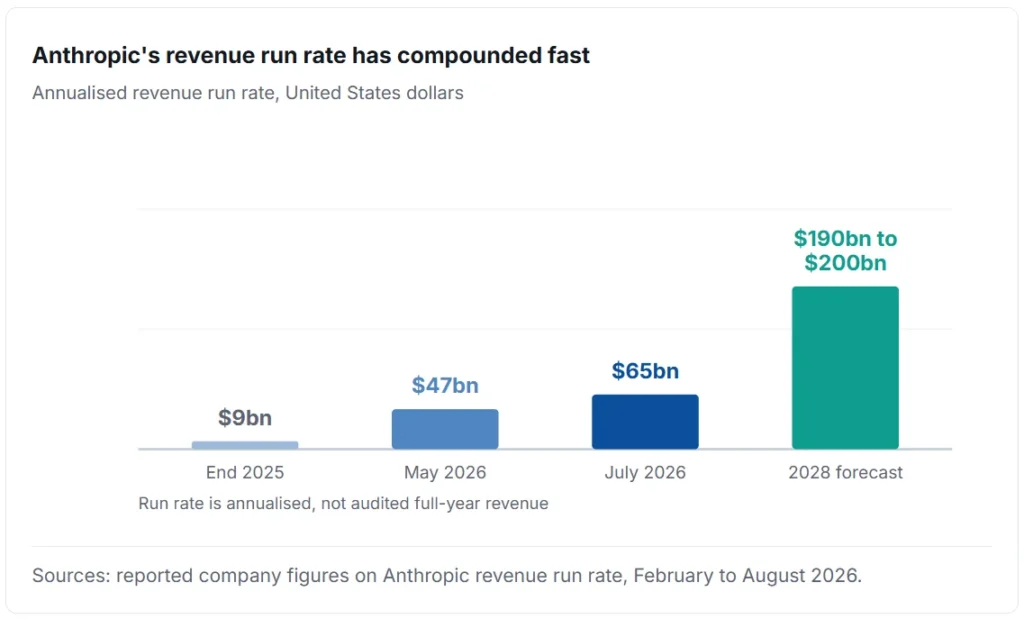
Anthropic’s revenue run rate reached about $65 billion by late July 2026.
No agreement has been signed, and rival bidders may still surface.
Anthropic is moving toward one of the largest private acquisitions in artificial intelligence. The target is Decart, an Israeli research lab founded in September 2023. Reported consideration sits near $7 billion. Crucially, most of that value would arrive as Anthropic stock.
That structure changes the shape of the exit. Decart holders would not simply bank a cash sum. Instead, they would hold equity in a company preparing for a public listing.
Why the payment mix matters
Anthropic has confidentially filed for an initial public offering. Bankers say the deal could match or beat the record $75 billion SpaceX float. A listing could arrive as early as autumn.
As a result, Decart holders would convert a fixed price into a variable one. If the listing prices are above the current mark, their $7 billion becomes worth more. However, the same mechanism cuts the other way in a weaker market.
Valuation has moved faster than revenue
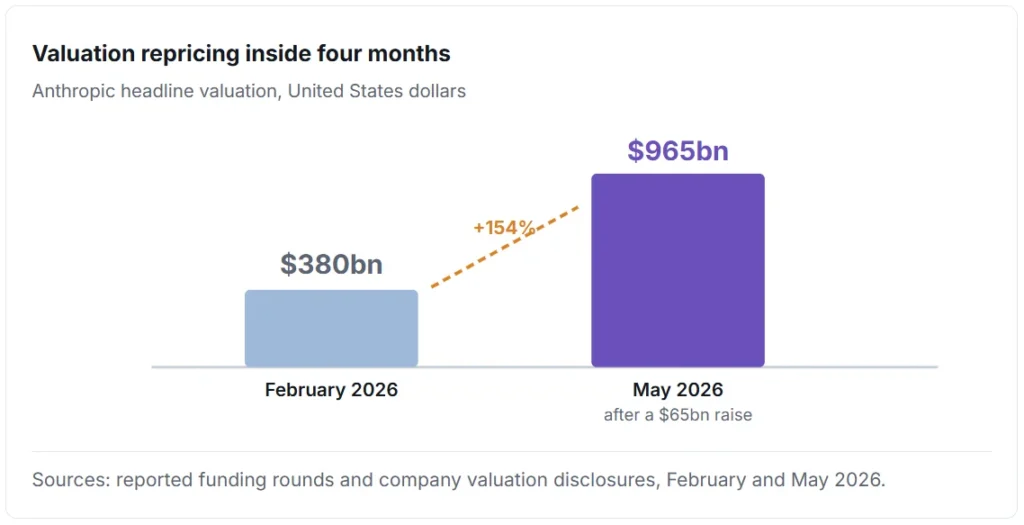
Anthropic carried a $380 billion valuation in February 2026. By May, a $65 billion fundraise lifted that mark to $965 billion. Revenue rose sharply across the same window, yet the multiple still expanded.
Buyers are, in effect, paying for 2028 output. Reported projections point to roughly $190 billion to $200 billion of revenue that year. Those numbers frame the risk in any share-based deal.
What Decart actually builds
Decart describes itself as a frontier lab for real-time world models. Its systems generate and transform video at millisecond latency. Lucy 2.5 handles live video transformation for retail, advertising, and gaming. Oasis 3 targets robotics, autonomous vehicles, and drones.
Its third pillar may matter most to Anthropic. The Decart Optimization Stack tunes workloads across Nvidia chips, AWS Trainium, and Google TPUs. Gains of that kind cut inference cost directly.
Efficiency is the strategic prize
Inference cost now shapes margins across every large model provider. Decart claims efficiency gains of up to 100 times on some workloads. It also reports profitability within three months of launching commercially. Such maths would ease Anthropic’s own compute bill sharply.
Nvidia lost a race it was leading
Decart had already reached advanced talks with Nvidia before Anthropic intervened. Reports suggest the chipmaker even offered a higher headline number. Nvidia already sat on the cap table, which simplified its position.
Sequoia Capital, the largest outside holder, reportedly favoured the Anthropic route. Google and SpaceX have also been named as potential examiners of the asset. Therefore, the outcome is not yet settled.
The founders and the caveats
Dean Leitersdorf leads the company as chief executive. His brother Orian, aged 23, serves as chief scientist. Orian completed a Technion doctorate at 22, a record for the institution. Moshe Shalev is the third co-founder.
Readers should note one key limit. No definitive agreement has been signed. News of the talks may also draw rival bids. Until a filing appears, the $7 billion figure remains a reported term rather than a completed transaction.