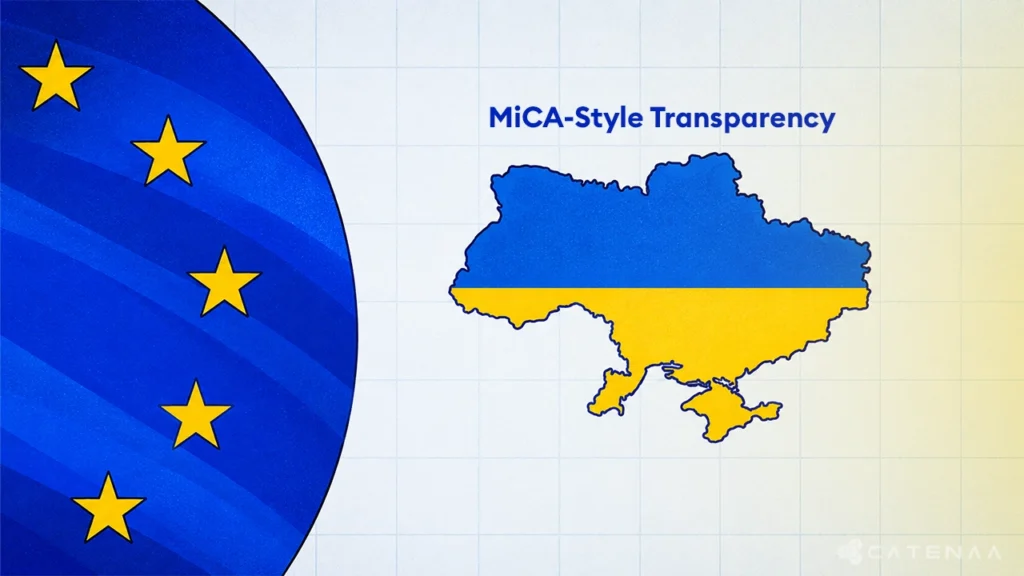


Catenaa, Saturday, August 01, 2026-Ukraine’s cryptocurrency market is becoming more transparent as the country aligns its digital asset regulations with the European Union’s Markets in Crypto-Assets (MiCA) framework, encouraging businesses to strengthen disclosure standards and expand tools that help users evaluate cryptocurrency exchange services.
The shift is reflected in the expansion of cryptocurrency exchanger monitoring services by Ukrainian financial platform Minfin.com.ua, which has enhanced its market-tracking capabilities as regulatory expectations across Eastern Europe continue to evolve.
For years, Ukraine’s cryptocurrency exchange market operated with relatively limited formal oversight, with many users relying on online communities, social media discussions and word-of-mouth recommendations when selecting exchange providers.
That environment is gradually changing as Ukraine works toward regulatory standards that mirror the European Union’s MiCA framework, placing greater emphasis on transparency, operational disclosure and consumer protection.
Rather than waiting for regulations to take full effect, companies are increasingly adapting their services in anticipation of higher compliance expectations.
Minfin’s expanded monitoring platform reflects that trend by allowing users to compare cryptocurrency exchangers using measurable market data rather than reputation alone.
The service aggregates information including trading volumes, exchange rates, fee structures and changes in exchanger activity over time, enabling traders to evaluate providers using publicly available data.
The platform also helps identify pricing differences and potential hidden costs while giving users a clearer picture of liquidity across participating exchange services.
Such tools are becoming increasingly valuable as cryptocurrency markets mature and investors place greater importance on operational transparency.
The growing emphasis on verified information marks an important shift in the development of Ukraine’s digital asset ecosystem.
Early cryptocurrency adoption was often supported by informal networks where traders relied on personal recommendations or community forums to identify reliable service providers.
Today, institutional investors and retail users alike are demanding standardized information that allows exchanges and payment providers to be compared using objective criteria.
That transition mirrors developments already taking place across the European Union under MiCA, where regulated disclosure is becoming a competitive advantage rather than simply a legal obligation.
Ukraine has long ranked among Europe’s most active cryptocurrency markets, driven by widespread digital asset adoption among businesses and consumers.
As the country continues harmonizing parts of its financial legislation with European standards, cryptocurrency infrastructure is also becoming more institutional.
The changes extend beyond exchanges to include custodians, payment providers, blockchain service companies and financial information platforms that support market transparency.
Industry observers expect neighboring Eastern European markets to follow similar paths as regional regulatory frameworks increasingly converge with European Union standards.
The evolution also highlights the growing importance of financial data providers within the digital asset economy.
Just as traditional financial markets rely on independent market data, ratings and research services, cryptocurrency markets are developing comparable information infrastructure that supports better decision-making.
Monitoring platforms help reduce information gaps by providing consistent data on exchange activity, liquidity and pricing, allowing users to compare providers more efficiently.
As regulation expands, such services are likely to become an increasingly important component of the broader digital asset ecosystem.
The expansion of cryptocurrency monitoring tools illustrates that MiCA’s influence extends well beyond licensed exchanges and custodians.
The regulation is reshaping the wider ecosystem by creating demand for independent verification, standardized disclosures and transparent market information.
For investors, improved access to reliable data can reduce the risks associated with selecting exchange providers and improve confidence in digital asset transactions.
For businesses, transparent operations may become an increasingly important competitive advantage as cryptocurrency markets mature under clearer regulatory oversight.
The European Union’s Markets in Crypto-Assets regulation establishes a comprehensive legal framework governing cryptocurrency exchanges, custodians, stablecoin issuers and other digital asset service providers. Although Ukraine is not yet an EU member, it has been working to align elements of its financial legislation with European standards as part of broader economic integration efforts. The country’s cryptocurrency sector has experienced rapid growth in recent years, making transparency, regulatory compliance and investor protection increasingly important priorities for both businesses and policymakers.