


September 04, 2026 – The regulator cleared a core national bank. It also fenced off four of Revolut’s more complex product lines.
In Summary
The Office of the Comptroller of the Currency granted Revolut conditional approval on 3 September 2026.
Revolut must inject at least $95m of paid-in capital into the new bank.
A tier 1 leverage ratio of 10 percent applies for the first three years.
Four product lines, including correspondent banking, need separate supervisory sign-off.
Revolut posted 2025 revenue of $6.0bn and pre-tax profit of $2.3bn.
A conditional yes, with a fence around it
Revolut has cleared its first major American hurdle. The Office of the Comptroller of the Currency granted conditional approval on Thursday. That decision covers a proposed national bank in the United States. Revolut filed the application in March 2026.
Chief executive Nik Storonsky called it a starting point. He described the decision as an important first step toward the proposed Revolut Bank US. Storonsky added that it provides a foundation in the world’s largest financial market.
Work remains before customers see anything. Applications with the Federal Deposit Insurance Corporation and the Federal Reserve continue. Final approval from the comptroller must also follow. Deposit insurance, in particular, requires its own separate review.
The conditions carry real teeth
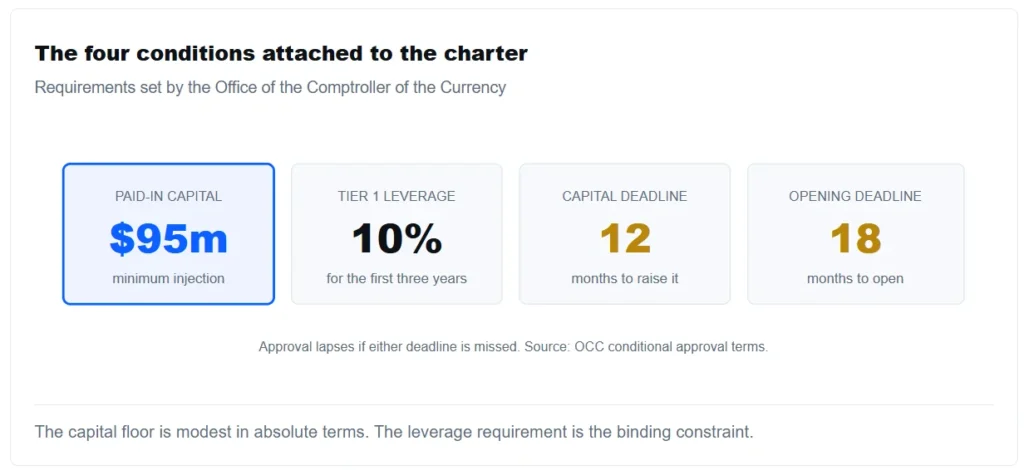
Capital comes first. Revolut must place at least $95m of paid-in capital into the bank. It must then hold a tier 1 leverage ratio of at least 10 percent for three years. That level sits well above the normal minimum.
Deadlines follow. The approval lapses if the capital is not raised within 12 months. It also lapses if the bank fails to open within 18 months. Charter approvals of this kind often carry such time limits, as the licensing manual sets out.
Four businesses stay behind the gate
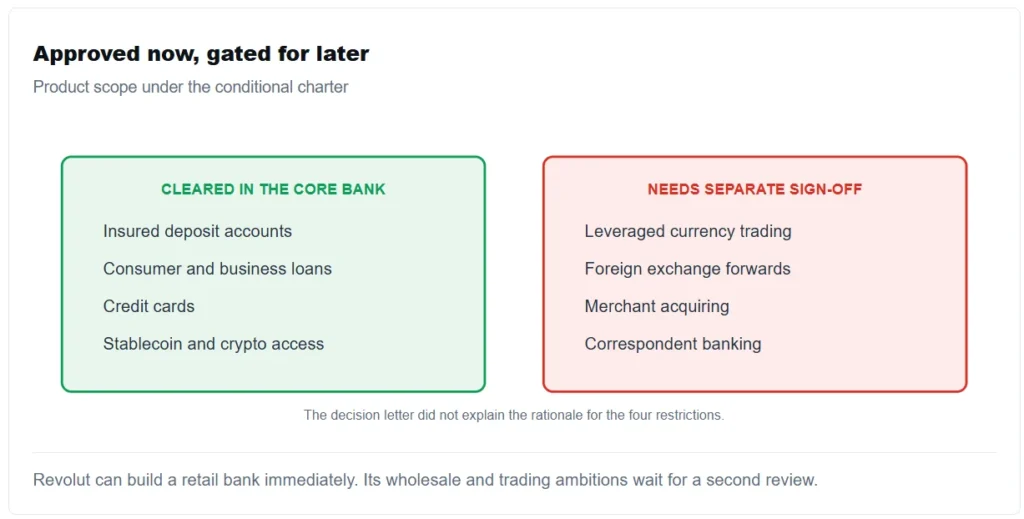
The regulator approved a core bank and paused the rest. Consequently, four activities need separate supervisory sign-off before launch. Leveraged currency trading heads that list. Foreign exchange forwards follow.
Two payment businesses complete it. Merchant acquiring, which processes card payments for businesses, sits behind the gate. Correspondent banking does too, meaning Revolut cannot yet hold dollar accounts for unaffiliated foreign banks.
Analysts read the split as deliberate. Evey Guo of FS Vector said the regulator approved the core bank while holding back the more complex product lines. The decision letter gave no reasoning. Each gated line, notably, carries higher financial crime or market risk.
The financial case behind the application
Revolut arrives with strong numbers. Group revenue rose 46 percent to $6.0bn in 2025, the company reported in March 2026. Profit before tax reached $2.3bn, an increase of 57 percent. That represents a 38 percent margin and a fifth straight profitable year.
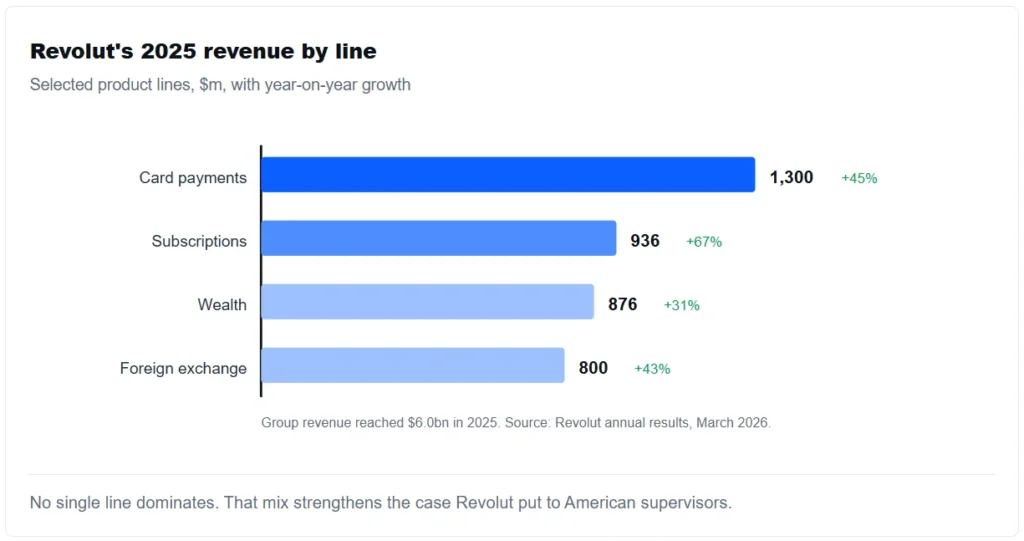
A broad product mix underpins the result. Eleven product lines each generate more than $135m annually. Card payments contributed $1.3bn, up 45 percent. Subscriptions added $936m, wealth services $876m and foreign exchange $800m.
Customer growth continued too. Retail customers rose 30 percent to 68.3 million. Business customers reached 767,000. Total customer balances jumped 66 percent to $67.5bn. Management targets 100 million customers by mid-2027.
A more open chartering climate
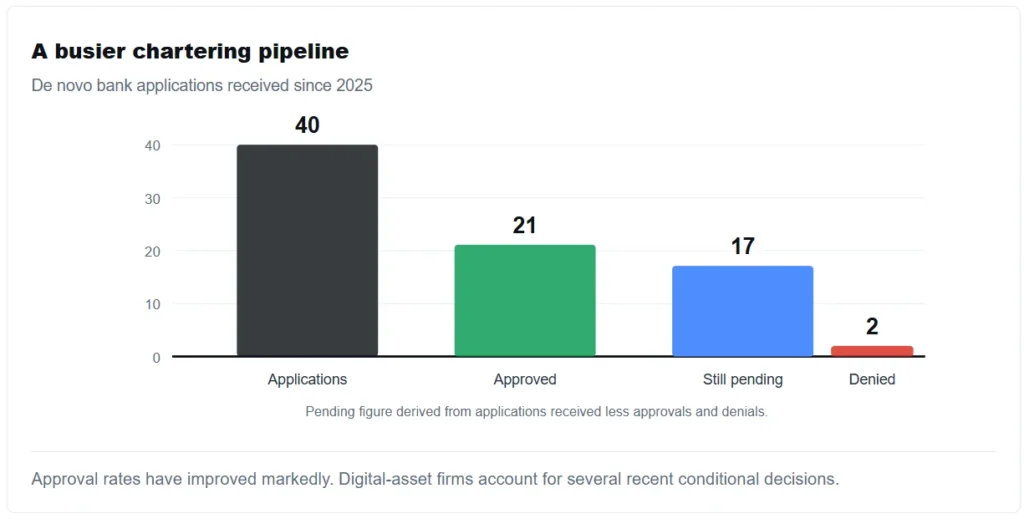
The regulator has changed posture since 2025. It has received about 40 de novo applications in that period. Twenty-one have been approved and two denied. Conditional approvals have gone to several digital-asset firms as well.
Competitive pressure follows from that shift. A charter removes the need for a sponsor bank. It lowers funding costs, widens lending capacity and improves margins. Fintechs that stay partnered will feel the difference.
Scrutiny has not disappeared, however. Todd Baker of Columbia University noted that certain issues would have been a major red flag. Clean supervisory records therefore remain essential.
Why the charter matters commercially
Revolut currently reaches American customers through partners. That structure caps economics and product design. A charter changes both at once. Deposits fund lending directly, and interchange economics improve.
Balance sheet scale explains the appetite. Customer balances across the group reached $67.5bn in 2025. Even a small American share would create meaningful funding. Management has also earmarked $13bn of investment over five years.
The competitive read
Rivals will study the conditions closely. A 10 percent leverage floor sets a clear price of entry. Applicants with thinner capital may struggle to match it. Regulators, meanwhile, gain a template they can reuse.
Incumbent banks lose a little shelter. A funded, licensed challenger can price deposits and loans directly. Competition should sharpen in cards and everyday banking first.
What to watch next
Three milestones will define the timeline. Watch first for the capital injection, due within 12 months. Look next for deposit insurance approval from the FDIC. Finally, track the Federal Reserve application covering holding company status.
Product sequencing offers a second signal. Deposits, cards and lending can launch first. Merchant acquiring and correspondent banking need the gate lifted. Any early approval there would show growing comfort at the agency.
Global expansion continues meanwhile. Revolut has launched in Mexico and holds licences in France, Australia and the United Kingdom. It plans a South Africa launch by 2028. Company updates appear on its newsroom.