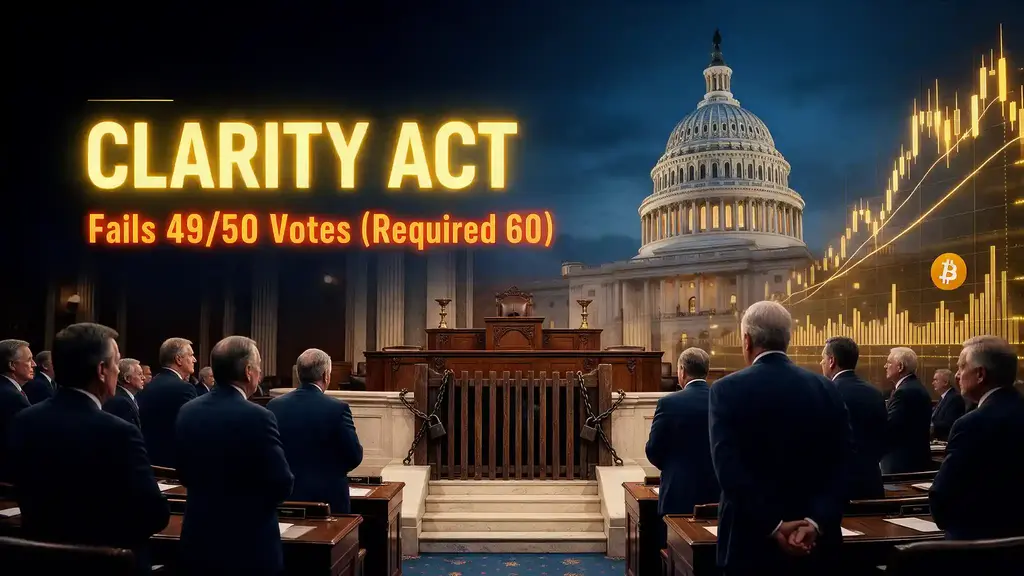


Catenaa, Tuesday, September 15, 2026- The US Senate has failed to advance the Digital Asset Market Clarity Act, dealing a major setback to an effort to establish a comprehensive federal regulatory framework for cryptocurrencies.
The Senate voted 49-50 today (Tuesday) against invoking cloture on the motion to proceed to H.R. 3633.
The measure required 60 votes to advance.
Democrats and several Republicans opposed the procedural motion after more than a year of negotiations over ethics rules, stablecoin rewards, anti-money-laundering safeguards and protections for software developers.
Democratic lawmakers involved in the negotiations said unresolved ethics provisions remained a central concern.
The debate has focused partly on whether conflict-of-interest restrictions should apply more broadly to elected officials and their families and how states could enforce those provisions.
Some Democrats also raised concerns about law-enforcement powers and the treatment of prediction markets.
Republicans argued that their final draft had made extensive concessions.
Sens. Cynthia Lummis, John Boozman and Tim Scott released a revised version before the vote containing 126 substantive changes requested by Democrats.
The draft incorporated most of the bipartisan Tillis-Gallego ethics proposal and gave state attorneys general a role in enforcing some conflict-of-interest rules.
It also sought to address concerns from community banks.
The Treasury secretary would have received temporary authority to restrict certain stablecoin rewards if payment stablecoins caused substantial deposit outflows from smaller banks.
Another provision narrowed money-transmission requirements for some software developers and created a civil safe harbor.
The CLARITY Act is intended to establish clearer jurisdiction between the Securities and Exchange Commission and Commodity Futures Trading Commission over digital assets.
The House passed an earlier version, but the Senate has spent months negotiating changes covering DeFi, stablecoins, market oversight and ethics.
Tuesday’s defeat does not formally kill the legislation.
Republican Sen. Thom Tillis initially voted to advance the measure before changing his vote and moving to reconsider the result.
That procedural step keeps open the possibility of another vote if negotiators can secure additional support.
However, the legislative calendar is becoming increasingly restrictive.
Even if the Senate later advances and passes the measure, changes would still require action by the House.
Lawmakers are also approaching the November 3 midterm elections, reducing the amount of time available for another attempt.
The failure leaves federal agencies with a larger role in shaping crypto regulation through existing authority.
The SEC and CFTC have continued developing digital-asset rules even as Congress has worked on market-structure legislation.
The vote therefore leaves the central question unresolved.
Congress has spent more than a year trying to create a statutory framework for US crypto markets, but lawmakers remain divided over how regulation should address ethics, financial crime, banking competition and decentralized finance.
Whether the CLARITY Act returns for another Senate vote will depend on whether those remaining differences can be narrowed before the legislative window closes.