

August 31, 2026 – The complaint calls the award arbitrary and capricious. ICE spent about six days on market research before concluding that only one vendor could do the job.
In Summary
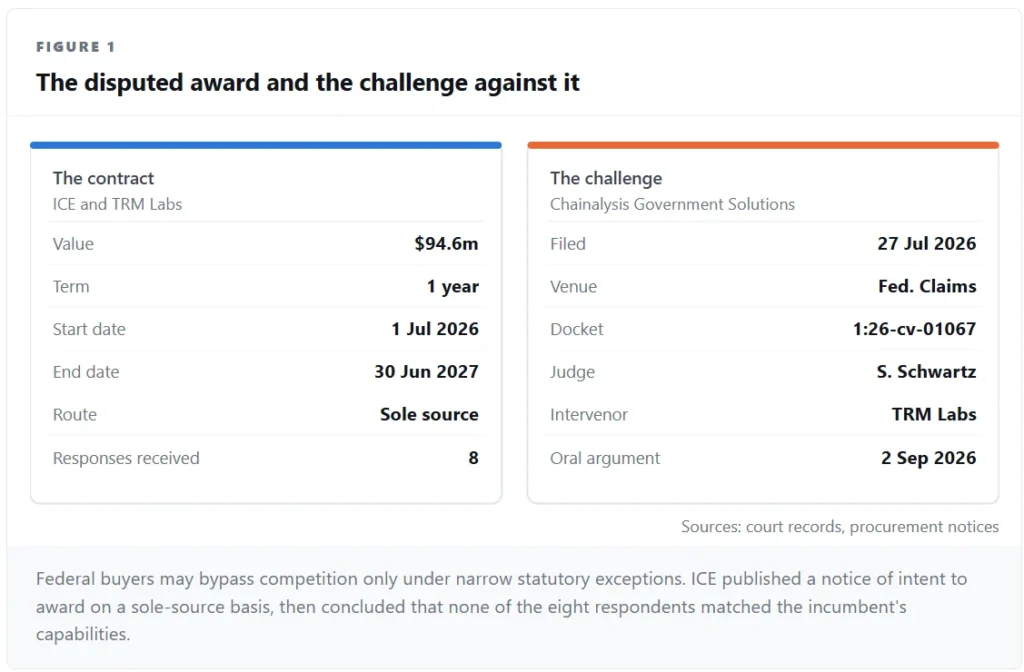
The disputed contract is worth $94.6 million over one year.
It runs from 1 July 2026 to 30 June 2027 and was awarded to TRM Labs.
Chainalysis filed at the US Court of Federal Claims on 27 July 2026.
The case is docketed as 1:26-cv-01067 before Judge Stephen Schwartz.
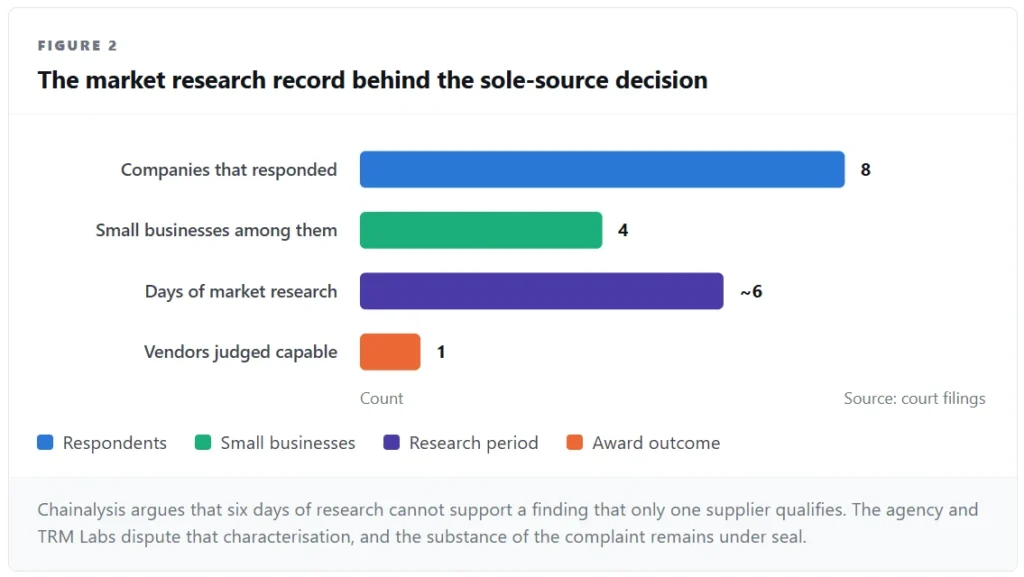
ICE conducted roughly six days of market research before the award.
Eight companies responded, and TRM Labs intervened to defend the contract.
Two blockchain analytics firms are now fighting in court. Chainalysis is challenging a contract that its main rival won without a tender.
Moreover, the sum is large. ICE agreed to pay TRM Labs $94.6 million over a single year. The term runs from 1 July 2026 to 30 June 2027. So the work is already well underway.
What the contract covers
The deal funds forensic software and support for Homeland Security Task Force work. Case types include fraud, cybercrime, and sextortion.
Broadly, these tools trace crypto payments between wallets. They then tie those wallets to known firms or people. So agents can follow money across exchanges and borders.
Demand has grown fast. Crypto crime cases now span sanctions, fraud, and drug supply. Therefore, agencies buy this software in bulk. Also, licences tend to renew for years.
The route in dispute
Federal buyers must normally run an open contest. Part 6 of the Federal Acquisition Regulation demands full and open competition. But only narrow exceptions apply. Each one must be justified in writing.
However, ICE used one of them. It judged that only TRM Labs could meet its needs. Before that, it published a notice of intent to award without a tender.
Meanwhile, eight firms replied, four of them small businesses. Yet the agency found none of them a match. It reached that view after about six days of market research.
Chainalysis filed a capability statement in that window. It says the agency moved too fast and on too thin a record. Moreover, it argues that its own tools meet the same needs.
The legal claim
So the firm went to the US Court of Federal Claims on 27 July. Its complaint calls the award arbitrary, capricious, and unreasonable.
Most of the filing is sealed. Chainalysis asked for that to guard trade secrets. So the detailed argument is not public. Neither side has published its evidence.
TRM Labs did not stand aside. It joined the case as a defendant on 28 July. It is now defending the award alongside the government. Because its revenue is at stake, that step was expected.
An unusually fast timetable
Although these disputes often drag on, this one is different. This one is moving quickly because the contract is already running.
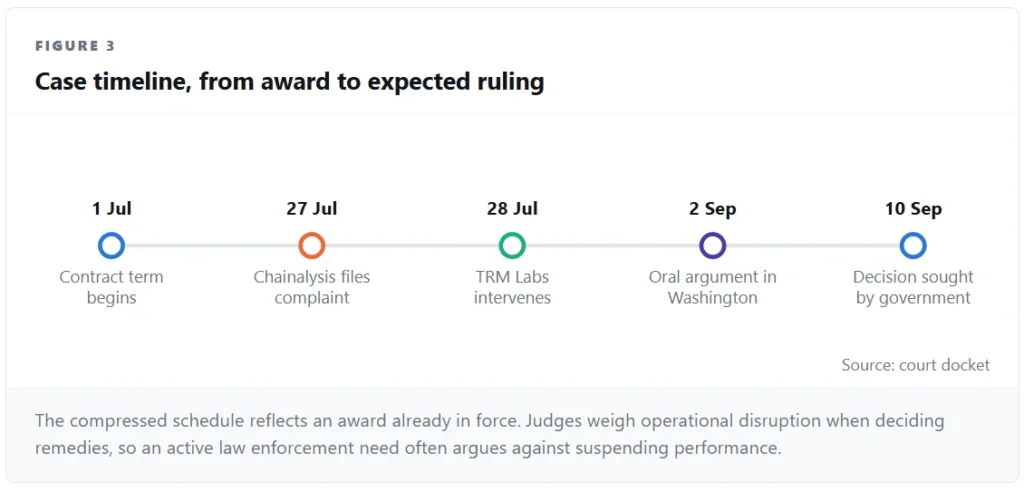
Judge Stephen Schwartz set oral argument for 2 September in Washington. Government lawyers asked for a ruling by 10 September.
Such speed usually signals operational need. Agents are presumably using the software daily. A sudden halt would disrupt live cases. Therefore the court will weigh timing carefully.
Why the stakes are high
Notably, government work anchors this industry. Agencies buy multi-year licences and name their supplier in public records. That choice acts as a badge of trust. Banks and exchanges often follow the government’s lead.
So losing an incumbent seat costs more than the fee. It shifts the reference client that drives commercial sales, too.
Chainalysis has supplied US law enforcement for years. TRM Labs has grown fast and won a rising share of federal work. That shift explains the heat in this case. Although the sum is large, the signal matters more.
Possible outcomes
Still, judges have several options here. Protest remedies vary widely. They can uphold the award. They can order the agency to redo its written justification. Or they can require a fresh contest.
Relief is discretionary, though. Courts weigh the public interest. An active law enforcement need often counts against any pause.
A middle path is common. A judge may leave the work running while ordering better paperwork. That protects both process and operations. Still, it would leave the rivalry unresolved.
Neither ICE nor the Department of Homeland Security has commented. A ruling should follow within days of the hearing.
What it means for the sector
The case matters beyond these two firms. Agencies buy analytics tools in long cycles. So a single award can lock in a supplier for years.
A ruling for Chainalysis would push buyers toward open tenders. A ruling the other way would confirm that speed can trump contest. Either outcome will shape how this market sells to the government.




