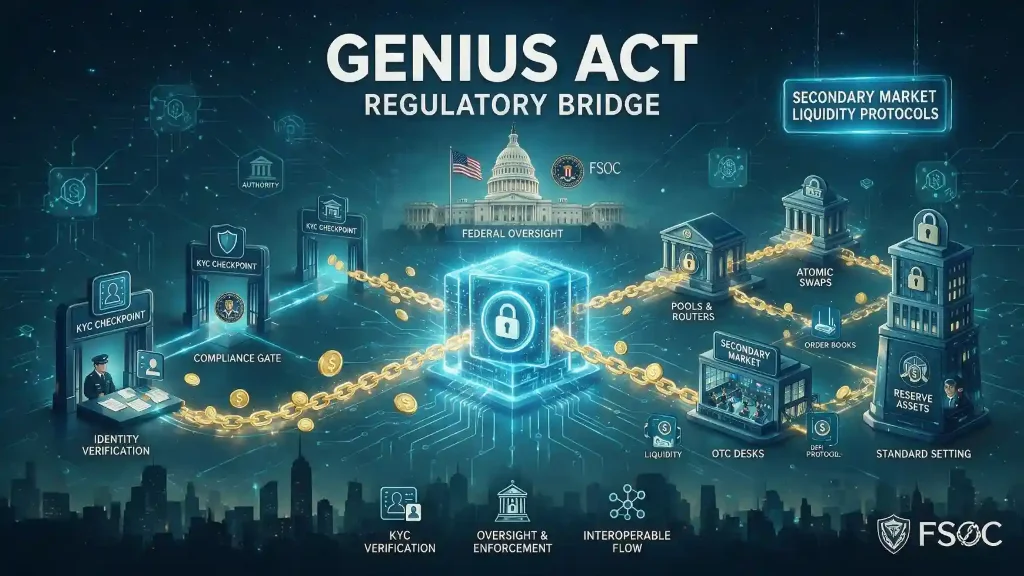


Catenaa, Thursday, August 27, 2026- The Blockchain Association has backed key elements of proposed US customer-identification rules for payment stablecoin issuers while urging regulators not to extend those obligations to ordinary secondary-market transactions.
The industry group submitted its comments Friday on joint rules proposed by the Financial Crimes Enforcement Network, Office of the Comptroller of the Currency, Federal Reserve, Federal Deposit Insurance Corp. and National Credit Union Administration.
The proposal implements customer-identification requirements under the GENIUS Act, the federal stablecoin law enacted last year.
The Blockchain Association said issuers should be required to identify customers when dealing with them directly in the primary market.
It argued that peer-to-peer transfers and other downstream transactions should generally remain outside an issuer’s customer-identification obligations.
The GENIUS Act establishes a federal framework governing who may issue payment stablecoins, the assets that can back them and how holders may redeem them.
Permitted payment stablecoin issuers must maintain customer-identification programs.
The dispute is increasingly about where those obligations should end.
The Blockchain Association supports requiring identification when a stablecoin issuer directly creates a customer relationship, such as when a user acquires or redeems tokens with the issuer.
It opposes forcing issuers to identify every person who subsequently receives or transfers the stablecoin through secondary markets.
That distinction could become important as regulated stablecoins circulate through exchanges, wallets, payment applications and decentralized blockchain networks.
Once issued, a stablecoin can move among users without the issuer participating in each transaction.
Making the original issuer responsible for identifying every later holder could impose requirements that are technically difficult to enforce across open blockchain networks.
The association also asked regulators to clarify several terms in the proposal.
Those include the definitions of “account,” “customer” and “digital asset service provider.”
The group recommended that some one-time stablecoin redemption transactions and activities unrelated to stablecoin services be excluded from definitions that could otherwise trigger broader compliance duties.
Clear definitions could determine how far the customer-identification requirements extend into exchanges, wallet providers and other digital asset businesses.
The association also asked regulators to avoid overlapping requirements when several agencies or compliance regimes cover the same activity.
Stablecoin issuers should retain flexibility in how they verify customer information, it said, rather than being required to follow one rigid identification method.
The group also wants the agencies to coordinate the effective date of the customer-identification rules with separate anti-money laundering regulations required under the GENIUS Act.
Implementing related rules at different times could force issuers to redesign compliance systems repeatedly.
A coordinated timetable could allow companies to build customer identification, transaction monitoring and other anti-money laundering controls together.
The comment period on the proposed customer-identification rules closed Aug. 21.
Regulators will now review submissions before deciding whether to revise the proposal and issue final rules.
The GENIUS Act marked a major change in US stablecoin regulation by creating a specific legal structure for payment stablecoins rather than relying largely on existing banking and securities rules.
Its implementation now depends heavily on regulations being developed by federal financial agencies.
Those rules will determine how reserve requirements, redemptions, customer checks and anti-money laundering obligations operate in practice.
The Blockchain Association said implementation should preserve safeguards while allowing stablecoins to function across blockchain networks.
Its position reflects a broader industry concern that applying conventional account-based banking rules too broadly could undermine one of the technical characteristics that distinguishes stablecoins from ordinary bank deposits.
A stablecoin issuer can identify the person buying tokens directly from it.
It may have no direct relationship with someone who receives those same tokens several transactions later.
The question has implications for how stablecoins function in payments.
Dollar-backed tokens increasingly move between individuals, exchanges and businesses without returning to the issuer after every transfer.
Requiring issuers to perform customer checks throughout that chain could make permissionless transfers difficult or require additional intermediaries to screen users.
The Blockchain Association is therefore asking agencies to distinguish between the regulated issuance and redemption relationship and subsequent blockchain transfers.
That does not mean secondary-market transactions would operate without compliance obligations.
Exchanges, banks and other regulated service providers can still face their own sanctions, anti-money laundering and customer-identification requirements.
The issue is whether those obligations should also be placed on the stablecoin issuer when it is not involved in the transaction.
The comment shows how the regulatory debate is shifting after passage of the GENIUS Act.
The question is no longer simply whether the United States should regulate stablecoins.
Attention is moving toward the details that will determine how the law works in practice.
For issuers, customer-identification rules could influence product design, wallet access and the ability of stablecoins to circulate freely after issuance.
For regulators, the challenge is preventing illicit finance without imposing obligations that cannot realistically be enforced across decentralized networks.
The Blockchain Association broadly supports the proposed framework but wants that boundary drawn at the issuer’s direct customer relationship.
How federal agencies resolve that issue could help determine whether US-regulated stablecoins operate primarily like conventional financial accounts or retain the peer-to-peer transfer characteristics of public blockchains.