

September 09, 2026 – Traders now price a Bank of Japan move on 18 September. A three percent currency swing in three weeks tells you how firmly.
In Summary
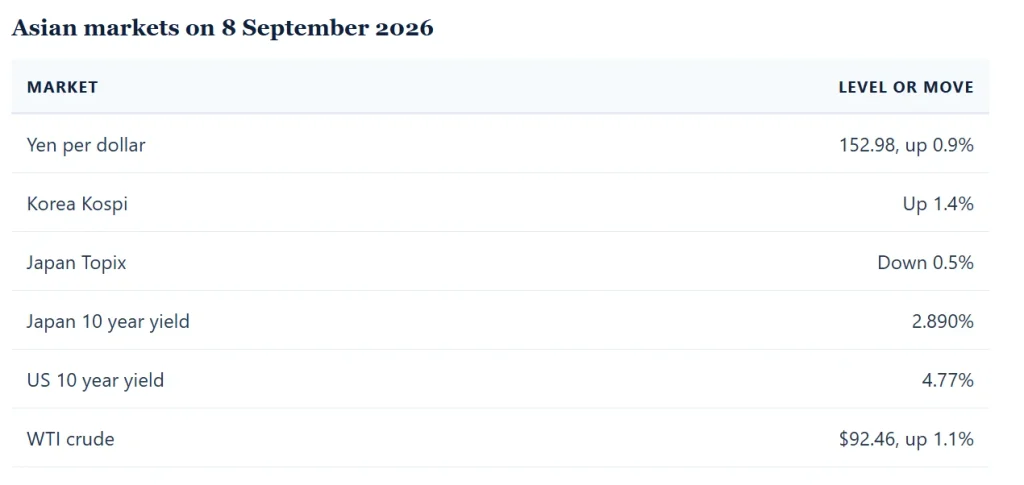
The yen reached 152.98 per dollar, its strongest level in six months.
Markets now expect a Bank of Japan rate rise on 18 September.
Policy has sat at 1.0 percent since the board held rates on 31 July.
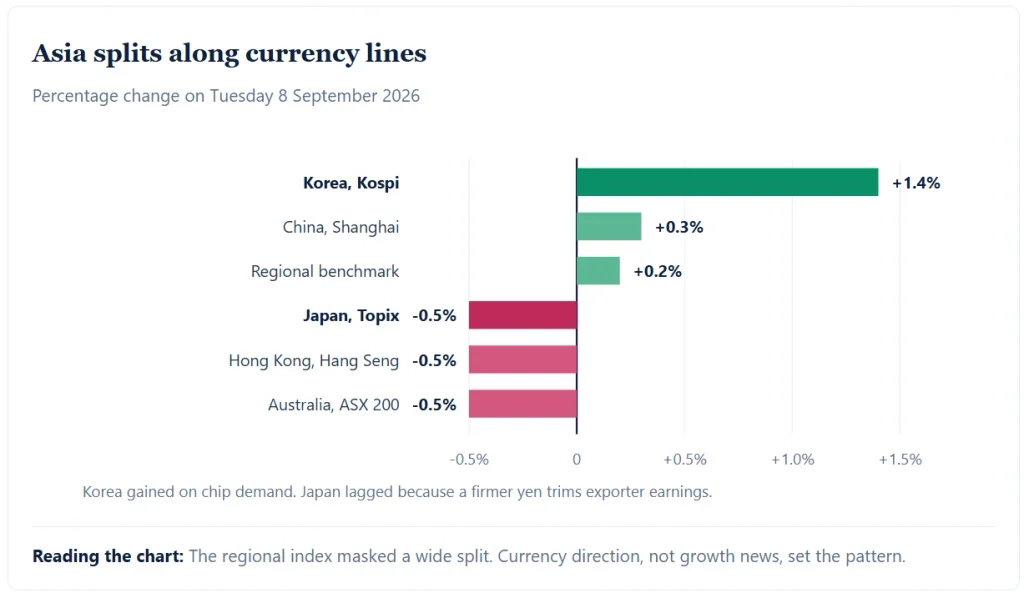
Korea’s Kospi rose 1.4 percent as chip makers advanced.
Japan’s ten-year bond yield eased four basis points to 2.890 percent.

The yen has found a strong bid. Indeed, it reached a six-month high against the dollar on Tuesday.
Traders now price in a Bank of Japan rate rise this month. That single shift has driven the move.
Currency markets rarely turn on one factor alone. In this case, though, the policy story explains most of it.
Japan’s currency changed hands near 152.98 per dollar. It gained about 0.9 percent in the session. Meanwhile, the dollar slipped about 0.2 percent against a basket of peers.
Why the yen turned
Furthermore, the Bank of Japan meets on 17 and 18 September. Markets read recent signals as a green light.
Takuji Aida advises Prime Minister Takaichi on the economy. Notably, he now expects a rise at that meeting.
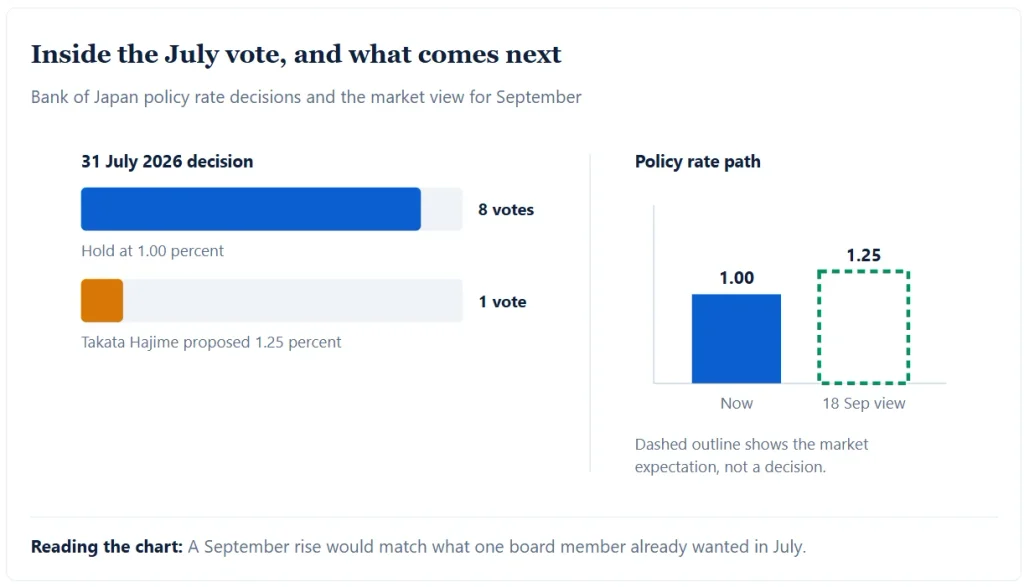
Policy already sits at 1.0 percent. Notably, the board held there on 31 July by an eight-to-one vote.
One member wanted more. Takata Hajime proposed 1.25 percent, citing upside price risks from abroad. His colleagues, however, rejected that plan.
So a hike this month would simply catch up with that dissent. In short, the case has been building inside the board itself.
The move has been fast
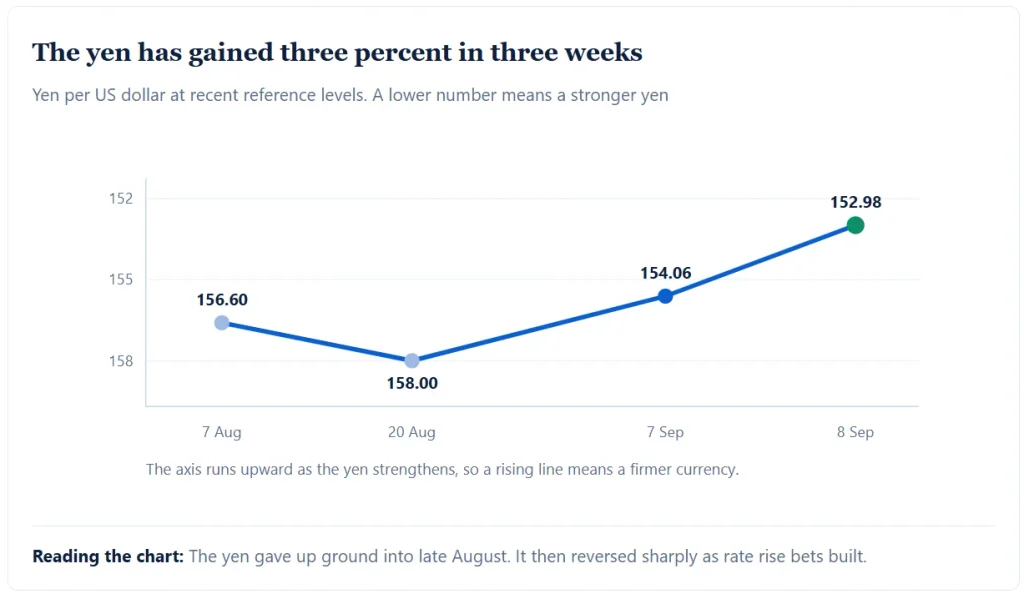
Reference levels tell the story clearly enough. For example, the yen sat near 158 per dollar on 20 August. It traded near 154 last Monday.
By Tuesday, it had reached 152.98. That is roughly a three percent gain in three weeks.
Such speed matters for exporters and for carry trades. A stronger yen cuts the home currency value of overseas earnings. Japanese blue chips felt that at once.
Borrowers in yen face the sharper pain, however. Traders who funded foreign assets cheaply now owe more in home terms. As a result, some of those trades unwind quickly.
Tokyo shares lag the region
In Tokyo, the Topix fell 0.5 percent as exporters led the decline. Korea moved the other way.
By contrast, Seoul’s Kospi rose 1.4 percent as chip names advanced. SK Hynix and Samsung Electronics both gained ground.
Elsewhere, the picture stayed mixed. Shanghai added 0.3 percent, while Hong Kong and Sydney each fell 0.5 percent. The wider regional benchmark ended 0.2 percent higher.
Memory pricing explains the Korean strength. Demand from AI servers keeps absorbing supply. As a result, contract prices have held firm all year.
Futures pointed to a steady start in the West. Nasdaq 100 contracts rose 0.3 percent, while European futures barely moved. In other words, the split stayed a regional story.
Bonds sent a calmer signal
Yields, meanwhile, eased modestly across the region. Japan’s ten-year bond yielded 2.890 percent, four basis points lower.
Similarly, US ten-year notes yielded 4.77 percent, down a single basis point. Australian equivalents traded at 5.17 percent.
Note the odd pattern here. Rate-rise bets usually push yields higher. Instead, long bonds rallied as investors bought duration.
That gap points to a market pricing in slower growth alongside tighter policy. Such a mix rarely lasts long.
Japan’s long end tells a sharper story. Thirty-year yields have climbed steeply through 2026. Consequently, pension funds and insurers have started to reprice their books.