

September 12, 2026 – Wall Street closed higher on 11 September, even after August consumer prices matched forecasts. Consumer confidence told a bleaker story.
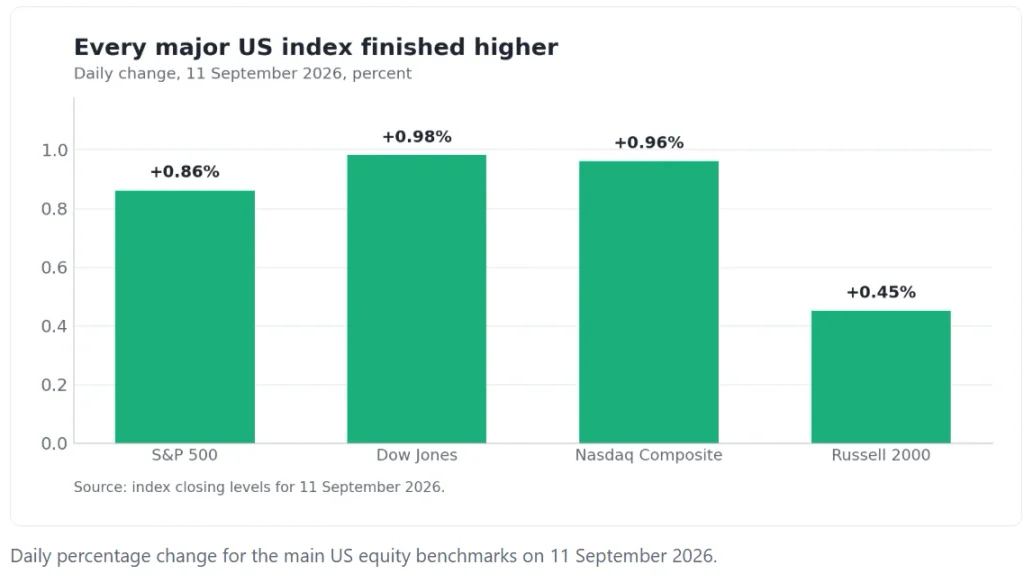
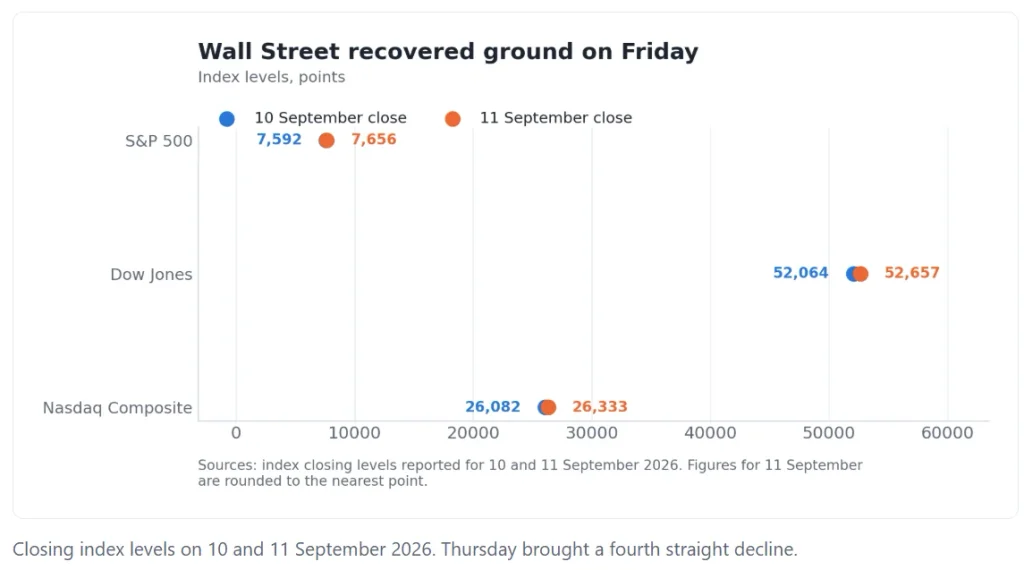
US inflation held at 3.4% in the year to August, and Wall Street liked the certainty. The S&P 500 rose 0.86% to 7,656 on 11 September. Moreover, the Dow Jones Industrial Average gained 0.98% to 52,657.
Traders had feared a nastier number. Instead, the headline matched forecasts almost exactly. Buyers then stepped back into equities, even though the same data all but locked in a rate rise next week.

In Summary
The S&P 500 rose 0.86% to 7,656 on 11 September, and the Dow added 0.98%.
August consumer prices rose 0.4% on the month, so annual inflation stayed at 3.4%.
Core inflation ran hotter than forecast at 0.3%, which lifted September hike odds toward 90%.
Michigan consumer sentiment sank to 47.8, its weakest flash reading in over a year.
Brent crude settled at $104.61, down about 2.8%, which eased one inflation worry.
What the US inflation report actually showed
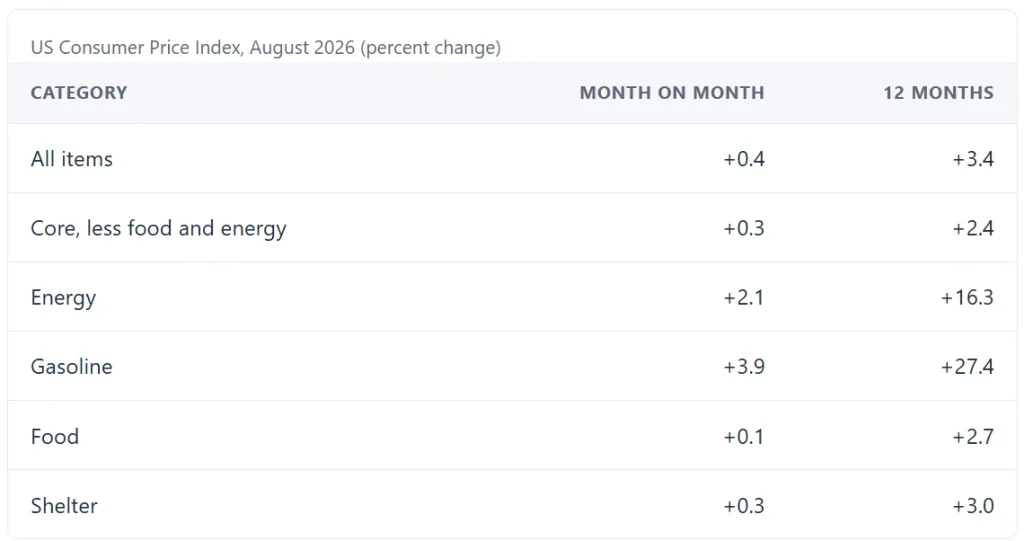
The Bureau of Labor Statistics recorded a 0.4% monthly rise in consumer prices. Annual inflation stayed at 3.4% for a second month. Core prices, which strip out food and energy, rose 0.3% and 2.4%, respectively.
Gasoline carried the print. Pump prices rose 3.9% in August, and that single line explained over a third of the headline gain. Across twelve months, gasoline costs jumped 27.4%.
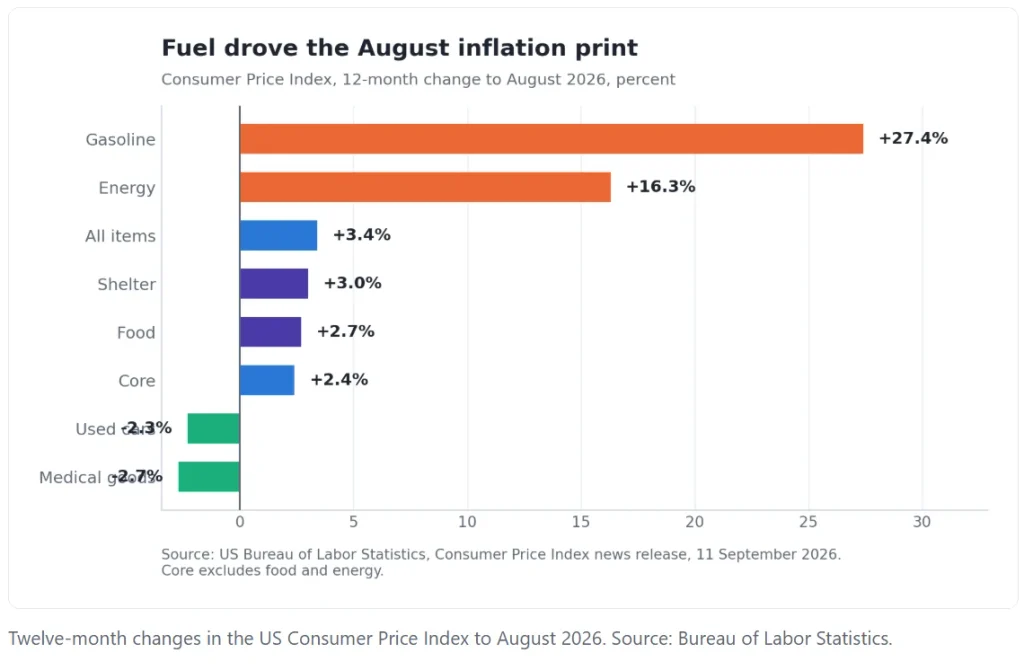
Elsewhere, the picture looked calmer. Shelter inflation ran at 3.0%, its steadiest pace in years. Food rose 2.7%. Meanwhile, used vehicles fell 2.3% and medical goods fell 2.7%.
Airline fares stood out as the exception. Ticket prices rose 23.4% over twelve months because jet fuel tracks crude closely. Travel budgets therefore, absorbed a heavy share of the energy shock.
Core inflation still tells the more useful story. At 2.4%, it sits far closer to the Federal Reserve target than the headline suggests. Strip out fuel, and the underlying economy looks reasonably well behaved.
Why equities rallied anyway
Markets hate surprises more than they hate bad news. Because the headline landed on forecast, uncertainty drained out of the session. Every major index then finished higher.
Falling oil helped too. Brent crude settled at $104.61 a barrel, roughly 2.8% lower. West Texas Intermediate slipped to $100.05. Consequently, one of the biggest upside risks to future prints eased slightly.
Breadth supported the move as well. Small caps joined in, since the Russell 2000 added 0.45%. Gold barely budged at $4,408.90 an ounce, which suggests no rush toward safety.
Context matters before anyone declares a turn. Thursday had marked a fourth straight decline for the main benchmarks. Friday therefore recovered ground rather than breaking new territory.
Households see a different economy
Consumer confidence collapsed while share prices climbed. The University of Michigan flash sentiment index fell to 47.8 in September, against a 51.0 forecast. Expectations dropped the most, to 45.8 from 51.5.
Inflation expectations tell the same story. Households now see prices rising 4.6% over the next year, up from 4.0% in August. Five-year expectations edged up to 3.4%.
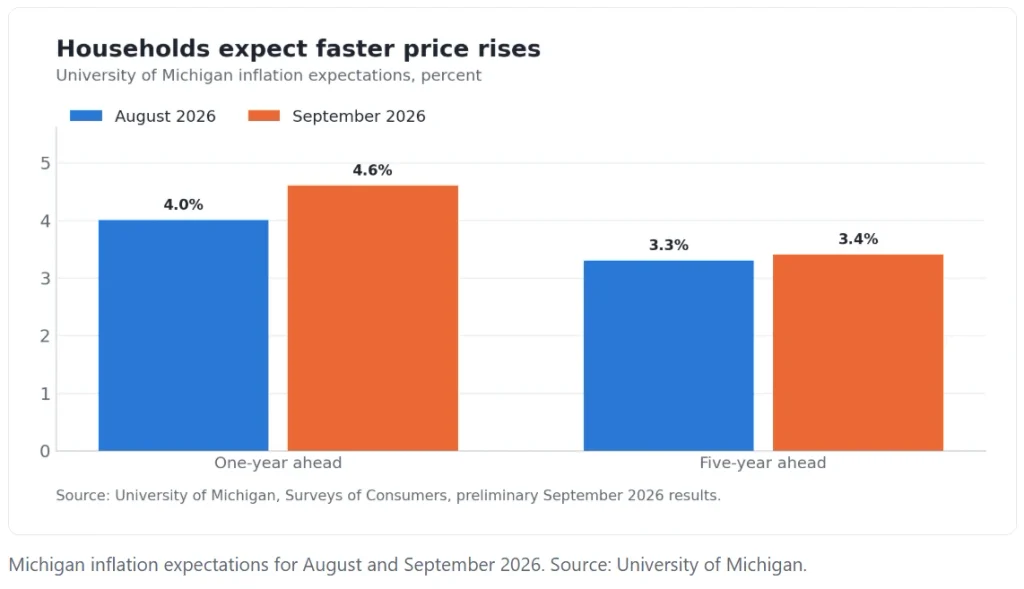
Survey director Joanne Hsu pointed to fuel costs and trade tensions. Year-ahead views on personal finances weakened sharply. Democrats and Republicans both turned gloomier, so the slide looks broad.
Why does this gap matter? Households drive roughly two-thirds of US output through their spending. Gloomy consumers eventually spend less, even while share prices climb.
Expectations also shape wage demands. Workers who expect 4.6% inflation will ask for bigger rises. Central bankers watch that loop closely because it can make high inflation stick.
The Federal Reserve now faces a hard week
Rate futures moved fast after the release. Traders had priced roughly 70% odds of a September increase beforehand. Afterwards, those odds climbed toward 90%, though such pricing reflects the market rather than official guidance.
The Federal Open Market Committee meets on 15 and 16 September. Officials last held the target range at 3.50% to 3.75%. Three of twelve voters wanted a hike even in July.
A tightening move would look unusual against weak sentiment. Yet policymakers face an awkward trade-off. Raise rates, and households feel more pain; hold steady, and inflation expectations may drift higher still.
Quarterly projections land alongside the decision. Those forecasts will show where officials expect rates to sit through 2027. Investors will read that path more carefully than the decision itself.
What to watch next
Energy remains the swing factor. The Energy Information Administration still expects Brent to average well below current spot levels next year. If that forecast holds, headline inflation should fade through 2027.
Bond yields deserve equal attention. Ten-year Treasury yields closed at 4.96% on Friday. Any push through 5% would test the equity rally quickly.
Higher yields hurt shares through two channels. They raise the cost of company borrowing, and they make safe bonds look more tempting. Equity valuations then face pressure from both sides at once.
September retail sales arrive later this month. Those figures will show whether gloomy households actually cut their spending. Weak numbers would complicate the tightening case considerably.
The bottom line for investors
Friday delivered relief rather than resolution. Inflation held steady, yet it still runs well above the 2% goal. Meanwhile, fuel costs keep the risk skewed to the upside.
Two indicators now deserve daily attention. Watch crude prices, since they drive the headline rate. Track the 10-year yield too, because it sets the discount rate for every risky asset.