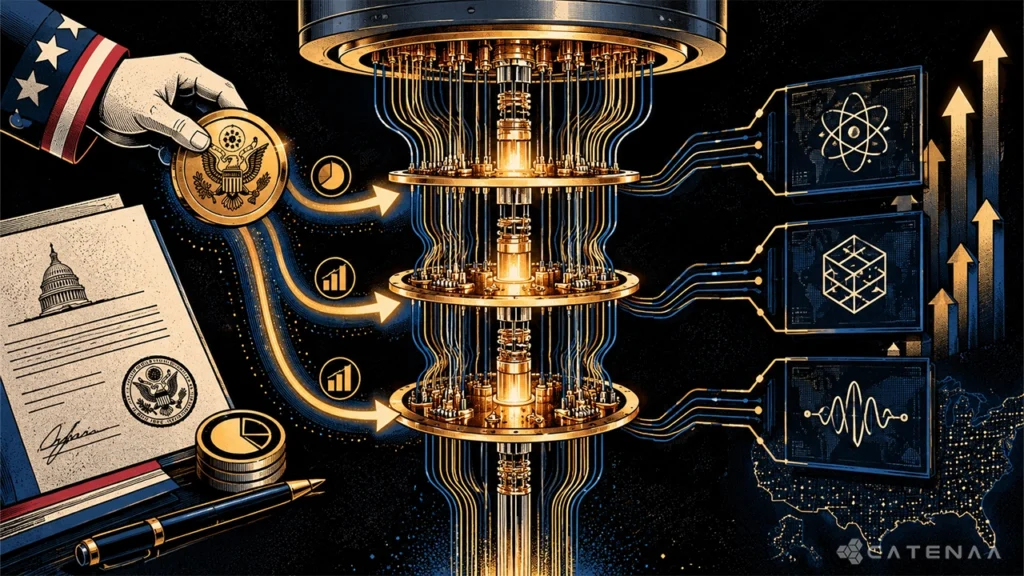


Rigetti and D-Wave issued nearly 15 million shares between them, yet most of the money still depends on milestones the government alone will judge.
In Summary
The US Commerce Department has finalised $100 million awards for Rigetti, D-Wave and Quantinuum.
Each award comes with a minority, non-controlling equity stake for the government.
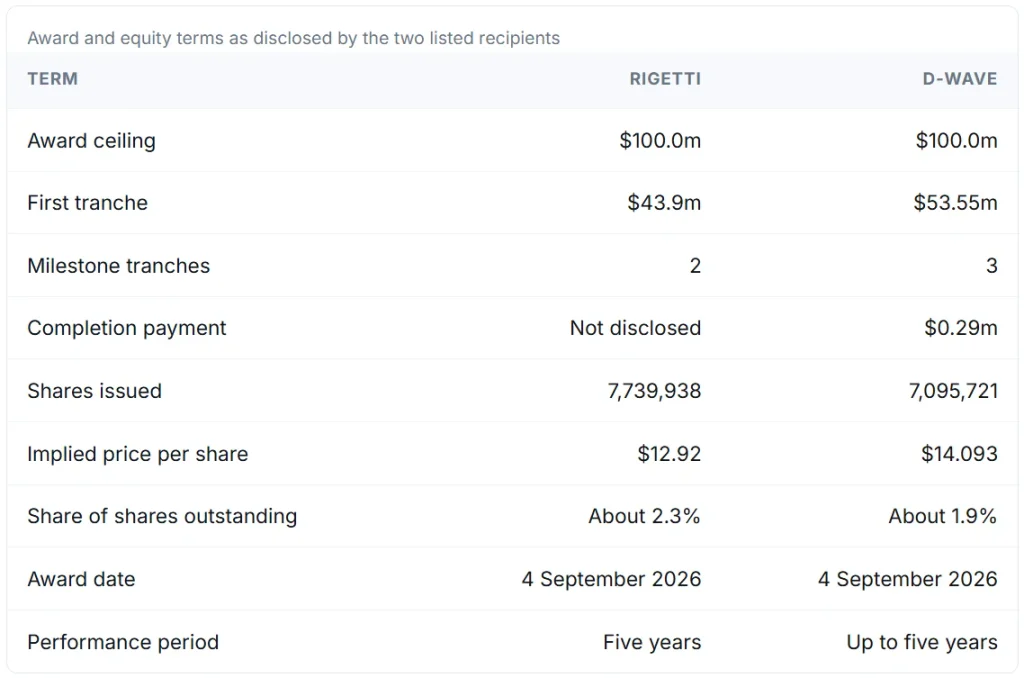
Rigetti issued 7,739,938 shares at an implied $12.92, and D-Wave issued 7,095,721 shares at $14.093.
Only part of the money arrives upfront, since later tranches depend on milestones the Department judges.
The three deals sit inside a wider $2.013 billion quantum programme covering nine companies.

Washington has taken equity in three quantum computing companies. The Commerce Department finalised awards worth up to $100 million each. Moreover, every award carries a share issuance to the government.
Rigetti Computing, D-Wave Quantum and Quantinuum signed the agreements on 4 September. All three disclosed terms four days later. Consequently, investors can now read the fine print.
The awards form part of a bigger programme
These deals did not appear from nowhere. The Department signalled its intent in May 2026. It named nine companies and set aside $2.013 billion in total.
IBM secured the largest slice at $1 billion. GlobalFoundries followed with $375 million. Six firms received $100 million each, while Diraq received up to $38 million, the Commerce Department set out in May.
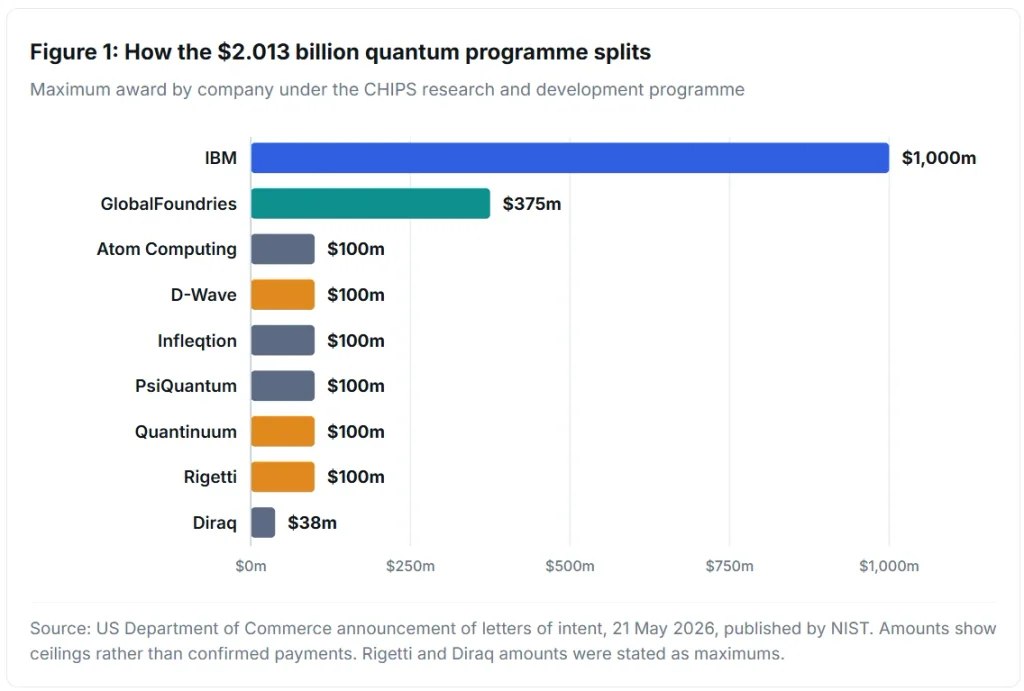
Officials framed the approach as a portfolio bet. Several quantum technologies compete for the same prize. Therefore backing one design alone would carry more risk.
The cash arrives in stages
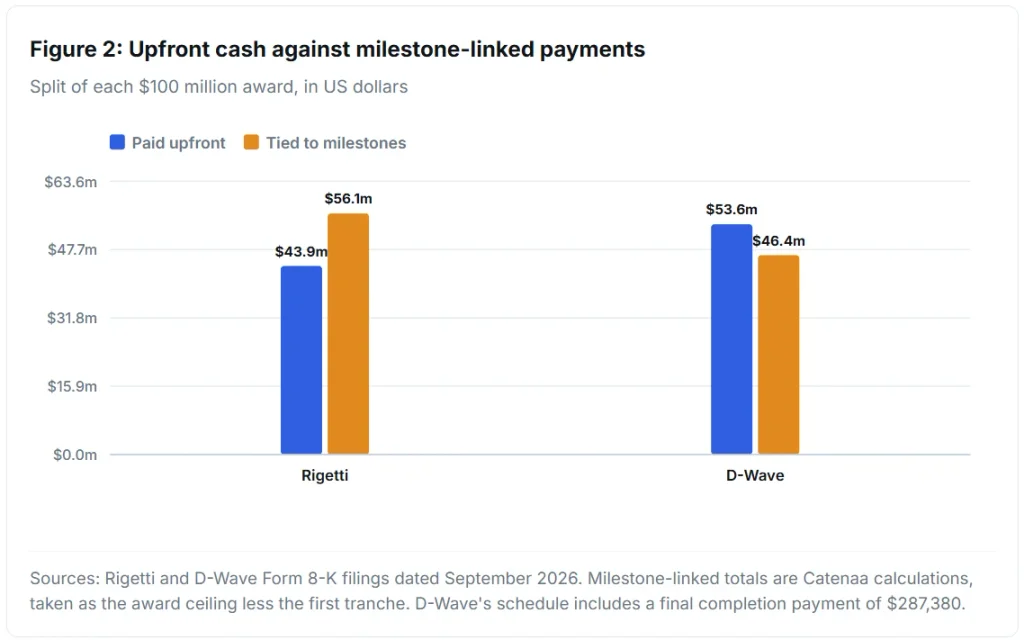
Headline numbers overstate the near-term flow. Rigetti receives $43.9 million shortly after the award date. Two later tranches of $29.9 million and $26.2 million depend on milestones.
D-Wave secured a larger opening payment. Its first tranche runs to $53.55 million. Three milestone payments follow, worth $9.08 million, $16.70 million and $20.39 million.
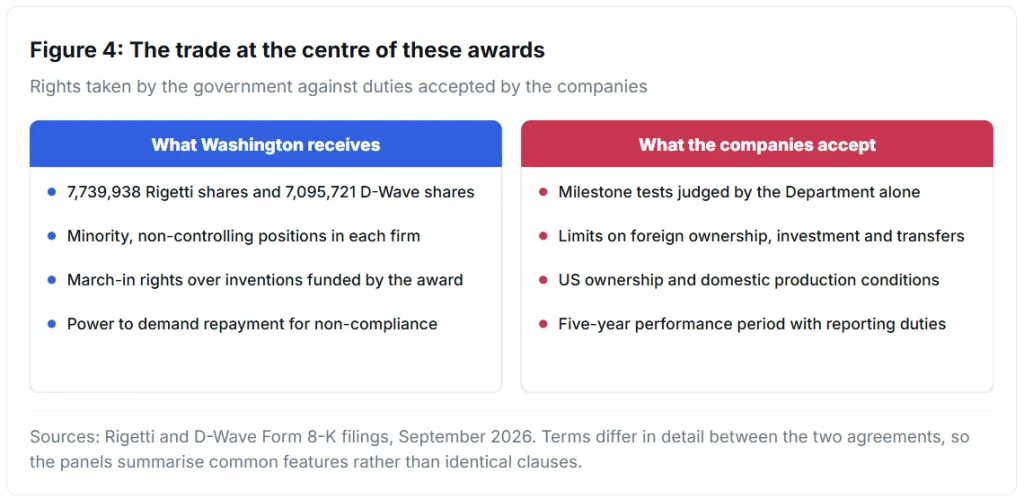
Judgement rests with the government. Rigetti’s Form 8-K filing says the Department confirms each milestone “in its sole discretion”. Hence execution risk stays with the companies.
What the money will build
Each award funds specific engineering work. Rigetti focuses on superconducting quantum processors. D-Wave pursues its own annealing and gate-model roadmap.
Quantinuum takes a third route entirely. It builds trapped-ion machines and the photonics they need. Consequently, the programme spreads bets across competing designs.
Pricing of the government stake
Share terms differ between the two listed firms. Rigetti issued 7,739,938 shares at an implied $12.92 each. That price multiplied by the share count equals the full $100 million.
D-Wave used a formula instead. It issued 7,095,721 shares at $14.093 each. The price came from the lowest reported closing price, discounted by 15%, its own filing shows.
Both stakes now sit in profit on paper. Rigetti trades near $15.24 and D-Wave near $17.12. Taxpayers therefore hold gains of roughly 18% and 21% respectively.
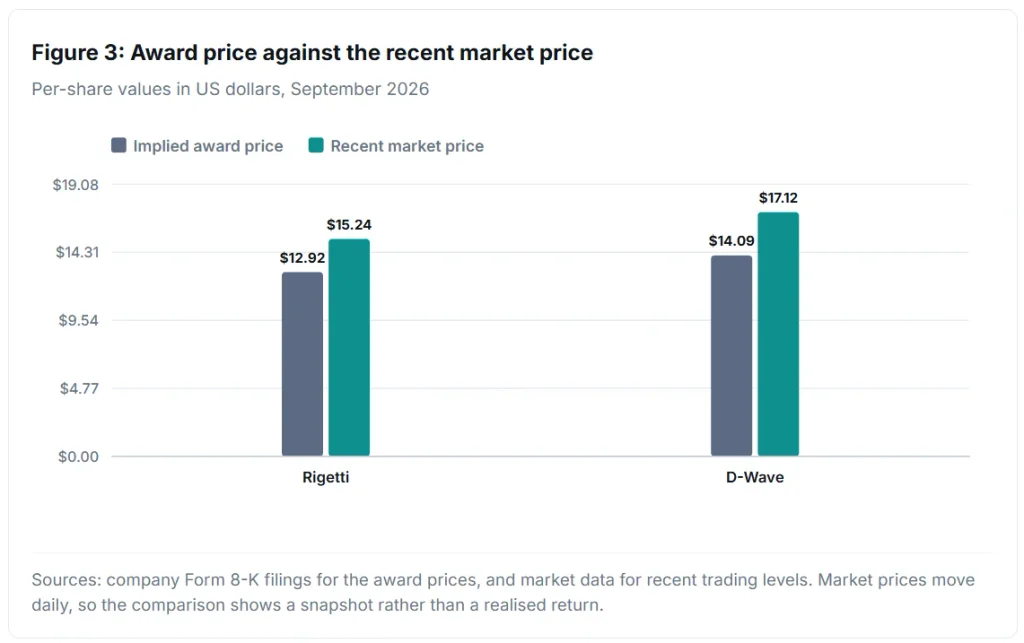
Timing shapes that comparison. Rigetti has traded between $12.53 and $58.15 over the past year. D-Wave ranged from $12.75 to $46.75 in the same period.
Dilution stays modest
Existing holders give up little on these numbers. Rigetti has about 333.8 million shares outstanding. The new block equals roughly 2.3% of that figure.
D-Wave shows a similar picture. Its share count sits near 372.4 million. Consequently the government holds about 1.9% of the company.
Markets took the news well at first. Both stocks rose on the announcement day. However, each has since given back part of that move.
Disclosure differs across the group as well. Two of the three recipients trade publicly and report results each quarter. Hence investors can track how fast those firms spend.
Strings come attached
Money arrives with conditions on both deals. Foreign investment, ownership changes and technology transfers need Department consent. Additionally, the companies accept US ownership and domestic production requirements.
Intellectual property carries its own clause. The government takes licence rights over inventions funded by the award. It also secures march-in rights, which allow intervention in limited cases.
Exit terms differ in one notable way. D-Wave may buy back the shares for $1.00 in aggregate if the Department ends the award early. That right runs for a defined window after the award period.
Why the state wants shares
Grant funding usually returns nothing to taxpayers. Equity changes that arithmetic. If the sector succeeds, the public purse shares the upside.
Critics see a different risk. State ownership can distort competition and invite political pressure. Nevertheless, the stakes remain small and carry no voting control.
Quantinuum joined the same programme on similar footing. The Department confirmed its award on 8 September, in a statement published by NIST. That award targets trapped-ion manufacturing in the United States.
The company set out its own plans alongside that news. It will build low-loss photonics and cryogenic parts at home, Quantinuum said in its release. Such work sits upstream of any working machine.
A pattern in Washington’s dealmaking
These awards follow a wider shift in policy. The state has taken equity in other strategic sectors this year. Officials argue that taxpayers deserve a share of any gains.
Quantum firms make an awkward fit for that logic. Most still earn little revenue. Furthermore, commercial advantage over classical machines remains unproven.
Precedent matters here as well. Similar equity terms now appear across several CHIPS agreements. Investors should therefore expect the structure to recur.
What to watch next
Three markers will define the outcome. First, watch whether the first milestone payments land on schedule. Second, track further finalisations among the remaining named companies.
Third, follow the share prices. Paper gains can vanish quickly in a young sector. In short, the state now owns a slice of a very volatile trade.