

June 03, 2026 – Banks stand to collect $500 million at a record-low rate. The world’s most anticipated public offering is rewriting Wall Street’s pricing rules.

In Summary
SpaceX targets underwriting fees below 0.75% on a $75 billion IPO raise, per Bloomberg News.
Wall Street banks still expect to collect roughly $500 million in absolute fees from the deal.
Goldman Sachs and Morgan Stanley co-lead a 23-bank underwriting syndicate.
The Nasdaq roadshow begins June 4, with listing on June 12 under ticker SPCX.
SpaceX’s $1.75 trillion target valuation would surpass Saudi Aramco’s 2019 IPO record.
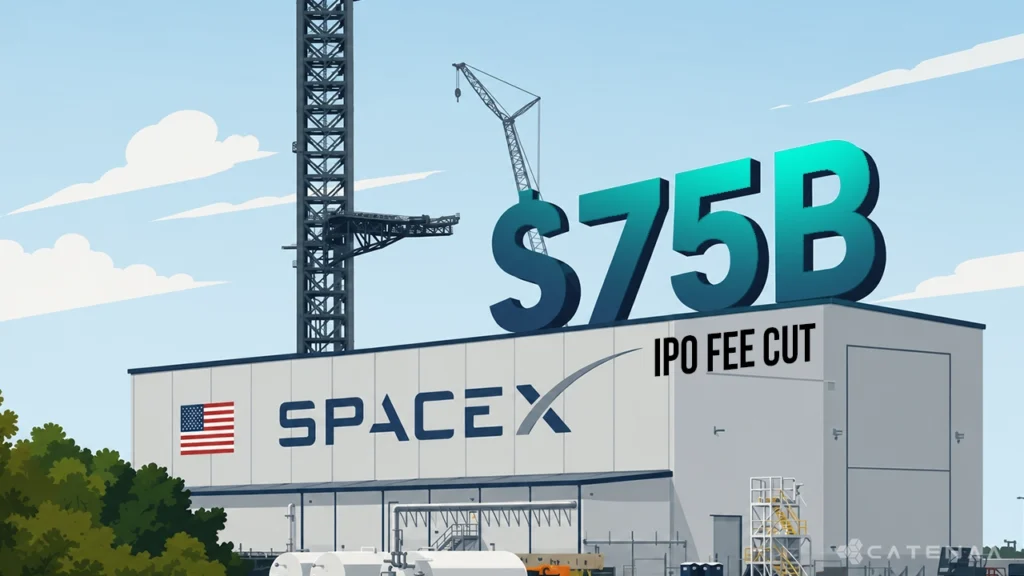
SpaceX is squeezing Wall Street ahead of its historic public debut. Bloomberg News reported on June 2 that the company is negotiating underwriting fees below 0.75%. The targeted raise is roughly $75 billion. Banks will still earn around $500 million from the deal. That sum ranks among the largest fee events in IPO history.
The Fee Structure Decoded
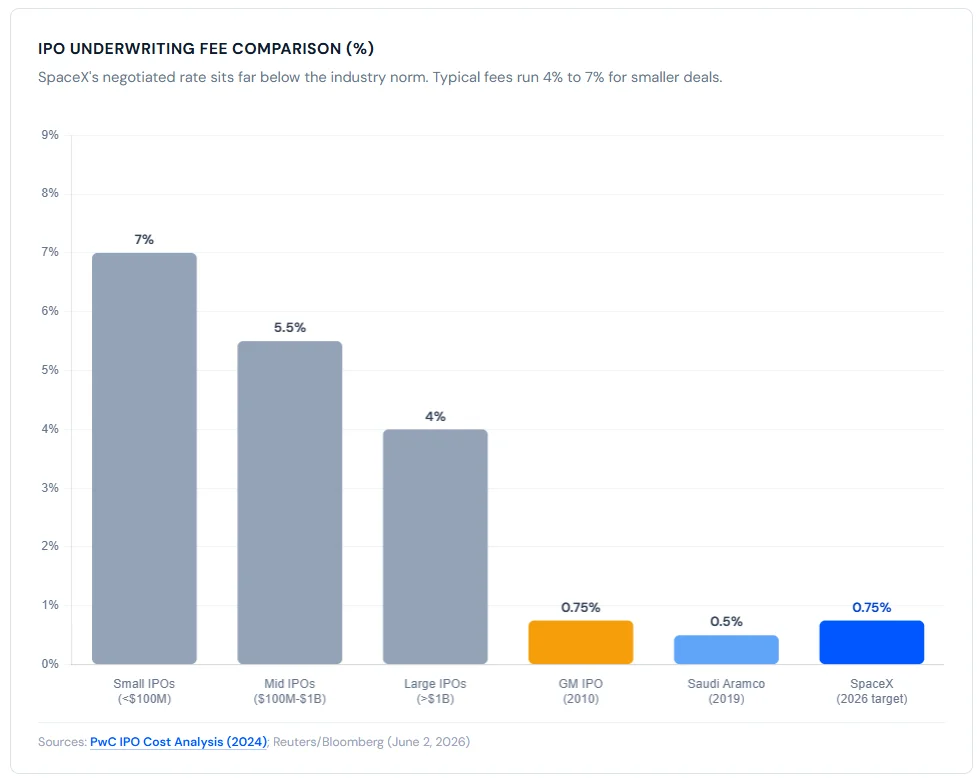
Standard underwriting fees run between 4% and 7% of gross IPO proceeds, according to PwC’s analysis of 1,300 company filings. SpaceX’s proposed rate sits dramatically below this range. However, the sheer size of the company’s deal flips the math firmly in banks’ favor.
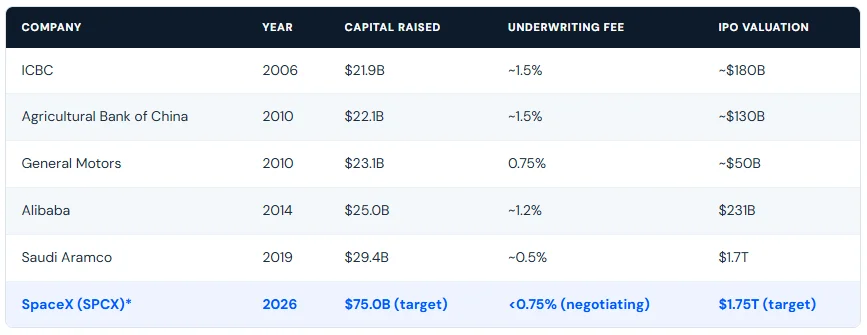
At exactly 0.75% of $75 billion, the fee pool reaches $562.5 million. SpaceX is pushing to negotiate an even lower rate than that. Nevertheless, even a sub-0.75% outcome still produces an extraordinary absolute payout.
For comparison, General Motors’ 2010 IPO established a similar precedent. The U.S. government negotiated a 0.75% fee from banks on the sale of that common stock. SpaceX appears set to break even that benchmark. Furthermore, these figures represent only the base fee. Discretionary incentive payments remain separate from the reported calculations.
The precedent matters beyond SpaceX itself. Future mega-IPOs will likely cite SpaceX’s negotiations as a new benchmark. Saudi Aramco’s 2019 listing redefined what a large IPO could raise. SpaceX now redefines what a large IPO will cost to underwrite.
Inside the Banking Syndicate
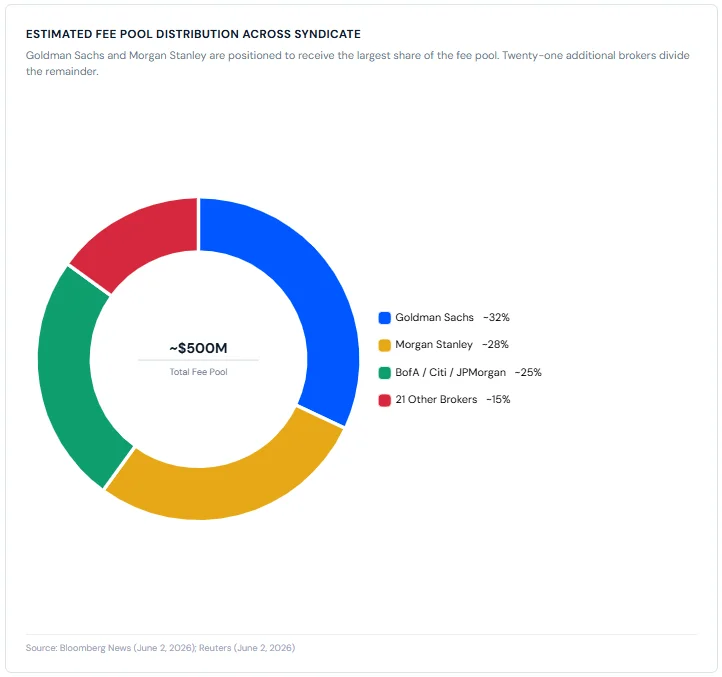
Goldman Sachs and Morgan Stanley serve as co-lead managers for the deal. They will capture the largest share of the total fee pool among all 23 participating banks. Bank of America Securities, Citigroup, and JPMorgan act as joint book-running managers.
Together, these five banks anchor a broader syndicate of 21 additional brokers. The smaller banks split the remaining portion of the fee pool. Furthermore, the reported figures cover only the base underwriting fee. Discretionary incentive payments are excluded from these calculations. Neither SpaceX nor Goldman Sachs commented when contacted by Reuters.
IPO Timeline and Valuation
SpaceX filed its public S-1 registration with the SEC on May 20, 2026. The investor roadshow begins June 4, with pricing scheduled for June 11. Nasdaq listing targets June 12 under ticker SPCX.
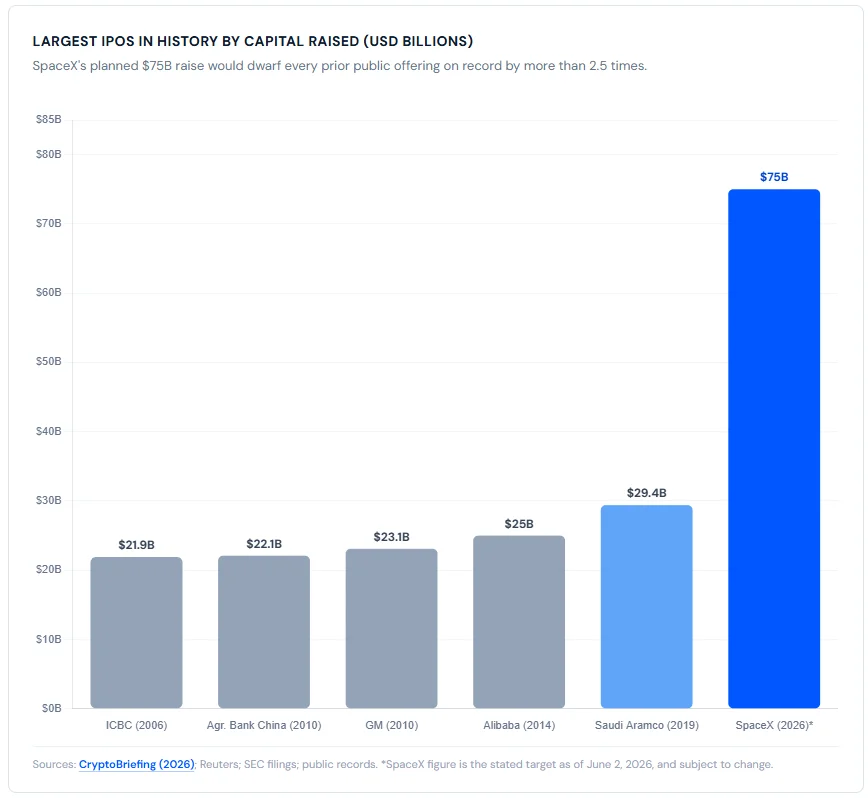
The company aims for a $1.75 trillion valuation, including the greenshoe option. That figure would place SpaceX among the world’s most valuable public companies from day one. Additionally, a $75 billion raise would more than double Saudi Aramco’s 2019 record of $29.4 billion. Therefore, SpaceX would shatter every prior IPO record by a considerable margin.
Data Point
At 0.75% of a $75 billion offering, the total fee pool reaches $562.5 million. SpaceX is pushing to go even lower. Even at a lower rate, the absolute dollar payout would rank among Wall Street’s largest-ever from a single public offering.
The xAI merger in February 2026 valued the combined entity at roughly $1.25 trillion. The IPO target range now sits at $1.75 trillion to $2 trillion. That represents more than double the December 2025 tender offer valuation in under six months. Growth at this pace is extraordinary by any public market benchmark.
The IPO will give Elon Musk full voting control through a dual-class share structure. Notably, Musk will not sell a single share in the offering. Therefore, all proceeds flow directly to the company’s expansion programs.
What Banks Risk vs. What They Gain
Compressed margins create pressure across the entire syndicate. However, the absolute dollar value still makes this one of Wall Street’s most lucrative mandates. Participation builds long-term relationships with SpaceX’s leadership team. Moreover, the greenshoe option could expand the offering size and further boost total fees.
SpaceX commands this pricing power for specific reasons. Its deal size is simply too large to ignore. Banks therefore face a straightforward calculation: accept thin margins on a record-breaking deal. The alternative is missing out on the decade’s most prestigious transaction entirely. Few institutions will choose to sit out.
Why This IPO Matters
SpaceX is no longer just a rocket company. It merged with xAI in February 2026, creating a combined space and AI conglomerate. Starlink has surpassed 9 million subscribers, with projected 2025 revenue of $15-$16 billion. Consequently, SpaceX’s business spans aerospace, telecommunications, and artificial intelligence.
Retail investors have never had direct access to a company at this scale. Furthermore, the IPO wave that SpaceX leads includes Anthropic, which is targeting a public debut by October 2026. Together, these listings could push new market capitalizations beyond $4 trillion. The stakes extend well beyond a single company going public. SpaceX’s listing marks a genuine turning point for public markets globally.