

August 22, 2026 – The Spanish lender now runs a $327 billion US bank. Management has promised an 18% return on tangible equity by 2028.
In Summary
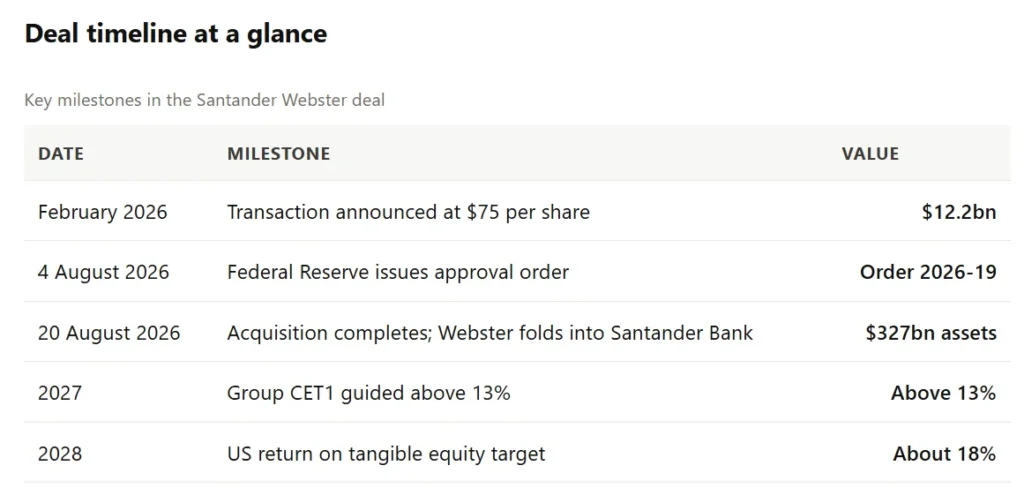
Santander completed its $12.2 billion purchase of Webster Financial on 20 August 2026.
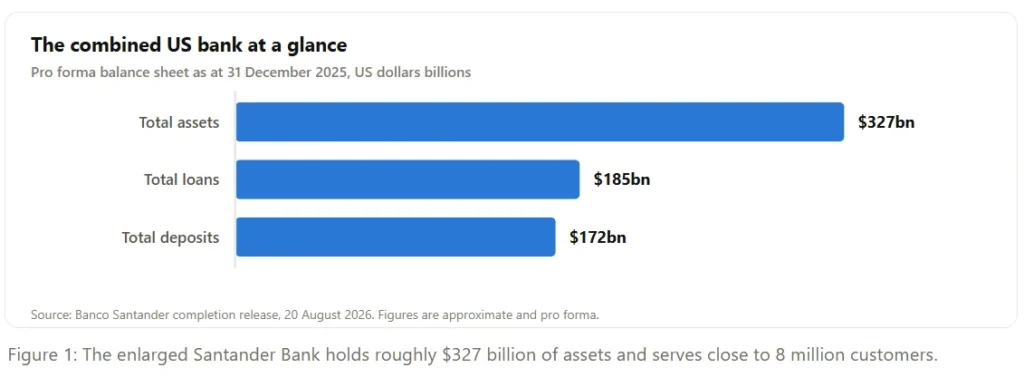
The combined US bank holds about $327 billion in assets, $185 billion in loans, and $172 billion in deposits.
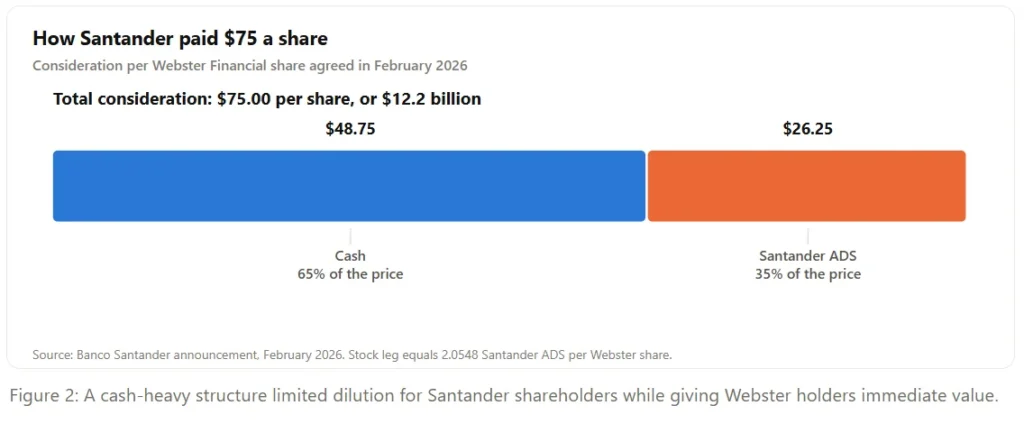
Shareholders received $48.75 in cash and $26.25 in Santander shares for each Webster share.
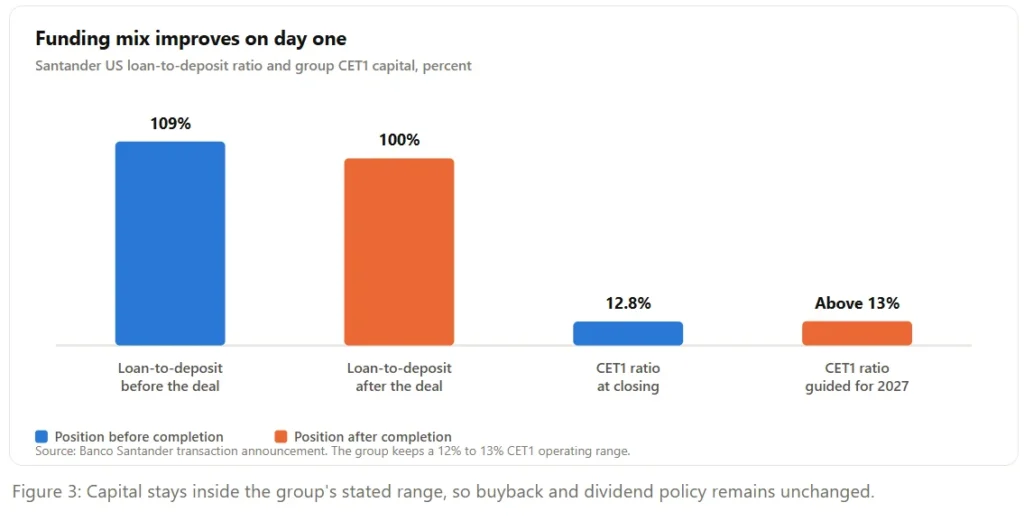
The loan-to-deposit ratio improves from 109% to roughly 100%, which lowers funding costs.
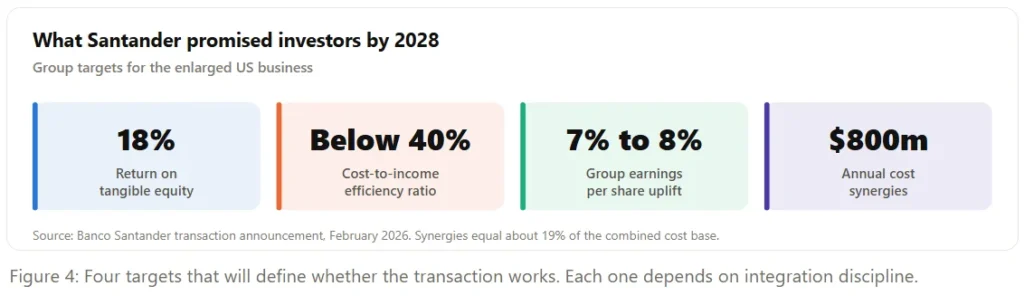
Santander targets an 18% US return on tangible equity and $800 million of annual cost savings by 2028.
The Santander Webster deal reaches the finish line
The Santander Webster deal is now done. It is the biggest US purchase in the group’s history. The Spanish group completed its purchase of Webster Financial on 20 August. The agreed price was $12.2 billion, or $75 per Webster share.
Furthermore, the deal reshapes a franchise that has often frustrated investors. Santander has operated in the United States for decades, yet returns have lagged its Latin American and European units. Management now has the scale it lacked.
How the price was structured
In practice, Santander split the consideration. Shareholders received $48.75 in cash and 2.0548 Santander ADS worth $26.25 for each Webster share. Cash therefore covered 65% of the total.
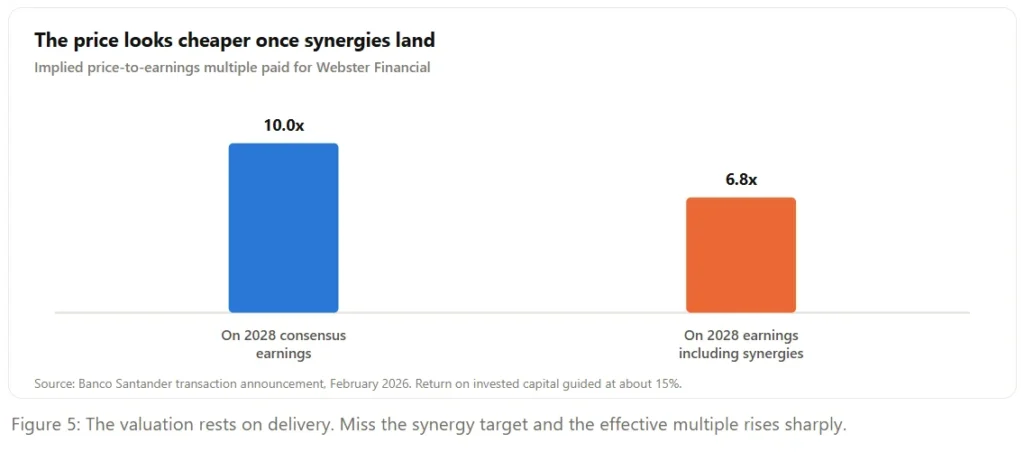
The offer carried a 14% premium to Webster’s three-day volume-weighted average price of $65.75. Moreover, the bank valued the target at about 10 times consensus 2028 earnings. Including planned synergies, the multiple drops to 6.8 times.
The problem the Santander Webster deal solves
Santander’s US arm has long carried an awkward balance sheet. Loans ran well ahead of deposits, so funding cost too much. Webster brings a large base of business deposits.
As a result, the loan-to-deposit ratio falls from 109% to roughly 100%. That shift matters more than the headline asset number. Cheaper funding feeds straight into the margin on lending.
Targets that management must now hit
Meanwhile, Santander has set a clear bar. It wants a return on tangible equity of about 18% in the United States by 2028. It also targets an efficiency ratio below 40% over the same period.
Crucially, cost synergies of roughly $800 million a year underpin those goals. That figure equals about 19% of the combined cost base, which is ambitious but not unusual for an in-market deal. Group earnings per share should rise 7% to 8% by 2028.
Regulators cleared the path in August
The Federal Reserve approved the application on 4 August under Order No. 2026-19. Shortly afterwards, the remaining conditions fell away. Completion arrived roughly six months after the February announcement.
Such speed is notable. Big bank mergers in the United States often stall for a year or more. The timetable therefore points to a warmer stance on deals among mid-sized lenders.
What it means for customers and rivals
Today, roughly 8 million customers sit inside one bank. They can use either ATM network at no cost. Branch brands will merge over time, and Webster signs will come down.
Meanwhile, rivals face a bigger local player in the northeast. Santander can now bid for larger business loans. It can also spread technology spending across a much wider base.
Yet scale alone rarely wins. Service quality decides whether business clients stay. Small firms move money fast when they feel ignored.
Leadership and the integration test
John Ciulla, previously Webster’s chief executive, now runs Santander Bank. Likewise, familiar faces stay in place elsewhere. Christiana Riley remains the country head for the United States. Luis Massiani takes the chief operating officer role across both entities.
Riley called the completion “a pivotal moment in Santander’s long journey in the United States”. Ciulla said the combination lets the bank “deepen our local relationships” with global support behind it.
In addition, Stamford, Connecticut, becomes a US corporate hub alongside Boston, New York, Miami and Dallas. Customers of both banks can already use either ATM network without fees.
What to watch from here
Merger risk now drives the story. Keeping deposits is the first test, because business clients often move after a change of owner. Systems work follows.
Therefore, investors should track three numbers in coming quarters. First, the deposit balance. Second, the reported efficiency ratio. Third, realised cost savings against the $800 million plan. Those figures will show whether the price paid was fair.
The next scheduled update comes with group results. Until then, the 18% goal remains a promise rather than a record.




