


September 02, 2026 – An Overweight upgrade puts Robinhood back on the buy side of Wall Street research. The thesis rests on product breadth, not on trading volumes.
In Summary
Morgan Stanley analyst Mike Cyprys moved Robinhood to Overweight from Equal-Weight.
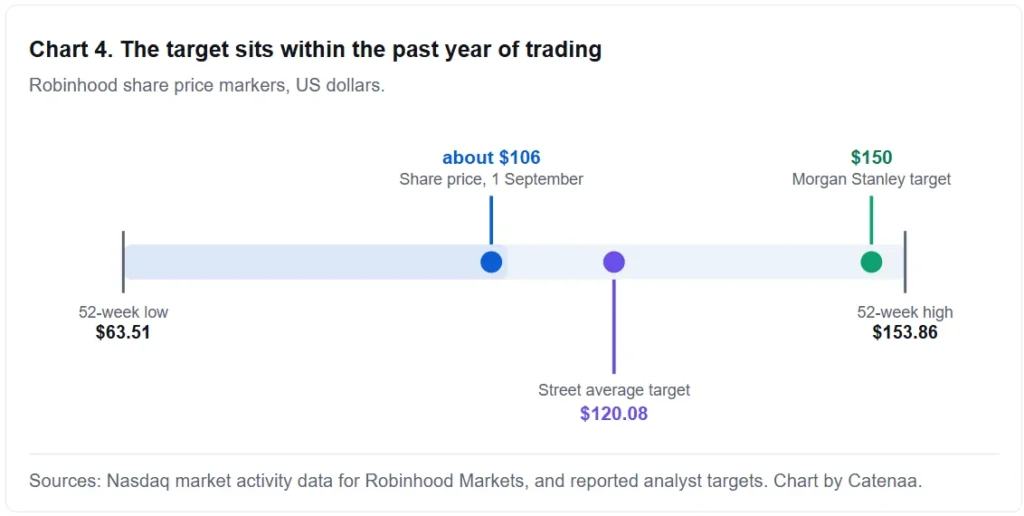
His price target rose to $150 from $124, roughly 41 percent above the early-September share price.
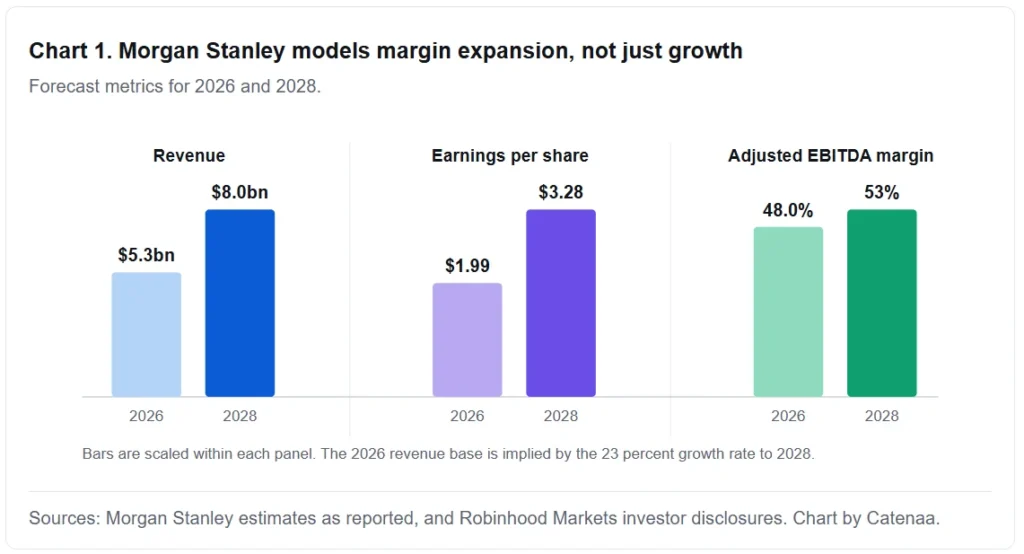
The bank models a 23 percent revenue compound growth rate to $8.0 billion by 2028.
Second-quarter net revenues reached $1.31 billion, up 32 percent from a year earlier.
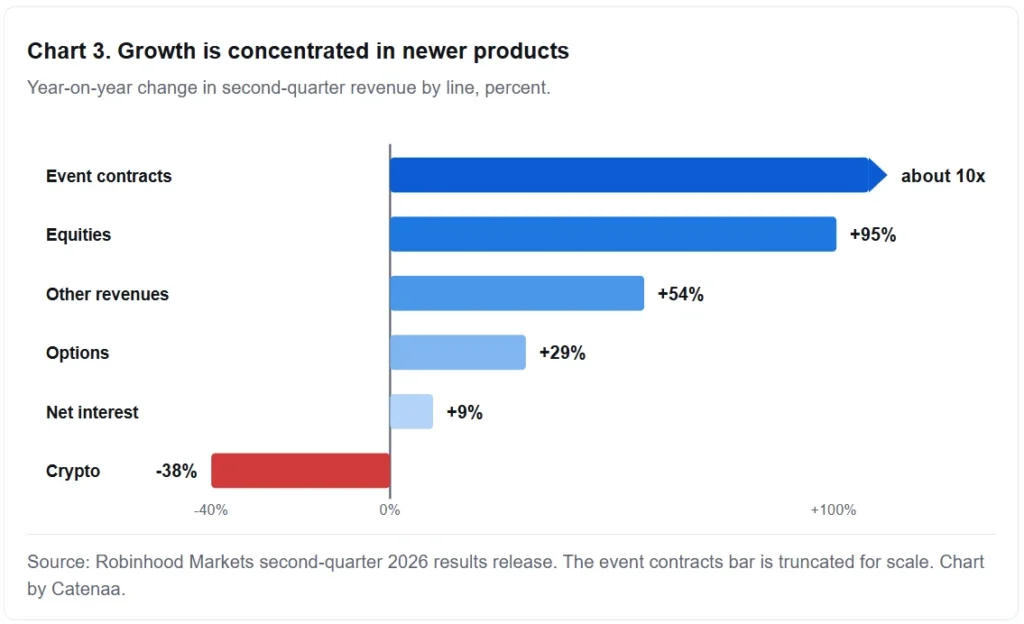
Event contracts delivered $156 million, roughly ten times the prior-year figure.
Robinhood shares gained ground on Tuesday after a rare research reversal. Morgan Stanley raised the stock to Overweight. Mike Cyprys, who covers brokers at the bank, lifted his target to $150 from $124. Shares traded near $106 in early New York dealings.
Timing looks notable. The stock had fallen about 10 percent this year before the call. Sentiment, therefore, had already cooled. Upgrades into weakness often carry more information than upgrades into strength.
What the upgrade actually claims
Cyprys builds his case on operating leverage rather than market share. He models revenue growth of 23 percent a year through 2028. Expenses, by contrast, grow at 14 percent. That gap widens the adjusted EBITDA margin from 48.0 percent in 2026 to about 53 percent in 2028.
Earnings compound faster still. His estimates imply a 28 percent annual rise in earnings per share. Forecast profits move from $1.99 to $3.28 across the period.
The quarter that set up the call
Robinhood published second-quarter results on 29 July 2026. Total net revenues hit $1.31 billion, a 32 percent annual gain. Net income reached $573 million, up 48 percent. Adjusted EBITDA came in at $741 million.
Balance-sheet momentum matched the income statement. Total platform assets closed at $369 billion, up 32 percent. Net deposits of $21.7 billion implied a 28 percent annualised growth rate. Funded customers reached 28.4 million.
The revenue mix has changed shape
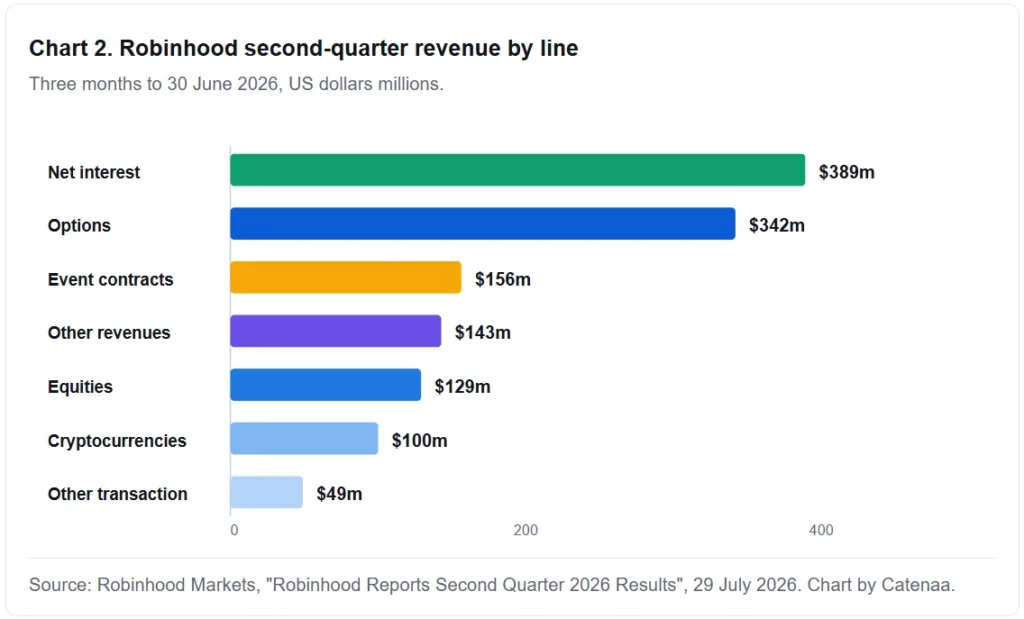
Transaction revenues of $776 million rose 44 percent. Options remained the largest single line at $342 million. Net interest income contributed $389 million, and other revenues added $143 million. Robinhood Gold subscribers climbed 39 percent to 4.8 million.
Newer products drive the growth
One line dominates the growth story. Event contracts generated $156 million, about ten times the prior-year total. Equities revenue nearly doubled, rising 95 percent to $129 million. Meanwhile, options grew by a steady 29 percent.
Diversification now looks real. Management says 13 business lines each exceed $100 million in annualised revenue. Average revenue per user climbed 24 percent to $187.
The platform story behind the numbers
Scale increasingly does the work. Total platform assets of $369 billion give the firm a larger interest-earning base. Net deposits of $21.7 billion show customers are still funding accounts. Moreover, average revenue per user rose faster than customer count.
That combination matters for margins. Adding revenue per existing customer costs far less than acquiring new ones. Consequently, the expense growth assumption of 14 percent looks defensible.
Crypto turned into a drag
Not every engine fired. Cryptocurrency transaction revenue fell 38 percent to $100 million. Retail crypto activity cooled through the first half of 2026. Robinhood, however, kept growing overall because other lines absorbed the shortfall.
That substitution effect underpins the bull case. A brokerage with one revenue engine deserves a cyclical multiple. Thirteen engines justify a higher one, provided the mix holds.
Why the street had turned cautious
Analyst opinion had drifted lower through 2026. The average target across covering brokers sits near $120.08. Individual estimates range widely, from $57 to $163.60. Such dispersion signals genuine disagreement about the business model.
Bears point to cyclicality. Retail brokers earn the most when volatility runs hot, and calm markets hurt them quickly. Bulls counter that subscription and interest income now smooth the cycle. Robinhood Gold, for instance, produces recurring fees regardless of trading activity.
The valuation arithmetic
Cyprys reaches $150 through a long-dated model. He applies a 25-times multiple to probability-weighted 2031 earnings of $7.99. That multiple sits about 19 percent below the 2027 rating on Interactive Brokers, at 30.8 times.
Context helps here. Robinhood carries a market value near $92 billion and trades at roughly 45 times trailing earnings. Its 52-week range spans $63.51 to $153.86, so the new target sits inside prior trading history. Reaching the target would still leave the stock below its own record high.
Risks to the thesis
Regulation heads the list. Event contracts sit in a contested legal area across several jurisdictions. An adverse ruling would remove the fastest-growing line. Furthermore, net interest income depends on the policy rate path.
Rate cuts would compress that $389 million quarterly contribution. Retail engagement also swings with volatility. Quiet markets historically reduce options volumes, which still drive the largest transaction line.
What to watch next
Third-quarter results arrive later this year and will test the growth curve. Investors should track event contract revenue, Gold subscriber additions, and crypto stabilisation. Vlad Tenev, the chief executive, argues the firm keeps “capturing a larger share of our customers’ overall financial lives”. Evidence for that claim now needs another quarter.