


September 01, 2026 – The chip designer will adopt NVLink Fusion for custom AI accelerators. Shares in the US chipmaker fell 4.57% as investors questioned circular financing.
In Summary
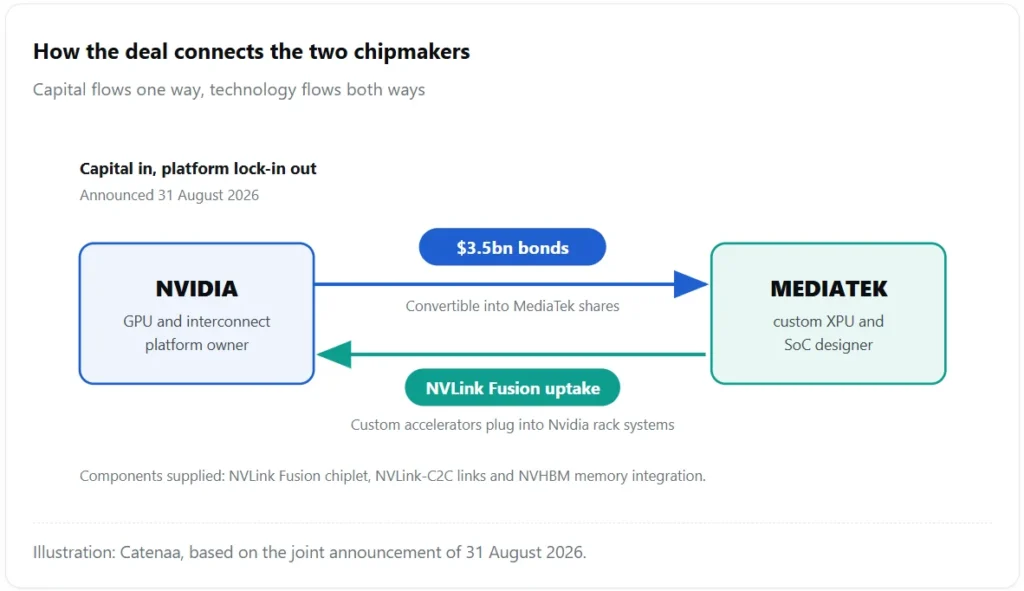
Nvidia bought $3.5 billion of convertible bonds issued by Taiwan’s MediaTek.
MediaTek will build custom AI accelerators on Nvidia’s NVLink Fusion platform.
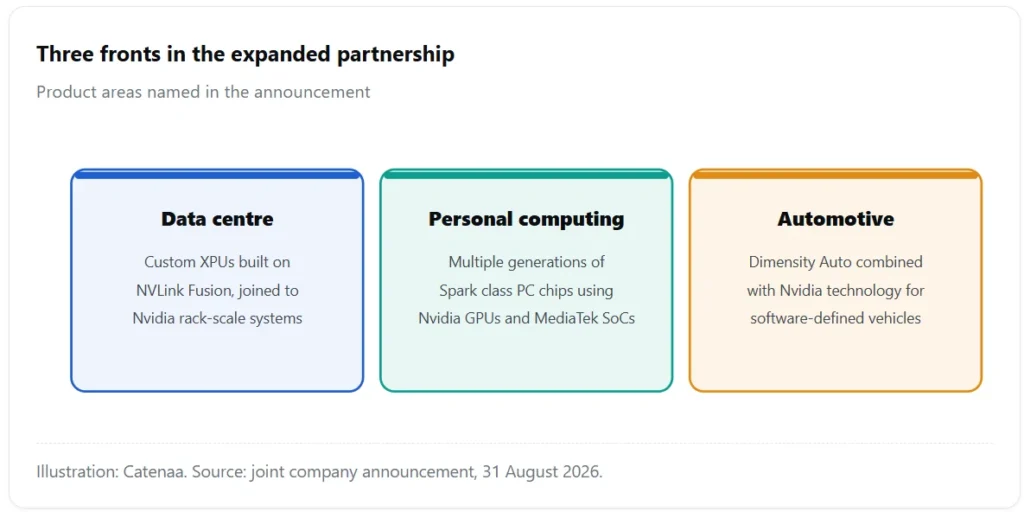
The partnership spans data centres, personal computers and vehicle platforms.
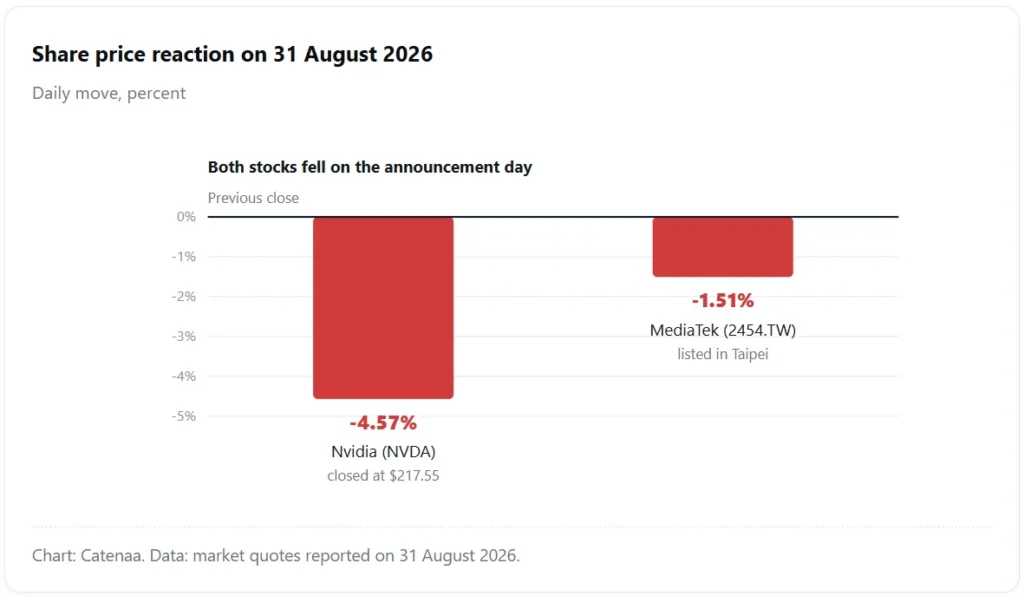
Nvidia stock fell 4.57% to $217.55, while MediaTek slipped 1.51%.
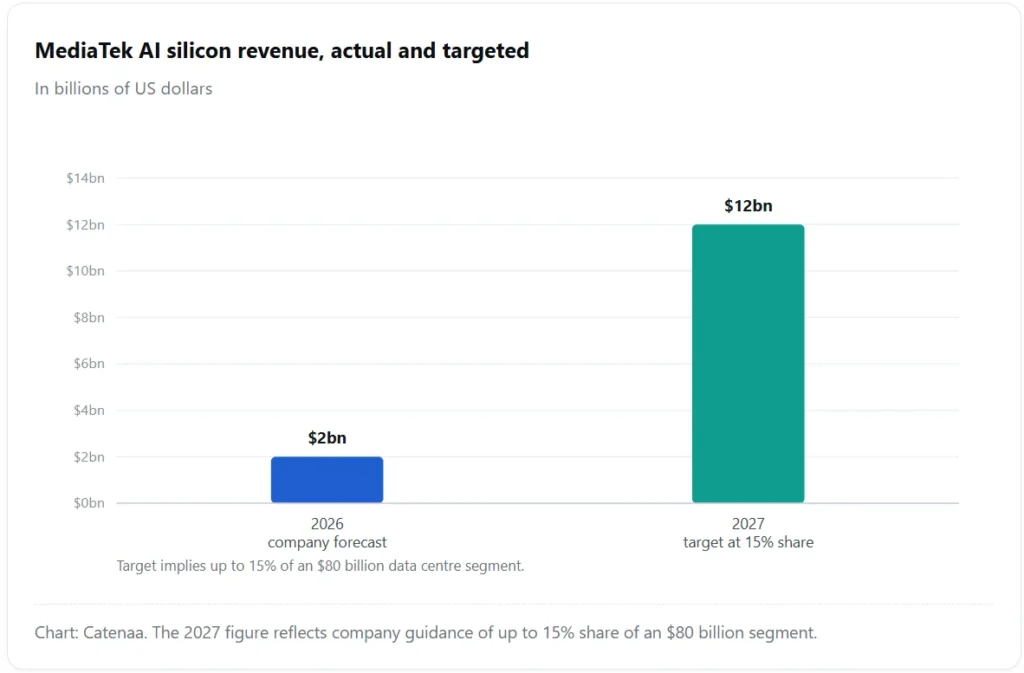
MediaTek targets up to 15% of an $80 billion data centre segment in 2027.
Nvidia has deepened its grip on the AI hardware chain. The company invested $3.5 billion in convertible bonds issued by MediaTek, the two firms confirmed on 31 August 2026. That instrument converts into MediaTek shares under agreed terms.
Convertible debt gives Nvidia optional equity exposure without an immediate stake. Meanwhile, MediaTek gains long-dated capital at a moment of heavy investment. Both sides, therefore, share the upside of a custom silicon boom.
NVLink Fusion sits at the centre
MediaTek will use NVLink Fusion as a design foundation for custom AI accelerators. The platform supplies a chiplet that links customer-designed XPUs to Nvidia’s scale-up fabric. It also provides NVLink-C2C connectivity and NVHBM memory integration.
That architecture matters commercially. Cloud operators increasingly want their own accelerators. However, they still need a high-bandwidth fabric to connect thousands of chips into a single system. Nvidia now sells that fabric to the very customers designing alternatives to its GPUs.
“AI is transforming every computing platform,” said Nvidia founder and chief executive Jensen Huang. He pointed to AI factories, the personal computer, and the car. MediaTek chief executive Rick Tsai described a shared vision for pervasive AI computing.
Personal computing and vehicles join the plan
The two companies will build several generations of Spark class PC chips. These parts pair Nvidia GPUs with MediaTek system-on-chip designs for local AI workloads. Consequently, MediaTek moves further into premium Windows and workstation silicon.
Automotive forms the third pillar. MediaTek’s Dimensity Auto platform will combine with Nvidia technologies for software-defined vehicles. Carmakers increasingly buy compute platforms rather than discrete controllers.
Why the market reacted badly
Investors did not celebrate. Nvidia stock fell 4.57% to $217.55 on the day, while MediaTek eased 1.51% in Taipei, market data showed.
The concern centres on circular financing. Nvidia keeps funding partners that then buy or enable Nvidia technology. Critics argue this practice flatters demand signals across the AI supply chain. Supporters counter that the capital secures scarce engineering capacity.
MediaTek’s data centre ambition
MediaTek has been rerated sharply this year. Its market value roughly tripled in recent months, the Taipei Times reported. The company forecasts about $2 billion of AI chip revenue in 2026.
Management targets as much as 15% of an $80 billion data centre segment next year. That share would imply roughly $12 billion of revenue. Such a jump would reshape the company’s earnings mix.
What it means for the AI supply chain
Custom silicon is no longer a threat sitting outside Nvidia’s business. Instead, Nvidia now monetises interconnect, memory integration and rack systems around rival accelerators. NVLink technology therefore becomes a toll road for the wider market.
Two risks deserve attention. First, convertible structures can dilute existing MediaTek holders on conversion. Second, regulators in several markets continue to study vendor financing across the AI sector.
For now, the message is straightforward. Nvidia wants a position in every rack, laptop and car that runs AI workloads.




