

July 22, 2026 – The global FX market is entering a decisive phase as central banks follow sharply different paths. The dollar remains dominant, yet euro, sterling, and yen moves show growing resistance to simple rate-driven trades.
In Summary
The dollar stays supported by high US rates, but recent gains remain uneven across major currencies.
The euro faces a near-term test as markets assess whether tighter policy can offset weaker growth.
The yen remains vulnerable despite a higher Japanese policy rate, because the US yield gap stays wide.
Hedging demand is rising as companies manage energy shocks, tariffs, and policy uncertainty.
Dollar strength becomes more selective
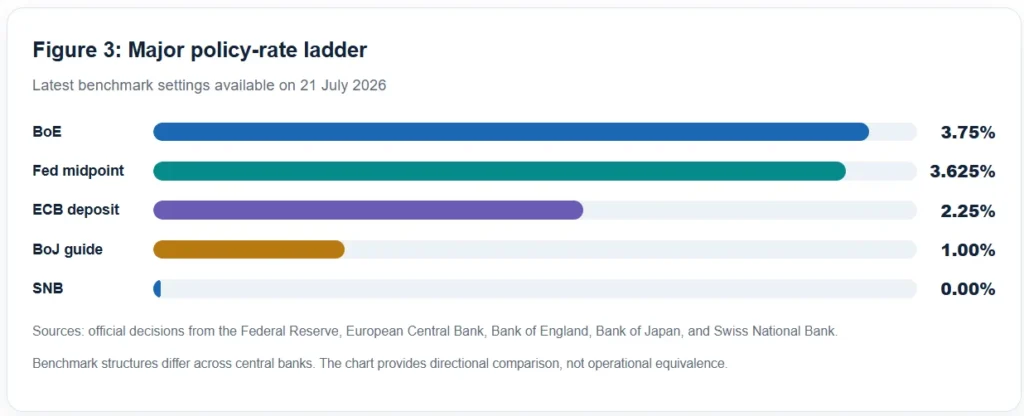
The Federal Reserve kept its target range at 3.50% to 3.75% in June. Officials also said inflation remained above their 2% goal. Therefore, the dollar still offers a strong yield advantage against several developed currencies.
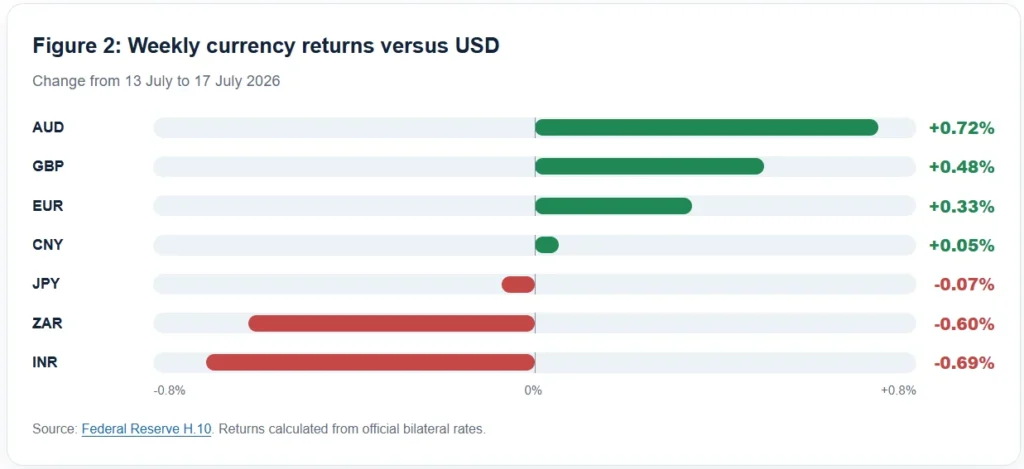
However, the latest price action lacks a single direction. The Federal Reserve broad dollar index closed at 120.5315 on July 17. During that week, the euro gained 0.33% against the dollar. Sterling rose 0.48%, while the Australian dollar climbed 0.72%.
By contrast, the yen slipped 0.07%. The Indian rupee lost about 0.69%, and the South African rand fell 0.60%. These moves show a market trading local risks, not only the dollar cycle.
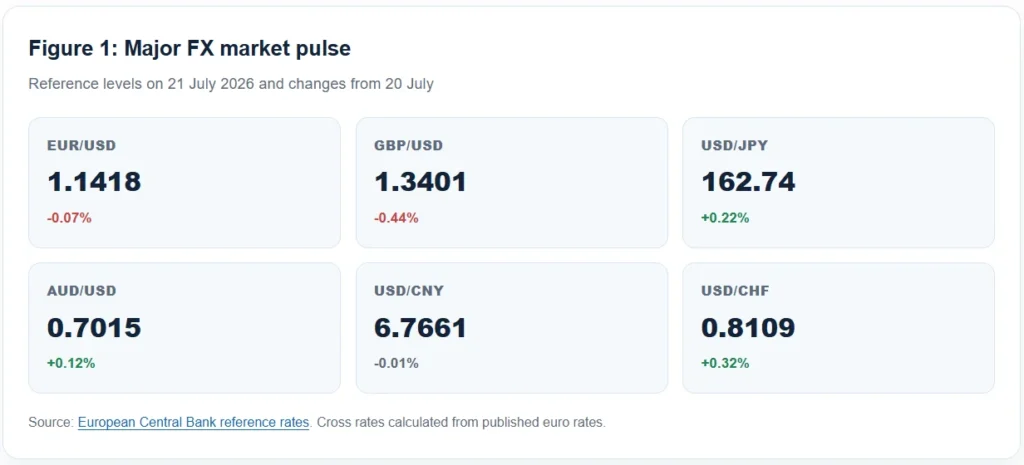
On July 21, the euro traded at $1.1418. Sterling stood near $1.3401, while one dollar bought about 162.74 yen. The dollar also traded near 6.766 yuan and 0.811 Swiss francs.
Policy divergence now drives the map
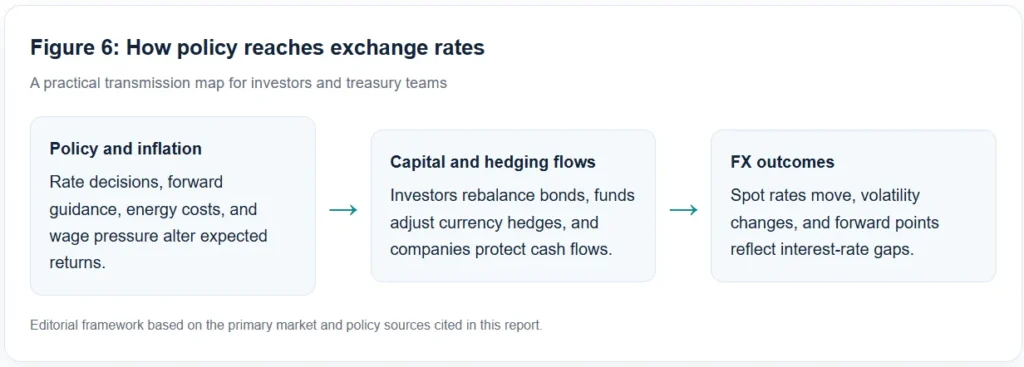
Interest-rate gaps remain the clearest guide for the global FX market. Yet traders focus on expected policy changes, not current rates alone.
The European Central Bank raised its deposit rate to 2.25% in June. It cited inflation pressure linked to the Middle East energy shock. That decision narrowed the gap with US rates and gave the euro some support.
The Bank of England kept Bank Rate at 3.75%. However, two committee members preferred a 4% rate. That split signals persistent inflation concern and supports sterling during risk-friendly sessions.
Japan moved in the opposite direction from its old ultra-low-rate framework. The Bank of Japan raised its overnight call-rate guide to around 1.0%. Even so, the gap with the Fed midpoint remains about 2.63 percentage points.
Switzerland presents another contrast. The Swiss National Bank kept its policy rate at 0%. It also retained a willingness to counter excessive franc appreciation through market intervention.
Euro and yen carry different risks
The euro benefits when investors expect tighter European policy. However, expensive energy can weaken growth and worsen the region’s trade balance. This creates a difficult mix for the currency.
The next euro move will depend on inflation language, growth signals, and energy prices. A firm policy message could support $1.15. Softer guidance could return attention to the US yield advantage.
The yen faces a different problem. Higher Japanese rates have not closed the yield gap quickly enough. Moreover, Japan imports large amounts of energy, making oil shocks important for its currency.
Still, crowded yen shorts create reversal risk. Faster Japanese tightening or weaker US data could trigger rapid position unwinding. Therefore, yen weakness should not be treated as a one-way trade.
A larger and more complex market
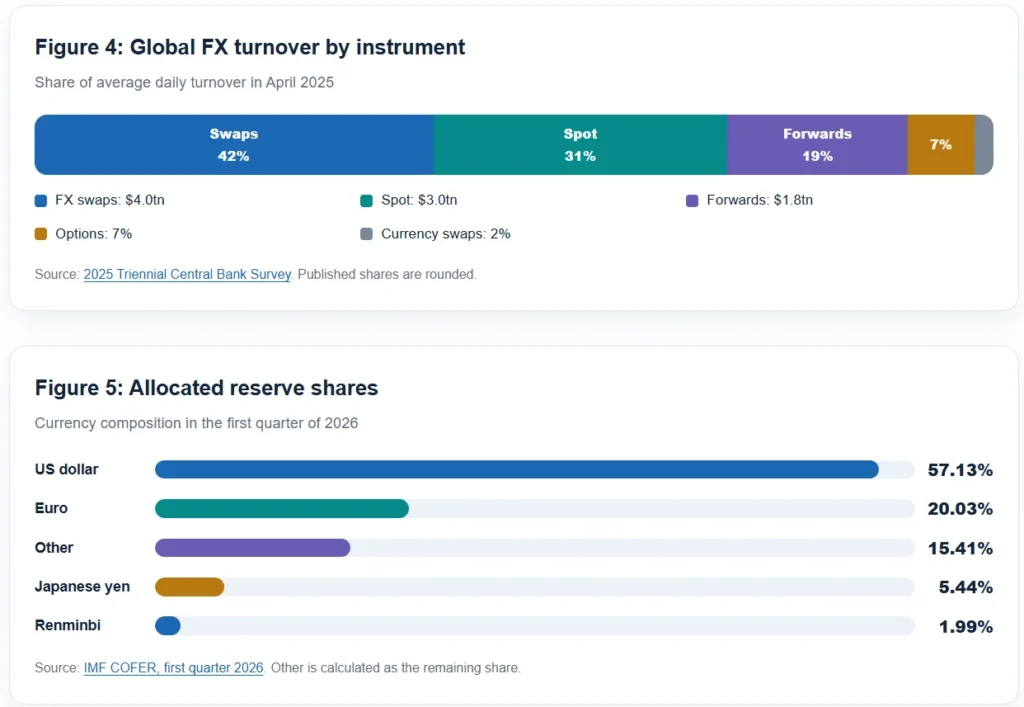
The global FX market now handles about $9.6 trillion each day. That total rose 28% between 2022 and 2025.
FX swaps remained the largest instrument, with $4 trillion in daily turnover. Spot trading reached $3 trillion, while outright forwards reached $1.8 trillion. Options represented 7% of activity.
These figures matter because most trading does not reflect simple currency speculation. Banks, funds, exporters, and importers use FX instruments to manage funding and future cash flows.
The dollar appeared on one side of 89.2% of all trades. The euro followed with 28.9%, while the yen held 16.8%. Both sides of each trade are counted.
Reserve data also confirm slow change, not sudden replacement. The dollar represented 57.13% of allocated reserves in early 2026. The euro held 20.03%, while the renminbi held 1.99%.
What businesses should do now
Companies should avoid making one large directional currency bet. Instead, treasury teams can hedge exposures in layers across several maturity dates.
Forwards can lock known costs and protect budget rates. Options can preserve favorable upside while limiting damaging moves. Natural hedges can also match foreign-currency revenue with expenses.
Importers should watch energy prices, shipping routes, and central-bank meetings together. Exporters should track overseas demand and the currency value of future receivables.
The next phase may bring wider intraday swings without a lasting dollar trend. Therefore, disciplined hedging may create more value than market timing.
The global FX market remains liquid, deep, and dollar-centred. Yet policy divergence now creates more varied opportunities and risks across currencies.