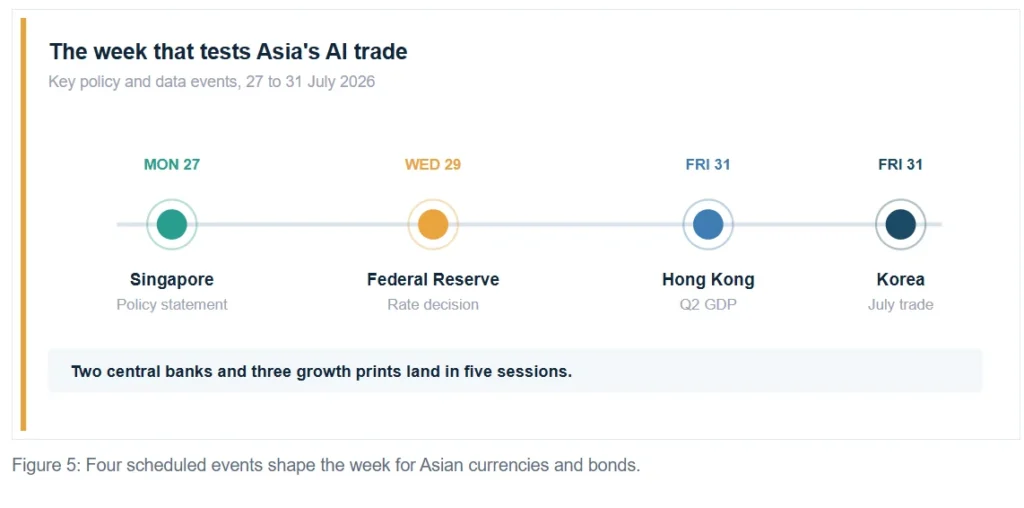


July 25, 2026 – Two central banks and three growth prints land in five sessions. Asia’s AI trade has never looked stronger, or more concentrated.

In Summary
The Fed decision on 29 July anchors a week with four scheduled Asian events.
Korea’s June exports crossed $100bn for the first time, on a 199.5% jump in chip sales.
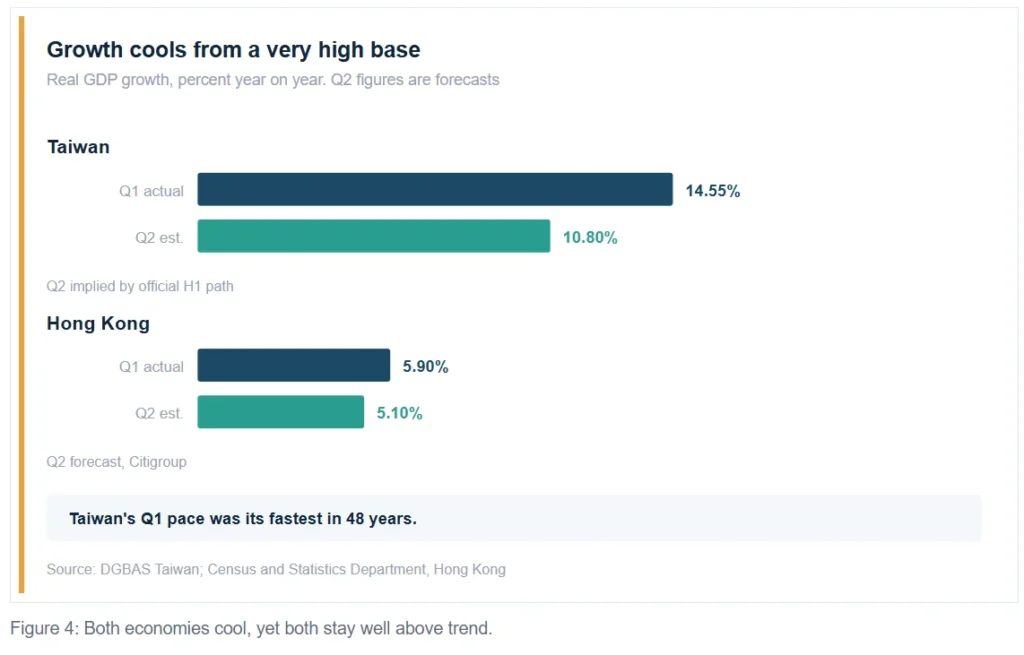
Taiwan’s official forecasts already imply Q2 growth near 10.8%, so the cooling is planned.
Singapore reports first, on Monday, with nine of ten polled economists expecting a hold.
AI hardware drives every record here, which makes the whole region one concentrated trade.
The Fed decision on Wednesday sits at the centre of a packed week for Asian markets. Traders must track two stories at once. Meanwhile, Asia keeps posting growth numbers powered by the global AI build-out.
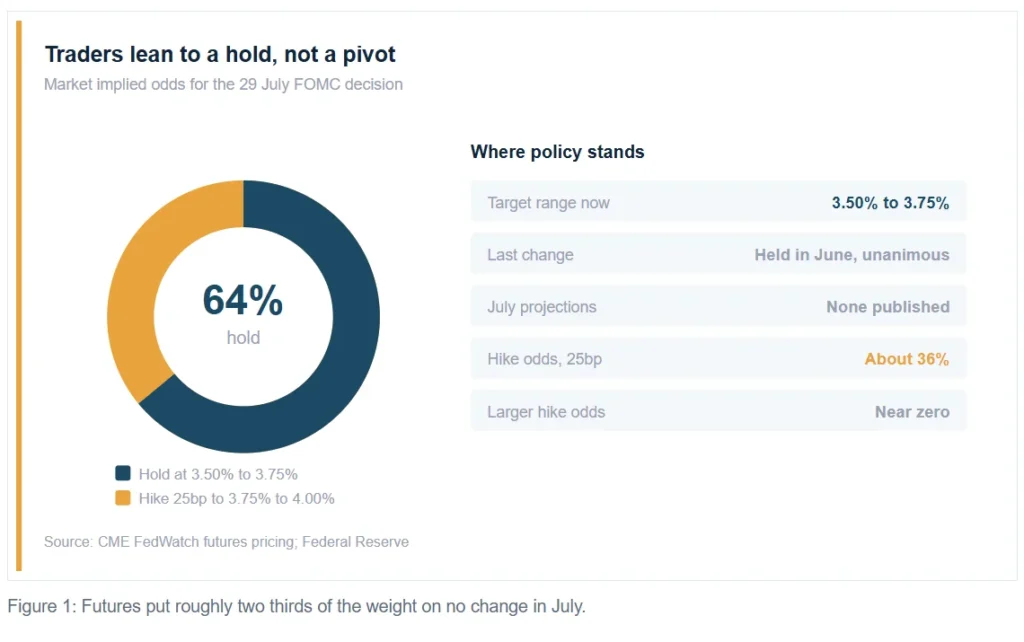
Markets put the odds of a hold near 64%. However, futures still price a live chance of a quarter-point hike. The target range has stayed at 3.50% to 3.75% since June. Chair Kevin Warsh speaks after the statement at 2:00 pm ET. Because July brings no fresh projections, his tone alone will steer September pricing.
That framing matters for a simple reason. Traders no longer argue about the direction of the next move. Instead, they argue about its timing. Rising crude prices have pushed hike odds up sharply since June. Roughly a third of the market now backs an immediate quarter-point step.
Korea chip exports set the pace
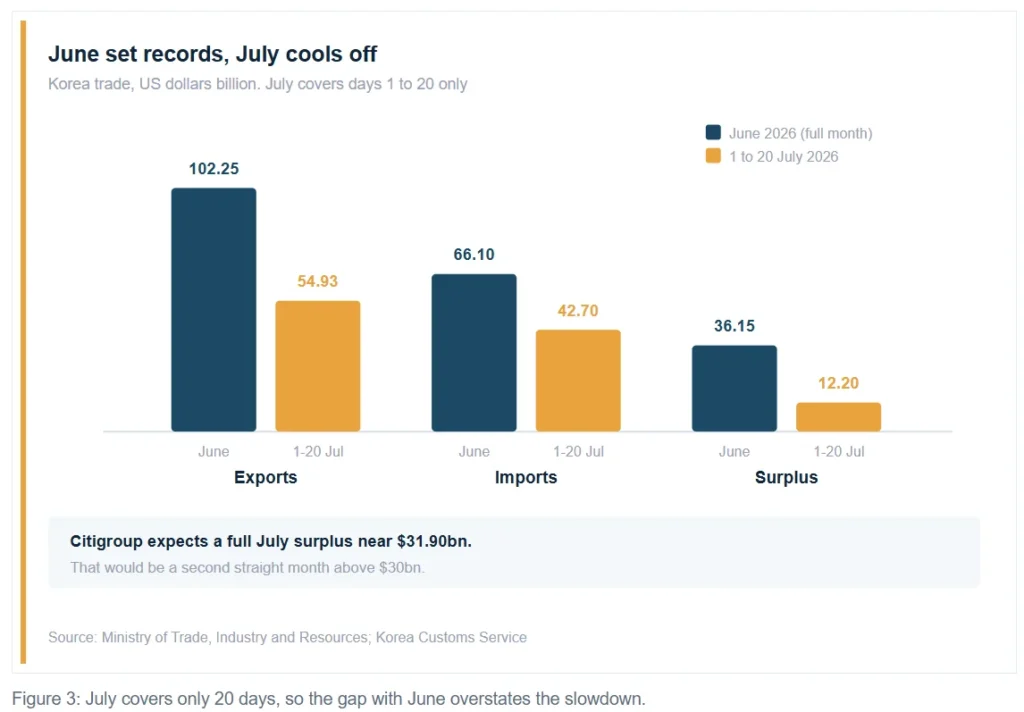
South Korea now offers the clearest window into AI demand. Exports hit $102.25 billion in June, up 70.9% from a year earlier. That crossed $100 billion for the first time. Only Germany, China and the United States had ever managed it. Furthermore, the trade surplus reached $36.15 billion, another record.
Chips did nearly all the heavy lifting. Chip exports jumped 199.5% to $44.82 billion. Non-chip exports rose just 28%. Therefore, the headline growth rate hides a very narrow engine.
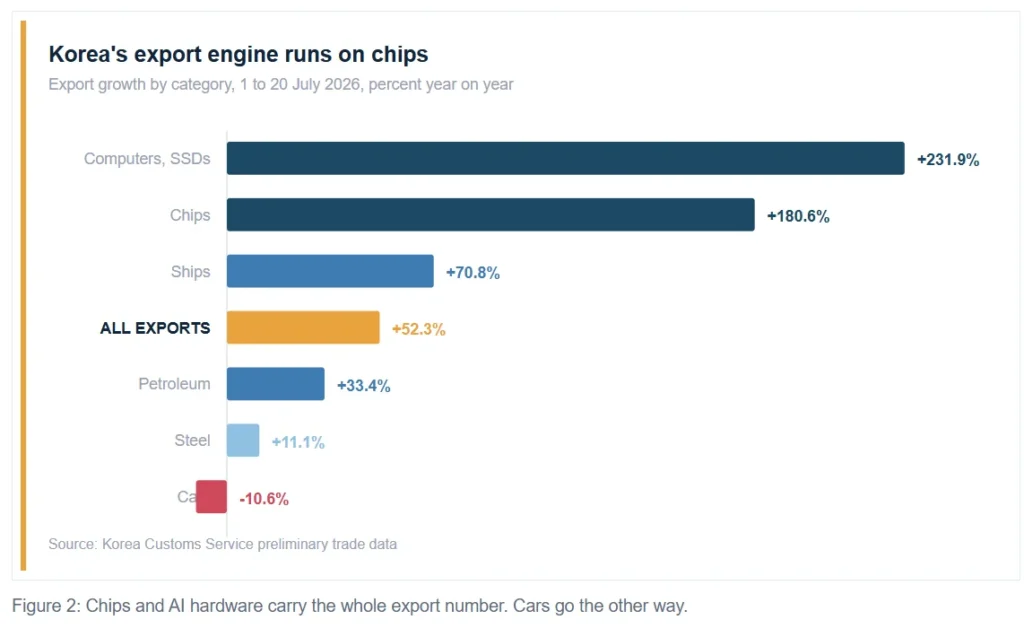
July looks softer but still strong. Customs data for the first 20 days showed exports up 52.3% to $54.93 billion. Chip shipments alone reached $22.11 billion. Yet the daily average slipped 8.2% from June. Citigroup now expects a July surplus near $31.90 billion.
Taiwan and Hong Kong ride the same wave
Taiwan tells a strikingly similar story. Its economy grew 14.55% in the first quarter, the fastest pace in 48 years. Exports of goods and services surged 35.76%. Factory output climbed 26.18% over the same span.
Official forecasts already point lower. The statistics agency sees first-half growth of 12.65% and second-half growth of 6.94%. Simple arithmetic implies second quarter growth near 10.8%. That lands inside the 10.5% to 11.6% band analysts expect. In short, forecasters flagged this cooling well in advance.
Hong Kong reports on Friday. Its economy grew 5.9% in the first quarter, the best run in almost five years. Goods exports rose 23.8% in real terms. Analysts at Citigroup expect 5.1% for the second quarter.
Singapore holds the first swing vote
Singapore delivers the week’s opening policy call on Monday. Nine of ten economists polled expect no change at all. Its central bank raised inflation forecasts in April to a 1.5% to 2.5% range. It also nudged up the currency band slope.
June core inflation came in at 1.6%. Headline inflation reached 1.9% across the same month. Both sit near the floor of that official range. Consequently, most desks see little reason to move now. Still, Barclays calls the meeting close, and flags real risk of a 50 basis point slope increase.
Currencies carry the strain
Asian currencies feel this tension first. Record surpluses normally lift a currency, yet dollar strength keeps capping those gains. Singapore uses its exchange rate as the main policy lever. Its band therefore absorbs shocks that other central banks meet with rate moves.
Bond desks face the mirror image. Strong Asian exports argue for higher regional yields. A hawkish Fed would push those yields higher again. As a result, hedging costs across the region look set to climb.
One driver, one concentrated risk
These records all share a single driver. AI infrastructure spending lifts chips, servers and drives across the region. That concentration cuts both ways.
Korea shows the split most clearly. Car exports fell 10.6% in the first 20 days of July. Oil product exports climbed 33.4%, although only because crude prices jumped. Brent now trades above $100 after Middle East supply shocks.

So the Fed decision matters far beyond Washington. Higher oil feeds American inflation directly. Rates that stay high then tighten funding everywhere else. If the Fed turns hawkish this week, Asia’s AI trade faces its first genuine stress test.
Nevertheless, the data still runs hot. Korea booked a $138.3 billion surplus across the first half. First half chip exports of $192.4 billion already beat the whole of 2025. Investors will learn on Wednesday whether cheap dollars keep funding that boom.