

July 22, 2026 – Interest rate derivatives trading volume accelerated sharply during the week ending July 17, 2026. The move signals stronger demand for protection, positioning, and balance-sheet certainty.
In Summary
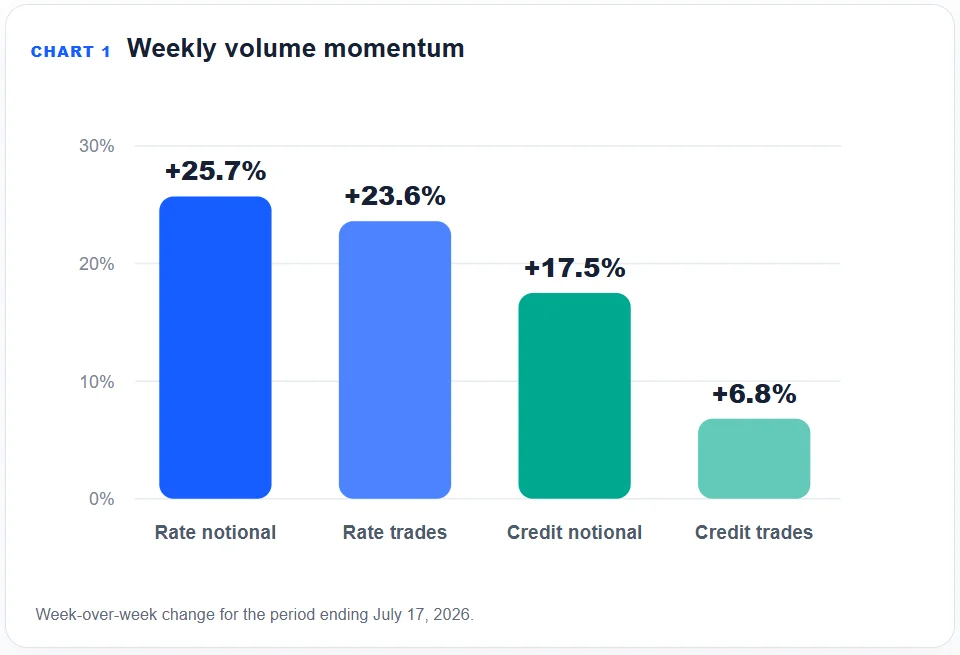
Interest rate derivatives notional rose 25.7% from the previous week, while trade count increased 23.6%.
Index credit derivatives notional climbed 17.5%, although trade count increased by a milder 6.8%.
Clearing remained dominant, covering 88.0% of rate notional and 79.9% of index credit notional.
Traders faced softer inflation data, a steep Treasury curve, and an approaching Federal Reserve decision.
Rate hedging returns with force
The latest weekly market data showed a decisive rise in derivatives trading volume. Interest rate derivatives led the expansion across reported markets.
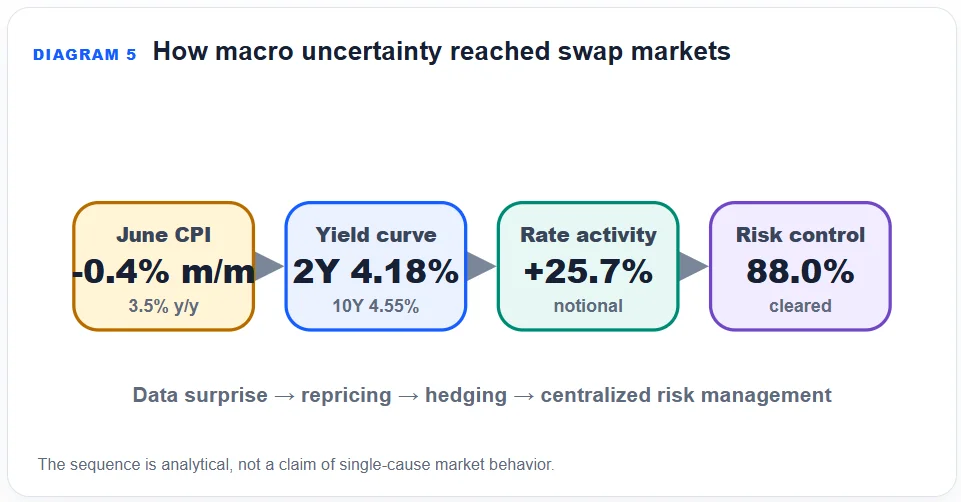
Traded notional increased 25.7% from the prior week. Meanwhile, the number of rate trades rose 23.6%.
That close relationship matters. It suggests activity broadened across transactions, rather than relying on a few exceptionally large trades.
The timing also offers important context. June consumer prices fell 0.4% on a seasonally adjusted monthly basis.
However, annual inflation remained 3.5%. Core inflation stood at 2.6%, leaving the policy outlook open to competing interpretations.
Therefore, traders had reasons to hedge both falling-rate and persistent-inflation scenarios. Swaps provide a direct method for managing that uncertainty.
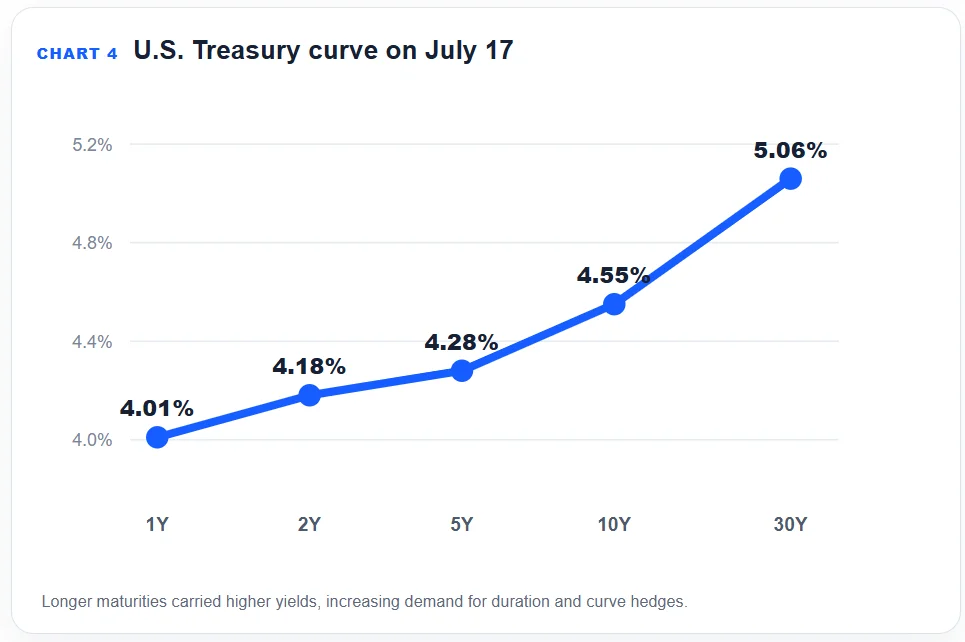
The Treasury curve reinforced that tension. On July 17, the two-year yield closed at 4.18%.
The five-year yield reached 4.28%, while the ten-year yield stood at 4.55%. The thirty-year yield reached 5.06%.
That upward curve reflects higher compensation for longer maturities. It also increases the value of duration hedging for banks and investors.
Credit activity rises, but trade sizes grow faster
Index credit derivatives also recorded a strong week. Traded notional rose 17.5%, while trade count advanced only 6.8%.
This gap indicates larger average transaction sizes. Institutional investors may have adjusted broad credit exposure through index products.
Credit indexes can quickly hedge diversified portfolios. They can also express views on spreads without trading many individual bonds.
However, higher notional does not automatically signal rising fear. The same activity may reflect portfolio rebalancing, relative-value trades, or dealer risk management.
The key signal comes from the combination. Rate activity broadened strongly, while credit activity concentrated in larger tickets.
Clearing strengthens market resilience
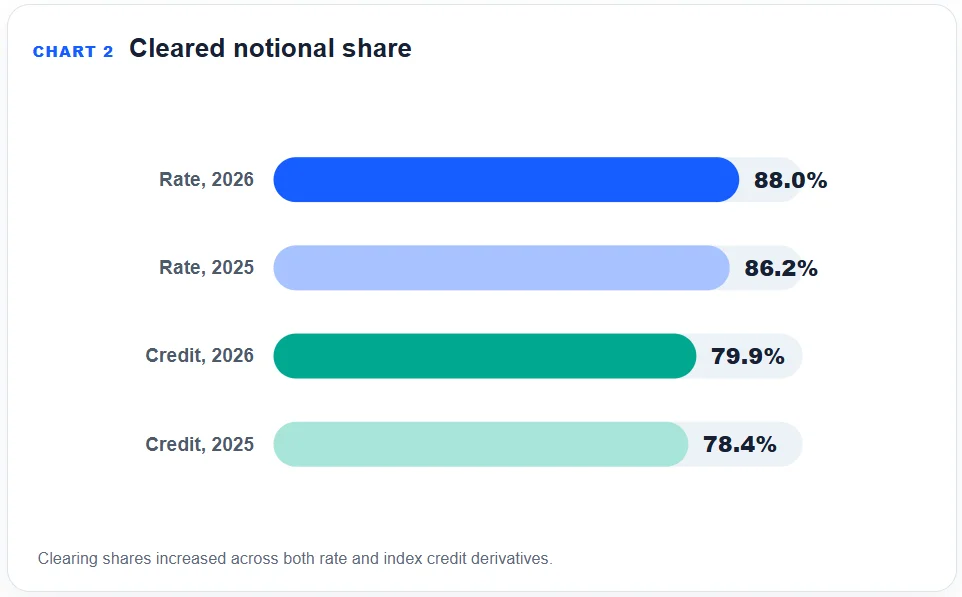
Market structure data also showed high clearing levels. Cleared rate notional reached 88.0%, compared with 86.2% one year earlier.
Cleared index credit notional reached 79.9%. That figure exceeded the 78.4% share recorded one year earlier.
Clearing reduces bilateral counterparty exposure through central risk management. It also supports margin discipline and standardized default procedures.
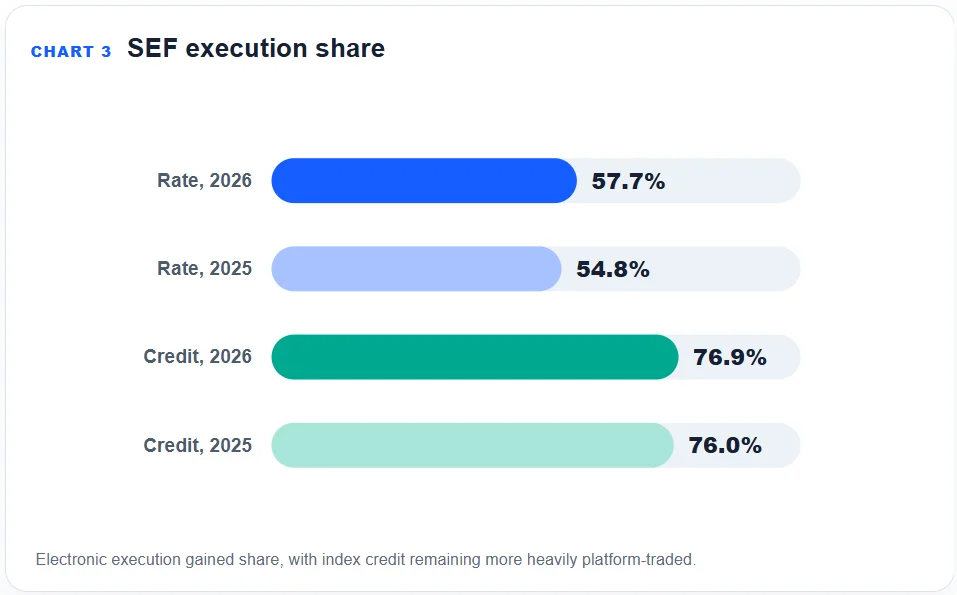
Electronic execution remained important. Swap execution facilities handled 57.7% of rate notional, up from 54.8% last year.
For index credit derivatives, the share reached 76.9%. The comparable share one year earlier was 76.0%.
Regulators publish aggregated swap reports to improve market transparency. Those reports help investors monitor activity, concentration, and outstanding risk.
What the volume surge means
The increase does not provide a single directional forecast. Instead, it reveals a market paying more attention to uncertainty.
A Federal Reserve meeting was scheduled for July 28 and 29. That event raised the value of near-term rate protection.
Softer monthly inflation supported easing expectations. Yet firm annual inflation and elevated long yields complicated that narrative.
As a result, dealers and asset managers likely needed more precise duration, curve, and spread hedges.
The strongest message comes from participation. Rate trade counts rose almost as quickly as notional, showing a broad trading response.
Credit volumes also expanded, although larger trades drove more of that increase. That pattern points toward institutional portfolio adjustments.
Overall, derivatives trading volume became a useful stress gauge during the week. It captured uncertainty before cash markets offered a clear answer.
For corporate treasurers, the shift has practical consequences. Higher activity can improve price discovery across common maturities and benchmarks.
However, active markets can also produce faster margin changes. Firms should test collateral buffers before major policy events.
Banks face a similar challenge. They must manage client flow, basis risk, liquidity, and counterparty exposure at the same time.
Consequently, strong clearing participation provides reassurance. Yet clearing moves risk toward daily margin calls and central counterparties.