

August 22, 2026 – A special purpose vehicle backed by Blackstone and Apollo could raise up to $100 billion. The borrowing would fund more than 20 gigawatts of AI compute.
In Summary
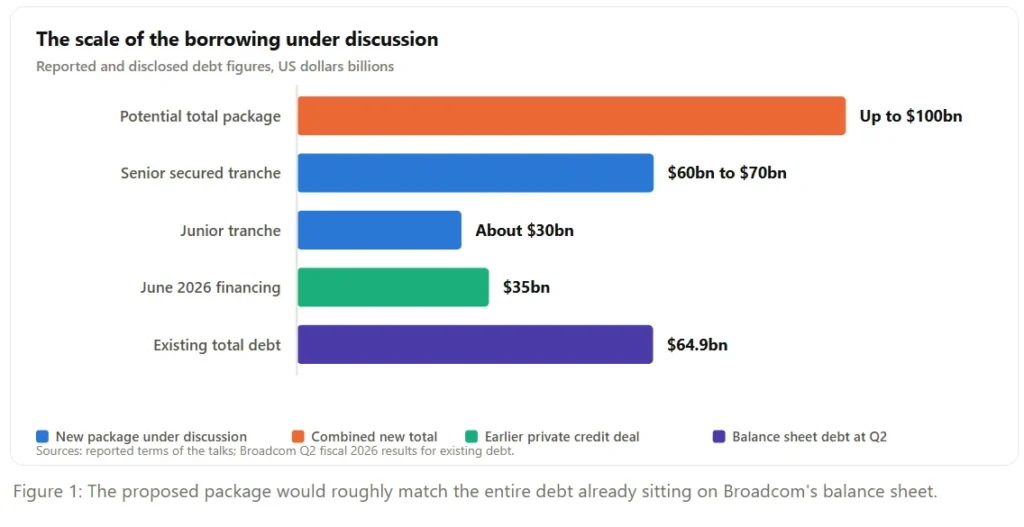
Broadcom is negotiating more than $60 billion of senior secured debt, plus a junior tranche near $30 billion.
Blackstone and Apollo Global Management would fund the deal through a special purpose vehicle.
The company reported $22.19 billion of revenue and $10.8 billion of AI chip sales in fiscal Q2 2026.
Free cash flow of $10.26 billion supports the borrowing, although total debt already stands at $64.9 billion.
The financing targets more than 20 gigawatts of AI computing capacity, with Anthropic named as a main beneficiary.
A Broadcom AI debt deal takes shape
A new Broadcom AI debt deal is taking shape in private credit markets. The company is in talks to raise more than $60 billion of senior secured debt. Reports of the negotiations emerged on 20 August. A junior tranche of roughly $30 billion may sit alongside it. Together, the package could reach $100 billion.
Blackstone and Apollo Global Management are named as financing partners. A special purpose vehicle would issue the debt, while Broadcom guarantees part of the senior piece. All parties declined to comment.
Why the structure matters more than the size
Off-balance-sheet vehicles change how risk is shown. The debt would sit outside Broadcom’s own accounts, yet the guarantee keeps the company exposed. Credit investors, therefore, look through the structure.
The design also spreads risk. Senior lenders rank ahead of the junior tranche, so each group prices its own slice. In turn, that widens the pool of buyers.
Private credit firms now fund a growing share of chip and data centre build-outs. Banks face capital rules that make such lending costly. Consequently, borrowers turn to funds that can move faster and take on more risk.
The revenue that supports the borrowing
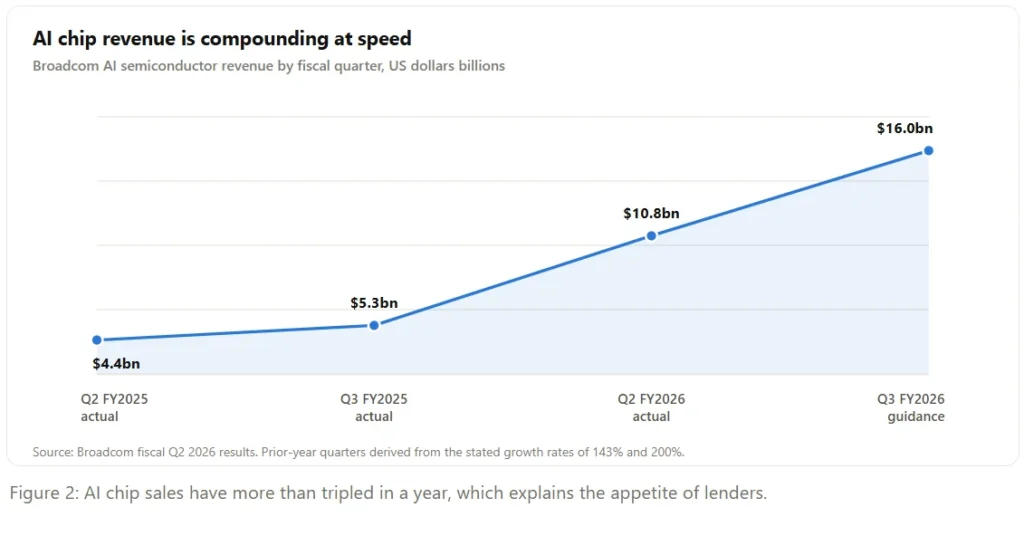
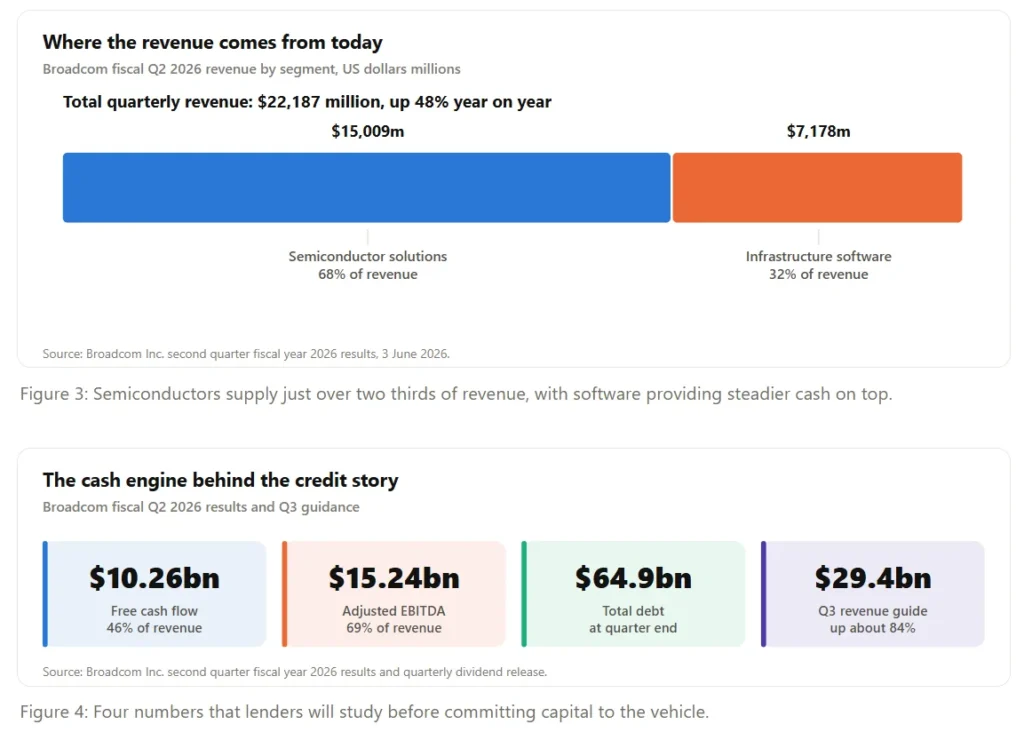
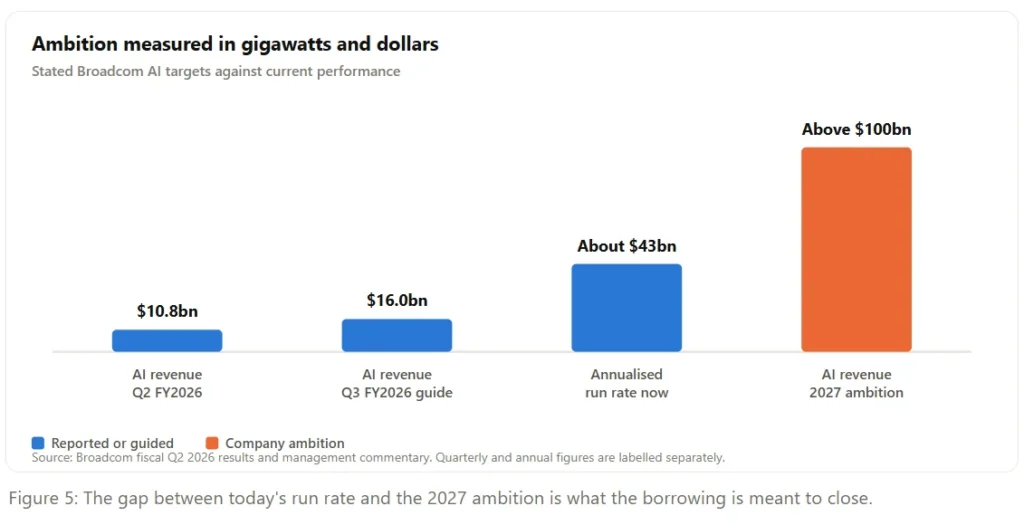
Broadcom is not borrowing from weakness. The company reported $22.19 billion of revenue in fiscal Q2 2026, up 48% year on year. AI semiconductor sales alone reached $10.8 billion, a rise of 143%.
Guidance points higher still. Management expects third-quarter revenue near $29.4 billion. AI chip revenue should climb by over 200% to roughly $16 billion in the same period.
Cash flow gives lenders comfort
Free cash flow reached $10.26 billion in the quarter, equal to 46% of revenue. Adjusted EBITDA came in at $15.24 billion. Those margins support a heavy debt load.
Total debt stood at $64.91 billion at quarter end. A further $60 billion would therefore double the group’s borrowings. However, the earnings base has also grown quickly.
Who the money is for
Reports name Anthropic as the main beneficiary of the new capacity. Other customers are said to be involved. Alphabet remains Broadcom’s largest customer through its custom accelerator programme.
The wider plan targets more than 20 gigawatts of computing power. Building that capacity needs hundreds of billions of dollars. Debt fills the gap that operating cash flow cannot cover.
An earlier arrangement in June raised about $35 billion with the same two private credit partners. The new talks therefore extend a template rather than invent one.
The risks inside the Broadcom AI debt deal
Concentration is the obvious concern. A small group of buyers drives most AI chip demand. If one delays orders, the revenue that services this debt could slip.
Valuation adds pressure. Broadcom trades near 65 times trailing earnings and about 19 times forward estimates. Shares also fell 5.9% on 19 August after a rival won work at Alphabet.
Furthermore, credit default swap pricing widened as the reports circulated. That move suggests some caution among debt investors, even while equity holders stayed calm.
Hedge funds have also trimmed exposure. Ownership fell from 202 funds to 173 in the latest filings. Short interest, however, remains modest at about 1.3% of the free float.
What happens next
Terms remain fluid, and the financing may arrive in stages. Nothing has been signed publicly. Investors should therefore treat the $100 billion figure as an upper bound rather than a plan.
Three signals will clarify the picture. First, any regulatory filing that confirms the vehicle. Second, the pricing and rating of the senior tranche. Third, Broadcom’s next results are due in the coming months.
Until then, the story sits at the heart of a wider question. Markets want to know how much of the AI build-out now runs on borrowed money.




