

August 26, 2026 – Chip stocks carried the cost of a global rethink on AI spending. Asian markets took the brunt, and a steep US yield curve kept risk on a short leash.

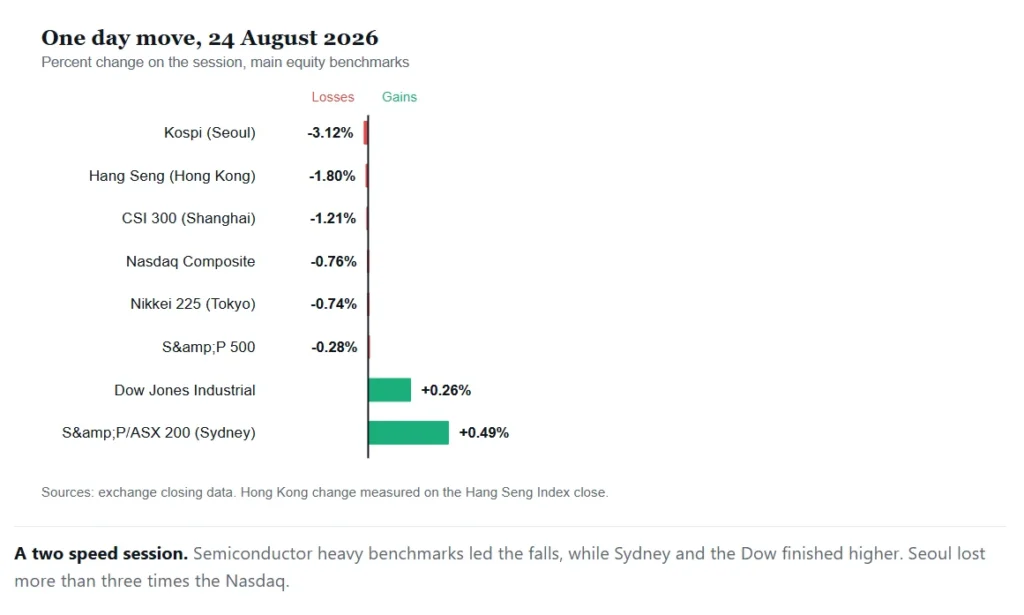
Selling gripped Asian markets on Monday. Seoul led the falls, and the Kospi shed 3.12% to close at 6,696.96. Moreover, the pressure spread across every chip-heavy index in the region.
Tokyo held up better. The Nikkei 225 slipped 0.74% to 65,528.09, while Sydney bucked the trend. Australia’s S&P/ASX 200 rose 0.49% to 9,103.10, helped by miners rather than tech.
In Summary
The Kospi fell 3.12% on 24 August, its worst session since the sidecar halt of 19 August.
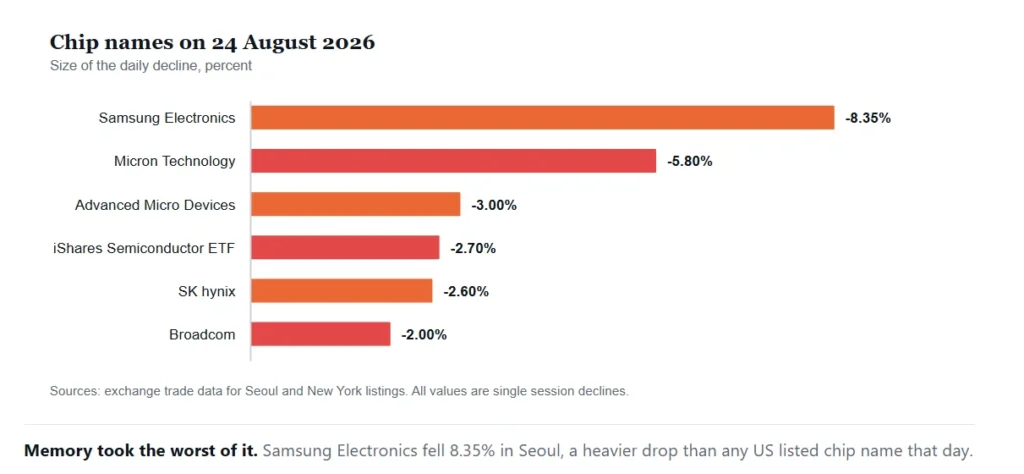
Samsung Electronics dropped 8.35%, and SK Hynix lost 2.60% as traders trimmed chip exposure.
Wall Street split, with the Dow up 0.26% while the Nasdaq Composite fell 0.76%.
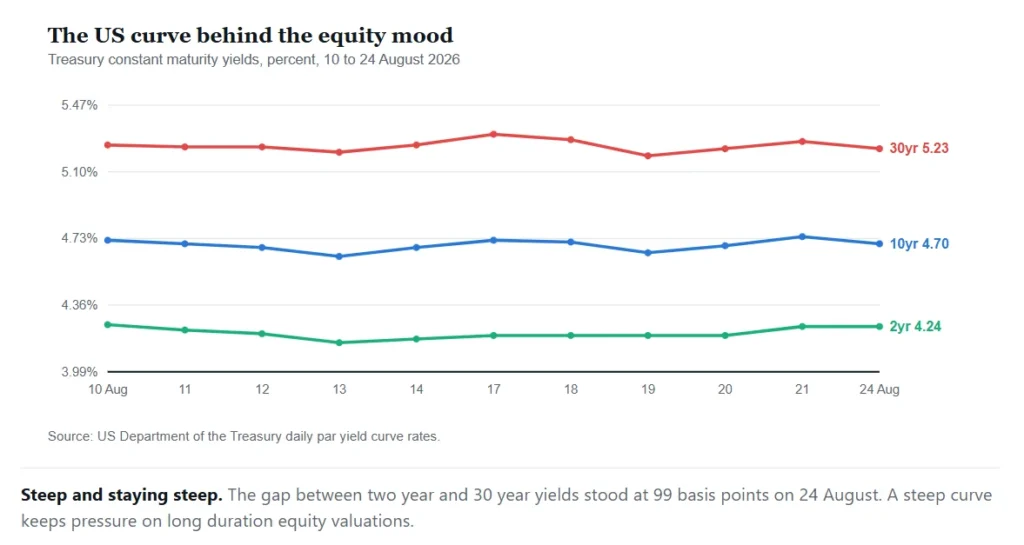
The 30-year Treasury yield sat at 5.23%, still near its highest level since 2007.
Gold futures settled at a three-month high as the dollar stayed soft.
Asian markets now wait on Nvidia results, a US inflation print, and Jackson Hole.
Why Asian markets took the hit
Ownership explains most of it. Korea and Taiwan carry the heaviest memory chip weights in the world. So any wobble in AI spending hits Seoul hardest.
Meanwhile, the trigger looked simple. Traders cut chip risk before Nvidia reports on Wednesday. In fact, the same names had jumped only days earlier.
That whipsaw has defined August. The Kospi fell 5.80% on 19 August, then jumped 5.89% the next day. Similarly, Samsung swung by double digits in one week. For example, its 8.35% drop followed a 9.49% gain.
Payouts have cushioned part of the damage. Samsung has pledged a record payout plan for this year. Meanwhile, SK Hynix has set out a large buyback of its own.
Wall Street split down the middle
New York told a two-speed story on Monday. The S&P 500 eased 0.28% to 7,652.86. Nasdaq lost 0.76% to 25,980.19. By contrast, the Dow gained 140 points to 53,417.16.
Chip’s weakness explains the split. Micron dropped 5.8%, while AMD and Broadcom each lost more than 2%. Also, laser parts makers Coherent and Lumentum fell more than 4% each.
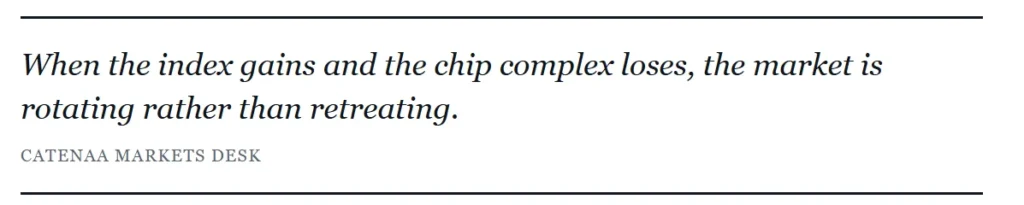
Breadth stayed healthy elsewhere. Banks, energy names, and health care all held their ground. In short, buyers rotated instead of running for the exit.
Bonds still run the show for Asian markets
Long yields still drive the tape. Treasury constant maturity data put the 30-year at 5.23% on 24 August. That sits just under the highest reading since 2007.
Relief came last week from an odd source. The Treasury said it would at least double its long end bond buybacks from 9 September. Yields fell nine basis points that day.
Yet the effect faded fast. By 21 August, the 30-year had climbed back to 5.27%. Therefore, many buyers doubt that buybacks alone can cap borrowing costs.
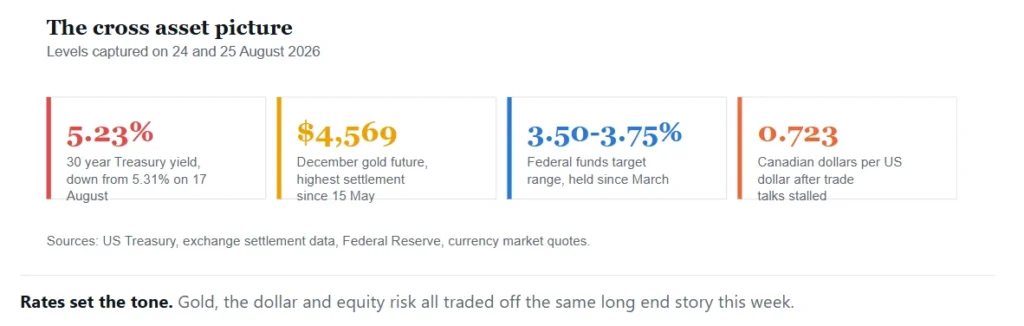
Rate policy offers little help now. The Federal Open Market Committee has held its target range at 3.50% to 3.75%. Chair Kevin Warsh speaks at Jackson Hole from 27 to 29 August.
Dollar weakness lifts gold
Currency moves backed up the rates story. The dollar has drifted lower all month. As a result, December gold futures settled at $4,569.40 on Friday, the best close since 15 May.
Gold has now risen for five straight weeks. That run followed its worst quarter since 2013. Even so, the metal still trades well below the record near $5,600 set in January.
The link back to Asian markets runs through central banks. Regional buyers have absorbed record tonnage this year. Therefore, a weaker dollar tends to lift both bullion and local reserves.
Oil muddies the inflation picture. Brent has held above $90 since fresh trouble around the Strait of Hormuz, based on EIA spot price data. Washington also rolled out new sanctions on Monday, aimed at the middlemen who keep Iranian barrels moving.
Trade friction adds a second front
Trade politics also weighed on risk appetite. Talks between Ottawa and Washington broke down last week. So the Canadian dollar slid 0.44% to 0.723 per US dollar.
The dispute has teeth. Washington applied a 50% tariff to about $28bn of Canadian goods in late August. Ottawa will match that step dollar for dollar from 8 September. Energy trade sits at the heart of the row.
What comes next for Asian markets
Tuesday brought no clean answer. Tokyo edged up 0.27% in early trade, yet Seoul fell again. Later in the day, the Kospi traded down 2.37%, with the Kosdaq off 1.23%.
Three events now rule the calendar. Nvidia reports on Wednesday. A US inflation print lands later in the week, and Jackson Hole follows. Above all, traders want proof that long yields have peaked.
Until then, expect more of the same. Big swings in memory chip names look set to continue. Meanwhile, the Federal Reserve H.15 series stays the most useful daily gauge for share buyers across the region. In short, bonds still lead, and stocks still follow.