

September 05, 2026 – Investors back an October listing that would value the AI firm above every company that has gone public.
In Summary
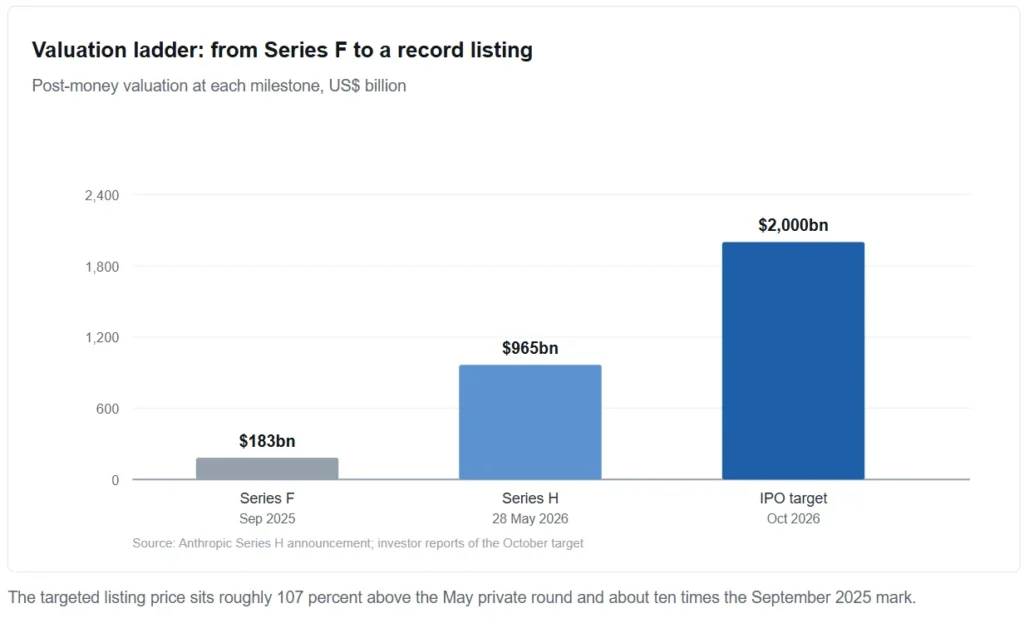
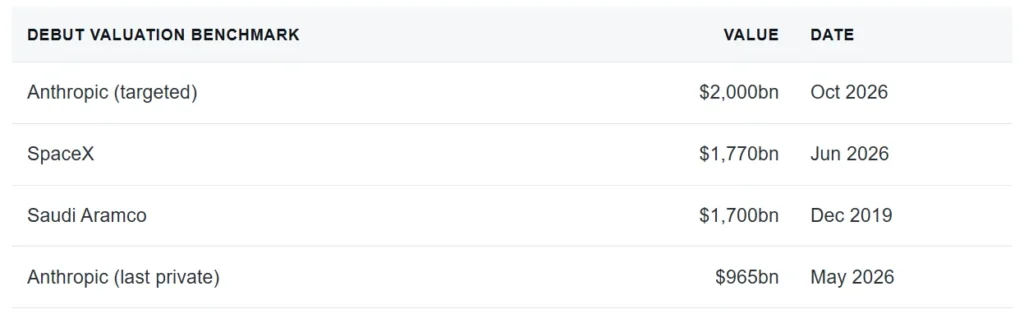
Investors close to the company target a valuation above $2 trillion for an October 2026 listing.
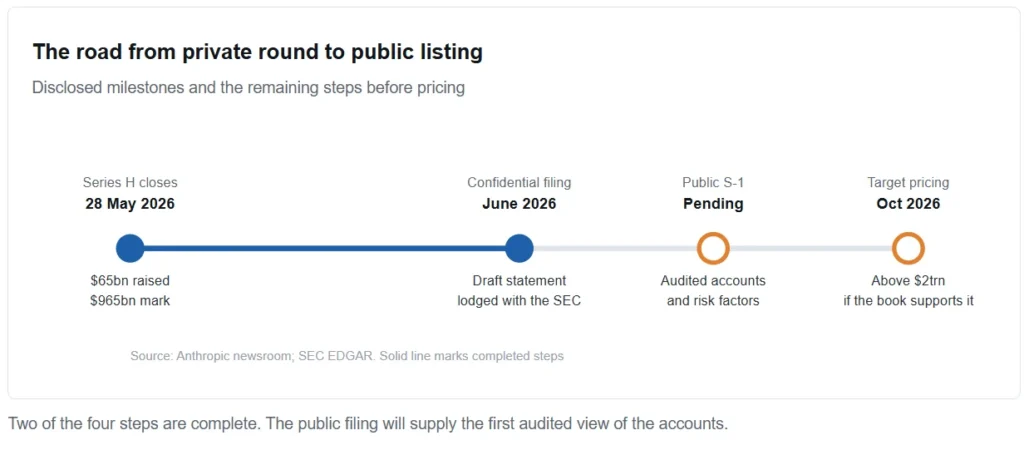
Anthropic closed a $65 billion Series H in May at a $965 billion post-money valuation.
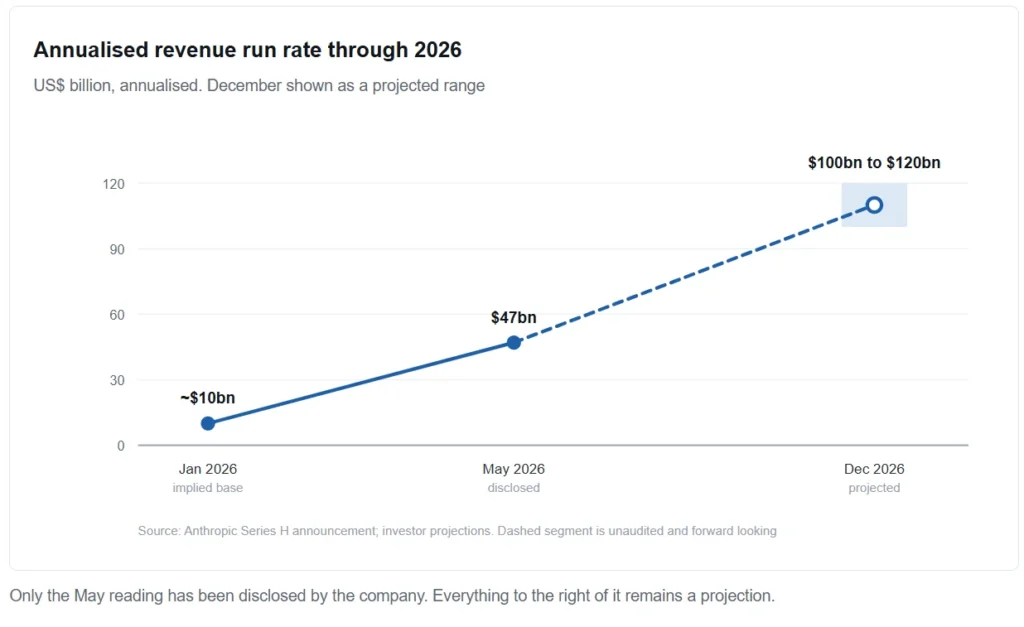
Annualised revenue passed $47 billion in May, with $100 billion to $120 billion projected by December.
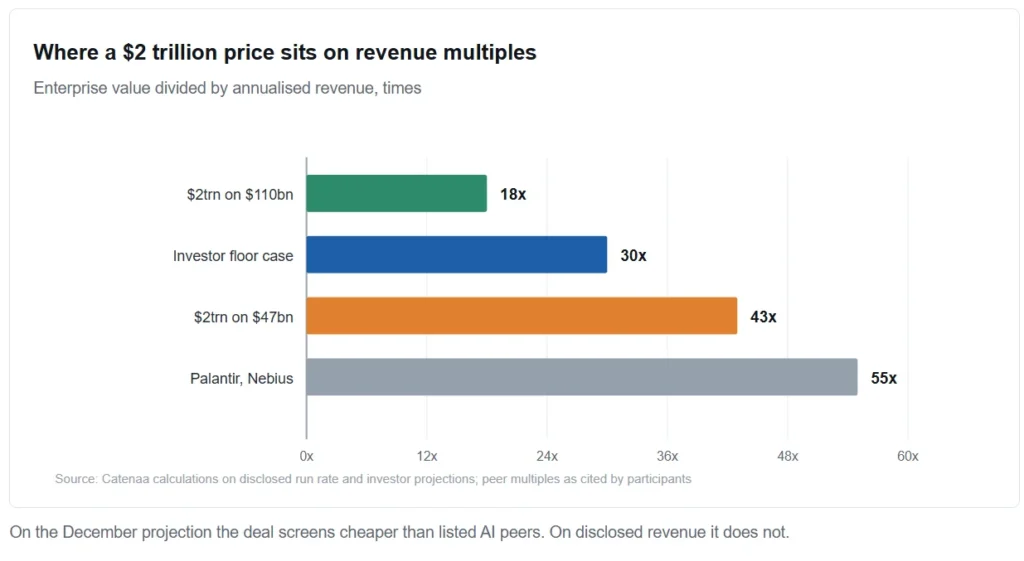
At $2 trillion, the equity would price near 18 times the projected December run rate.
Morgan Stanley, Goldman Sachs and JPMorgan lead the underwriting syndicate.
Export controls and a defence procurement dispute remain unresolved risks for public shareholders.

Anthropic is lining up the biggest stock market debut in history. Investors close to the deal now want a price tag above $2 trillion. The listing is pencilled in for October 2026. At that level, it would beat every float ever done.
The whole case rests on one number. Sales at the AI firm have grown at a pace few peers match. However, whether public buyers pay for that pace stays an open question.
A valuation that doubles the private mark
The firm closed its Series H on 28 May 2026. It raised $65 billion at a $965 billion post-money value. Altimeter Capital, Dragoneer, Greenoaks and Sequoia Capital led the round. Cloud partners added a further $15 billion, including $5 billion from Amazon.
State funds and big long-only names sat beside them. GIC, Temasek, Fidelity, Baillie Gifford and T. Rowe Price all took part. That list matters, because the same funds tend to anchor big share sales. So a $2 trillion float would double the May mark in five months.
Anthropic lodged a draft filing with the Securities and Exchange Commission in June. Morgan Stanley, Goldman Sachs and JPMorgan run the books. As a result, three of Wall Street’s largest desks now own the outcome.
Revenue growth carries the whole argument
Yearly sales passed $47 billion in May 2026. Meanwhile, buyers now look for $100 billion to $120 billion by December. That path points to growth near 800 per cent in one year. Few firms of any size have grown that fast.
The headline multiple therefore hangs on which sales figure you pick. On the May run rate, $2 trillion equals about 43 times sales. Switch to a $110 billion December exit rate and the same price drops to 18 times. So the December figure does most of the work here.
The multiple looks modest beside listed peers
Similarly, rival AI names already trade at richer levels. Palantir and Nebius change hands near 55 times sales. One investor on the deal called 30 times sales a fair floor. That case would push the equity above $3 trillion.
Those sums need care. Sales multiples reward growth, yet they say nothing about margins. Besides, compute is still the largest cost line at any frontier lab. Also, none of the December sales figures has been audited or filed publicly.
Pricing power meets policy risk
Claude sells at a premium to rival systems. Reported token pricing runs near 2.5 times the cost of the leading rival model. High prices lift the quality of each dollar earned. However, they also invite switching once cheaper models catch up.
Policy adds a second layer of risk. The Commerce Department has placed short-term export limits on the most powerful systems. Anthropic is also in court with the Department of Defence over a supply chain risk label. New shareholders would inherit both fights on day one.
A market that has already absorbed one mega listing
The window for very large private firms reopened this year. SpaceX was listed in June 2026 at about $1.77 trillion. Therefore, Anthropic would clear that mark with room to spare. Moreover, its debut would land two months before year-end, when index flows run heavy.
What investors should watch into October
Three tests will settle the outcome. First, the draft must turn into a public filing on SEC EDGAR with audited books. Second, sales must land inside the guided band. Third, the banks must build a book deep enough for a float this large.
Ultimately, a strong print would lift marks across the whole private AI market. Late-stage rounds in the sector already use this deal as an anchor. Weak trading after the bell would work the other way, and fast. October now matters more for AI prices than any earnings date this year.




