

September 07, 2026 – Two data centre firms took almost three-quarters of the week’s largest venture rounds. Power, not cash, now sets the pace.
In Summary
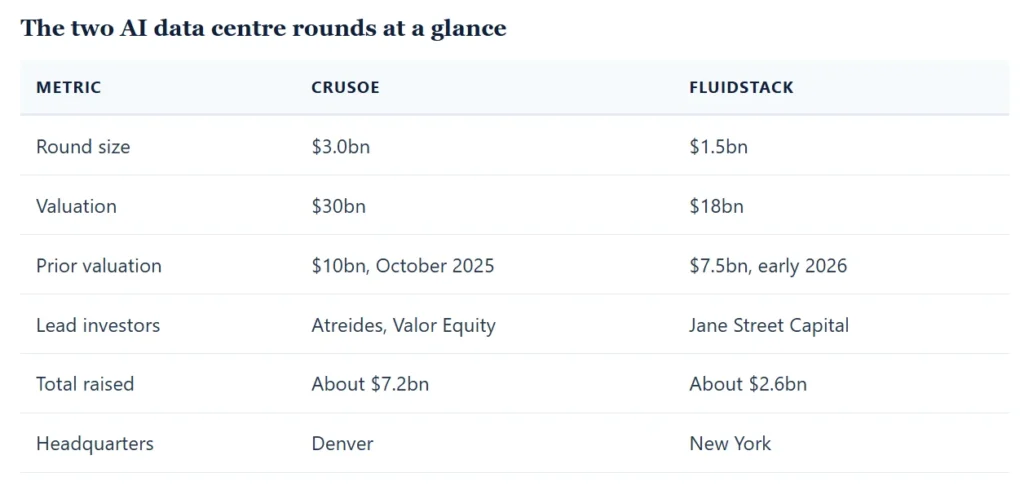
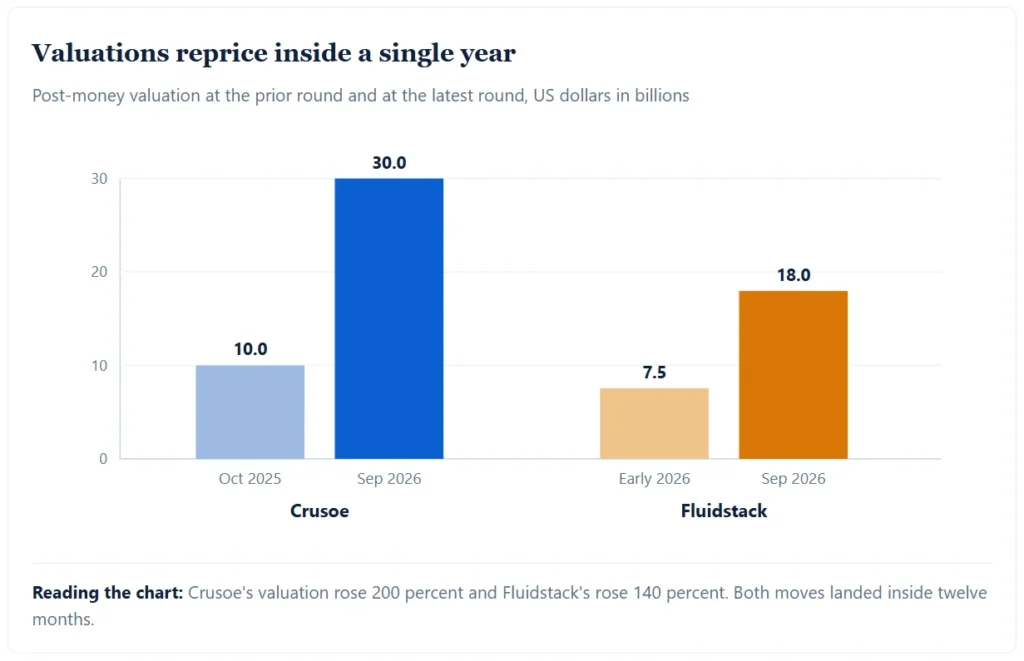
Crusoe raised $3bn at a $30bn valuation, three times its October 2025 mark.
Fluidstack raised $1.5bn at $18bn, in a round led by Jane Street Capital.
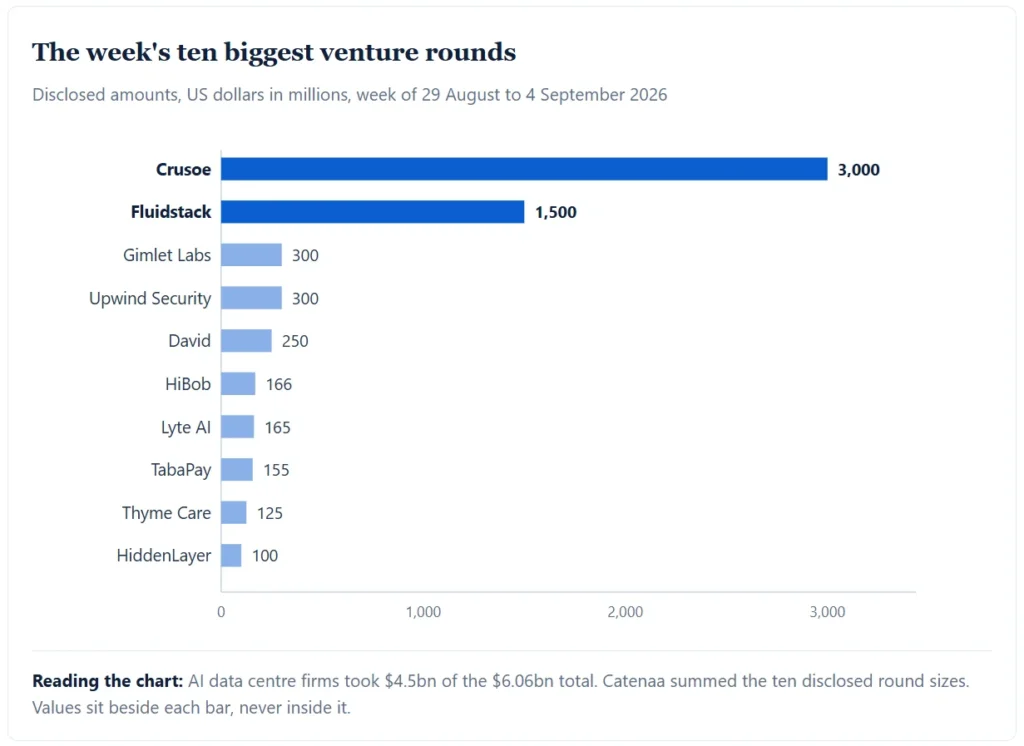
The two deals took 74 percent of the week’s ten biggest disclosed rounds.
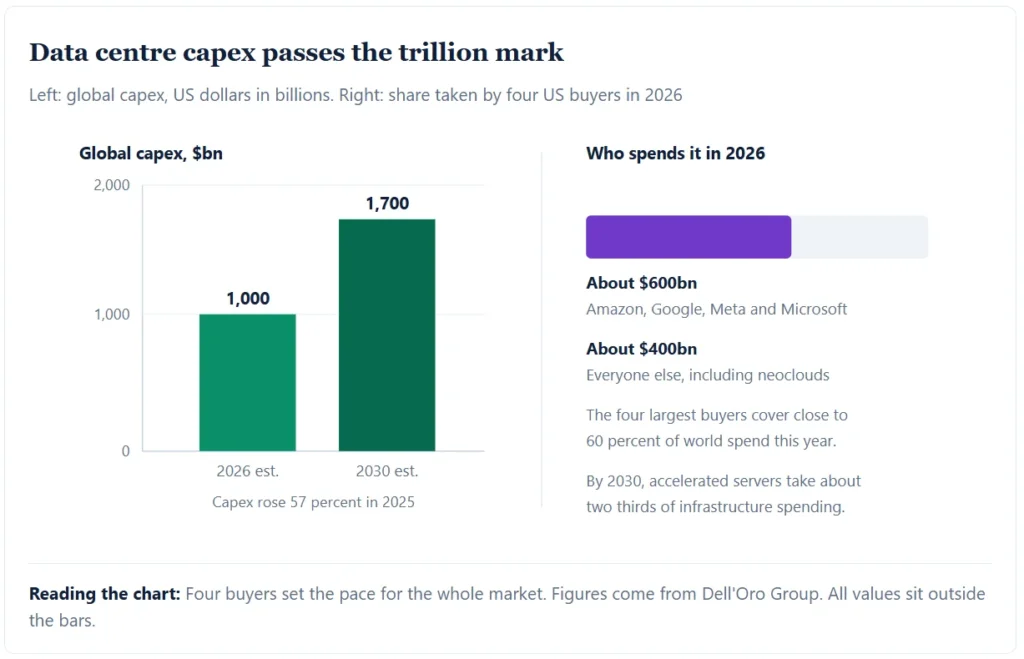
Dell’Oro Group expects global data centre capex to pass $1 trillion in 2026.
Amazon, Google, Meta and Microsoft alone plan close to $600bn this year.

Cash flooded into AI data centres last week. Two firms took most of it.
Crusoe raised $3bn. Fluidstack raised $1.5bn. So the pair banked $4.5bn between them.
The ten largest disclosed rounds came to $6.06bn, by Catenaa’s count. Therefore the two deals took 74 percent of the total. Eight other firms shared the rest.
That split matters. Above all, it shows where risk capital now wants to sit. Backers are paying up for power, land and chips. They pay far less for the apps on top.
Crusoe triples its price tag
Crusoe closed a $3bn Series F at a $30bn valuation. Atreides Management and Valor Equity Partners co-led the deal. Mubadala Capital also joined. In addition, total funds raised now sit near $7.2bn.
Compare that with October 2025. Crusoe then raised $1.38bn at a $10bn mark. So its price tripled in about eleven months.
The firm began in 2018 as a bitcoin miner. It burned flared gas at oil wells for power. Later on, it moved into AI cloud and data centre work. Microsoft, Meta, OpenAI and Oracle now buy from it.
Growth has come fast. Crusoe named a 900 megawatt campus in Abilene, Texas in March. In July it added a one gigawatt site in Childress, Texas. Deals of that size need long dated power contracts.
Jane Street leads the Fluidstack round
Fluidstack raised $1.5bn at an $18bn valuation. Jane Street Capital led the round. Earlier in 2026 the firm raised $750m at $7.5bn. So its value more than doubled inside one year.
Fluidstack began in London in 2017. Staff moved the head office to New York in December 2025. The firm owns almost no chips itself. Instead it finds, funds and runs compute for others.
Anthropic agreed a large data centre plan with Fluidstack in November 2025. Meta, Mistral and Poolside also use it. Of course, that client list explains much of the price.
Yet the model carries a catch. Asset light firms can grow fast. But they hold weaker claims on the sites they use.
One trading firm on both sides
One name links the two deals. Jane Street led the Fluidstack round. It also signed a five year cloud deal with Crusoe worth about $13bn.
That mix is rare. Trading firms seldom fund plants and grids. However, AI compute now trades like a scarce good. Buyers want supply locked in, not bought on the day.
So the client has become the backer. Such deals blur the line between customer and shareholder. In turn, they raise fair value questions for later rounds.
The other eight rounds look ordinary
The rest of the week was modest by contrast. Gimlet Labs and Upwind Security each raised $300m. David raised $250m at $2.25bn. HiBob took $166m and Lyte AI took $165m.
TabaPay raised $155m for payments work. Thyme Care raised $125m in health care. HiddenLayer closed $100m for AI security.
Note the spread. Six of the eight sit in software or services. Even so, their combined total still trails Fluidstack alone. So the gap between compute and code keeps widening.
Big spenders set the backdrop
These rounds sit inside a much larger wave. Dell’Oro Group expects global data centre capex to pass $1 trillion in 2026. That implies growth above 50 percent on 2025. Spending had already risen 57 percent last year.
Four US buyers drive most of it. Amazon, Google, Meta and Microsoft entered 2026 with combined plans near $600bn. So the big four alone cover close to 60 percent of world spend.
The forecast runs much further out. Dell’Oro sees $1.7 trillion of annual capex by 2030. Accelerated servers would take about two thirds of that sum.
Such numbers dwarf the venture market. Indeed, one week of record rounds equals a rounding error beside them.
Power is now the hard limit
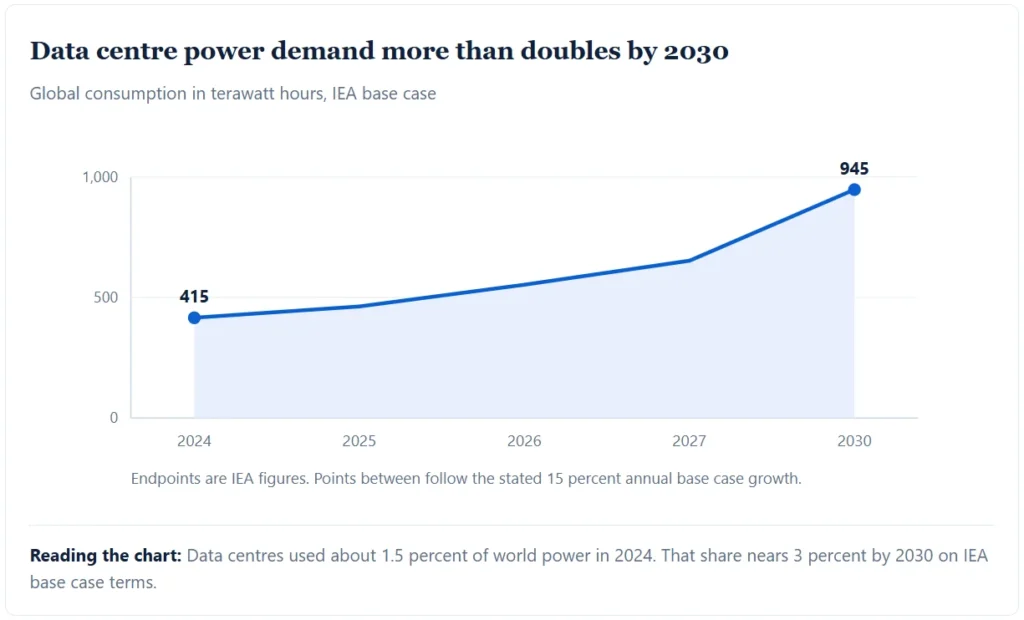
Money is no longer the scarce input. Power is. The International Energy Agency put data centre use at about 415 terawatt hours in 2024. That was near 1.5 percent of world power use.
Its base case sees about 945 terawatt hours by 2030. Faster chips drive almost half of that rise.
Crusoe’s own notes track the shift. Contracted capacity neared 5 gigawatts by June 2026. In July the firm signed a nuclear tie up with Aalo Atomics. It also agreed a 5 gigawatt backup power plan with ON.energy.
Grid queues are the real bottleneck. New supply takes years, at least in most markets. Chips take months. That gap sets the price of ready sites.
Why lenders should care
Banks now face this build as a credit question. Data centre debt is growing fast. In practice, loans rest on power deals, leases and tenant quality.
Credit teams must test three things. First, is the power contract firm and long dated? Second, does the tenant hold an investment grade rating? Third, what happens when chip cycles turn?
Rating work is still young in this field. So spreads vary widely across broadly similar assets.
What backers are really buying
Prices now assume near perfect delivery. Crusoe trades at three times its October 2025 mark. Fluidstack trades at more than double its early 2026 mark. Yet neither firm owns its full power stack.
Client mix is the second risk. A small group of model builders drives most demand. If one large buyer trims orders, revenue cover falls fast.
Debt is the third. Sites of this size need project finance. Rates and lease terms will shape returns as much as chip supply.
Exit routes matter too. Crusoe has met banks about a listing. By comparison, public markets price these assets on cash flow, not promise.
Still, the trend looks set. Money keeps moving from software down to the plant beneath it.