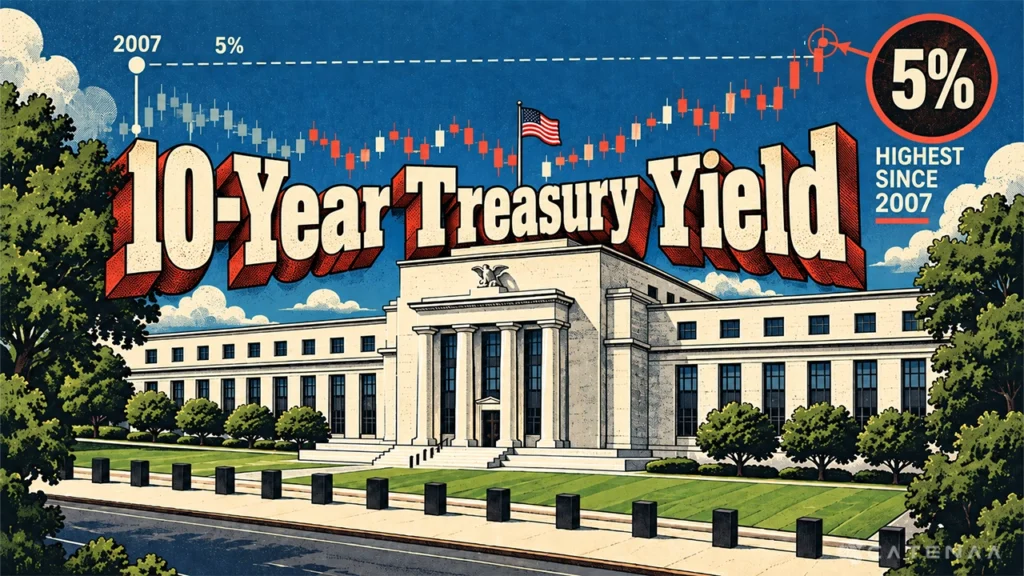


September 17, 2026 – The US benchmark closed at 5.00% on September 15, up 81 basis points this year. Real yields, not inflation fears, explain most of the move.

In Summary
The 10-year Treasury yield closed at 5.00%, its highest since 19 July 2007.
The yield has climbed 81 basis points in 2026 and 103 basis points from its February low.
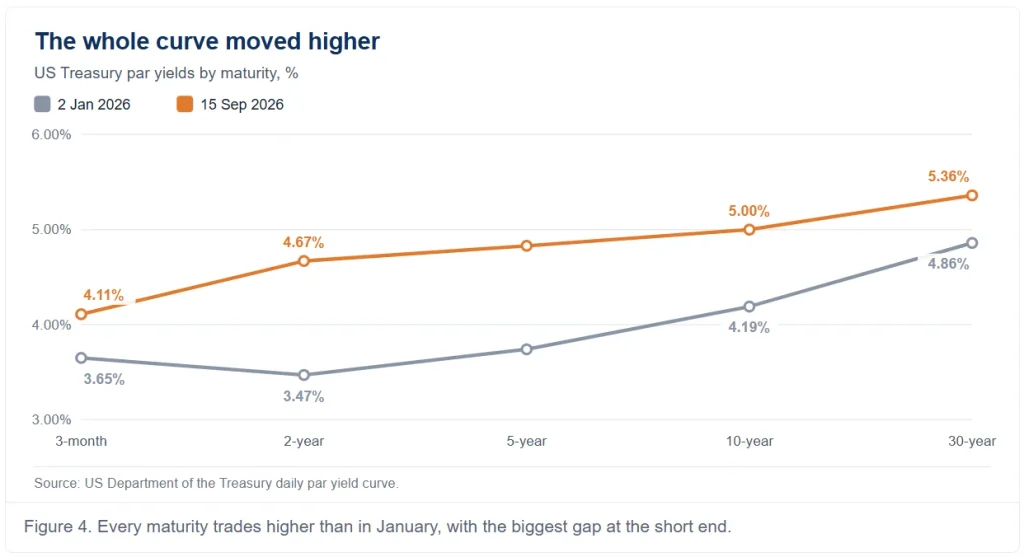
Two-year yields rose 120 basis points, flattening the curve to 33 basis points.
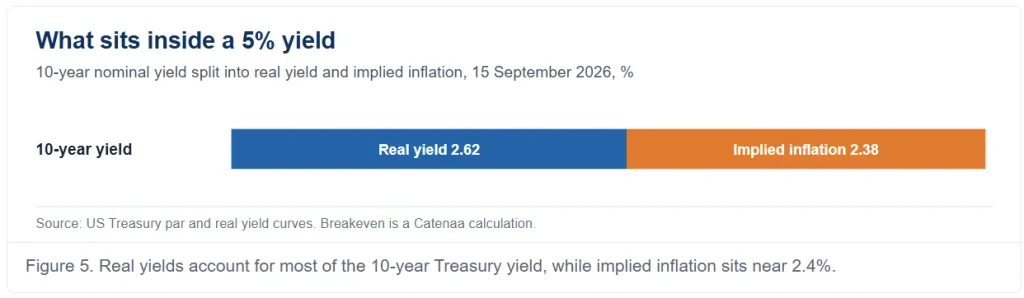
The 10-year real yield stands at 2.62%, so implied inflation sits near 2.4%.
Average 30-year mortgage rates reached 6.76%, up from 5.98% in February.
The 10-year Treasury yield closed at 5.00% on Tuesday, the highest finish since July 2007. The benchmark has now risen 81 basis points this year. Moreover, the move came one day before a Federal Reserve decision that could bring a rate hike.
A 5% yield matters far beyond the bond market. It sets the tone for mortgage rates, company borrowing costs and stock valuations around the world.
How the 10-year Treasury yield reached 5%
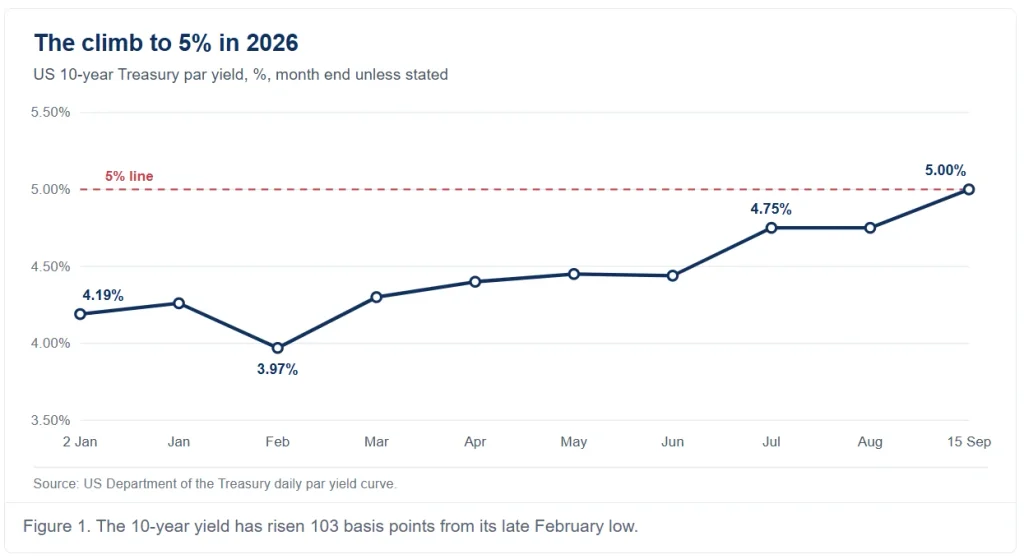
The Treasury par yield curve shows the 10-year note at 5.00% on 15 September. It started the year at 4.19% and hit a low of 3.97% at the end of February. Since then, it has fallen in only one month, June, and by just one basis point.
The biggest jump came in July, when the yield rose 31 basis points to 4.75%. In September alone, it added another 25 basis points. As a result, the path looks more like a staircase than a spike.
A level not seen in 19 years
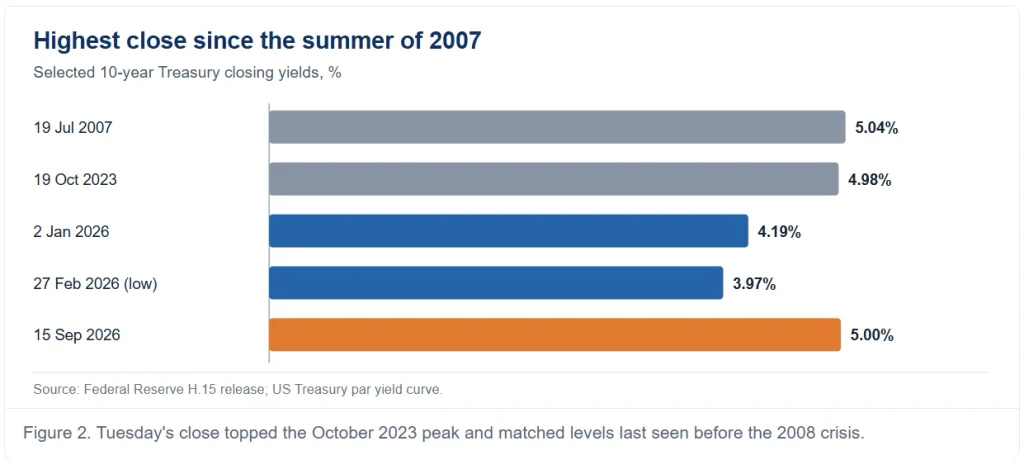
Federal Reserve daily rate records put the last close at or above 5% on 19 July 2007, at 5.04%. In October 2023, the yield came close but peaked at 4.98%. So Tuesday’s close broke a ceiling that held for almost two decades. Back in 2007, the Fed’s policy rate stood above 5%. Today, by contrast, the top of the range sits at just 3.75%.
Why yields keep rising
Several forces push in the same direction. Inflation has stayed above 3% since March, according to government data. At the same time, markets expect the Fed to raise rates this week. Furthermore, three Fed officials already voted for a hike in July.
Energy remains the common thread. Higher fuel costs lift inflation, which in turn pushes the central bank toward tighter policy. Bond investors then demand more compensation to hold government debt.
Short maturities led the move
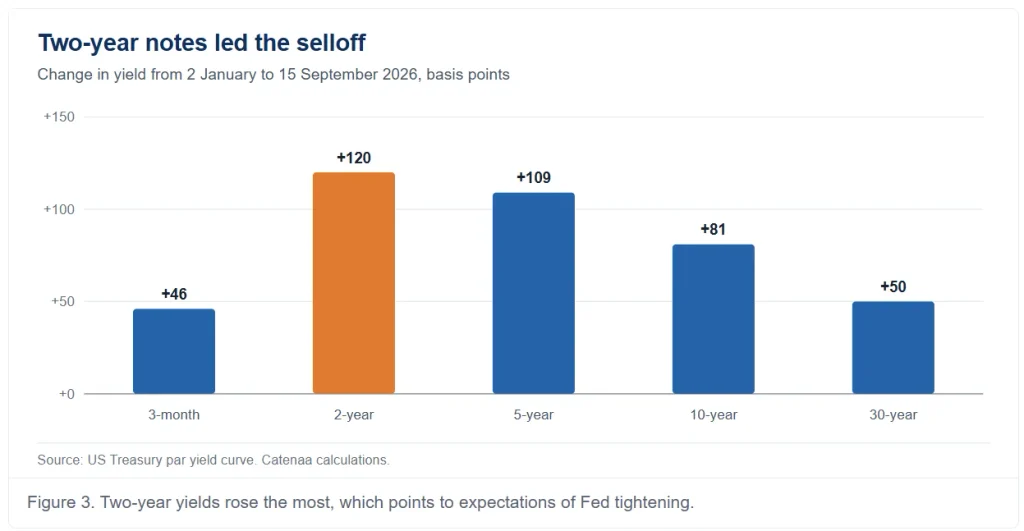
The selloff hit two-year notes hardest. Their yield jumped 120 basis points this year to 4.67%, reflecting bets on tighter Fed policy. By contrast, the 30-year bond rose 50 basis points to 5.36%.
That pattern flattened the curve. The gap between 10-year and 2-year yields shrank to 33 basis points from 72 in January. In other words, traders have priced more Fed tightening at the short end than at the long end.
Real yields do most of the work
The real yield curve shows the 10-year inflation-protected yield at 2.62%. That leaves implied inflation of about 2.38%, based on a Catenaa calculation. Therefore, more than half of the 5% yield reflects real returns rather than inflation fears.
That split matters. Headline consumer inflation runs at 3.4%, driven by a 16.3% jump in energy costs. Yet bond investors seem to expect price pressure to fade over the next decade. Instead, they demand a higher real reward for lending to the government.
Mortgage borrowers feel the pinch
Mortgage rates track the 10-year closely. The Freddie Mac weekly survey put the average 30-year fixed rate at 6.76% on 10 September. That compares with a 2026 low of 5.98% in late February.
A jump of 78 basis points adds real cost to a home loan. For example, it lifts the monthly payment on a new 30-year loan by about 8.5%. That estimate is a Catenaa calculation. Consequently, housing demand could cool just as builders face higher financing costs.
Global ripple effects
The move also travels abroad. Many governments and companies borrow in dollars or price loans off US rates. Therefore, a 5% benchmark can raise funding costs well beyond the United States.
Higher US yields can also lift the dollar. That tends to squeeze emerging market currencies and commodity prices, which trade in dollars.
What it means for investors
Higher yields raise the bar for stocks. When safe government bonds pay 5%, investors demand more from riskier assets. Growth and technology shares often feel this pressure first because their value rests on distant profits.
Crypto markets face a similar headwind. Bitcoin and other tokens offer no yield, so their relative appeal fades when bonds pay more. Meanwhile, cash and short-term bills now offer returns above 4%. For savers, that makes simply waiting on the sidelines a paid option again.
Next, watch the Fed decision on Wednesday. A hike with firm guidance could push short yields higher still. On the other hand, a softer tone could pull the 10-year back below 5%.