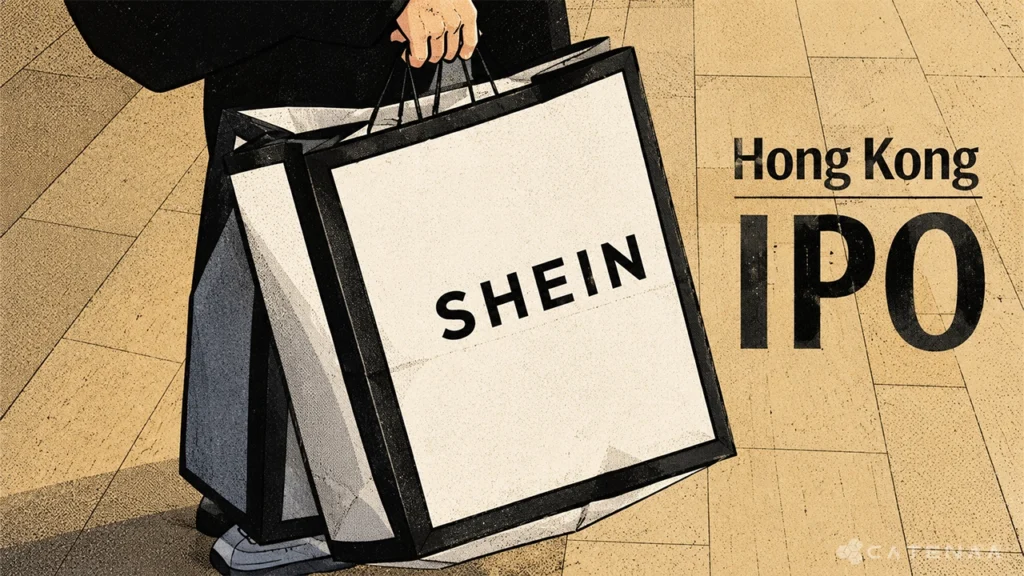


August 26, 2026 – After New York and London closed their doors, the fast fashion group finally has a venue. The price it accepted for this Hong Kong IPO tells the real story.

Shein has finally opened its books to public buyers. The Hong Kong IPO seeks as much as HK$13.86bn, or about $1.77bn. Moreover, the deal values the fast fashion group at close to $27bn.
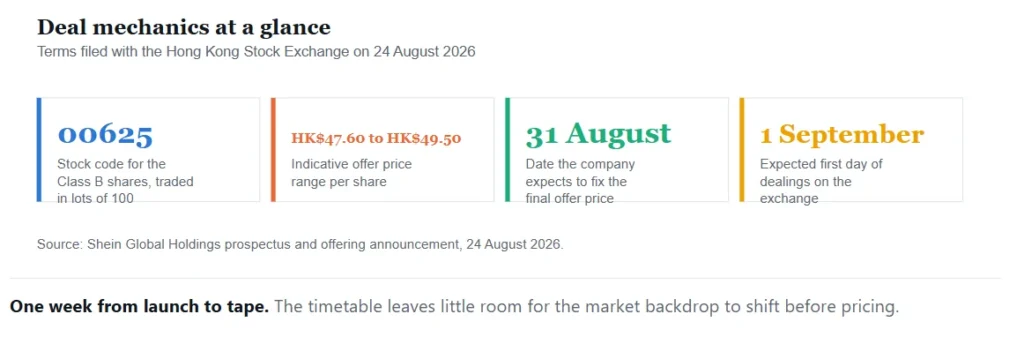
The company filed its prospectus on 24 August. It offers 280m Class B shares at HK$47.60 to HK$49.50 each. Trading starts on 1 September under stock code 00625.
In Summary
Shein seeks up to $1.8bn, including the over-allotment, at a value near $27bn.
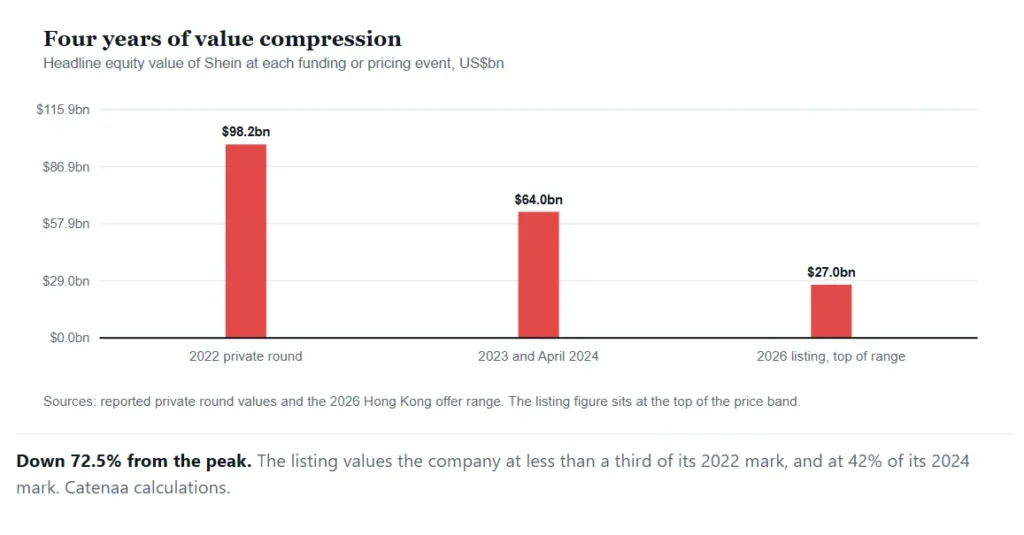
That mark sits 72.5% below the $98.2bn private valuation set in 2022.
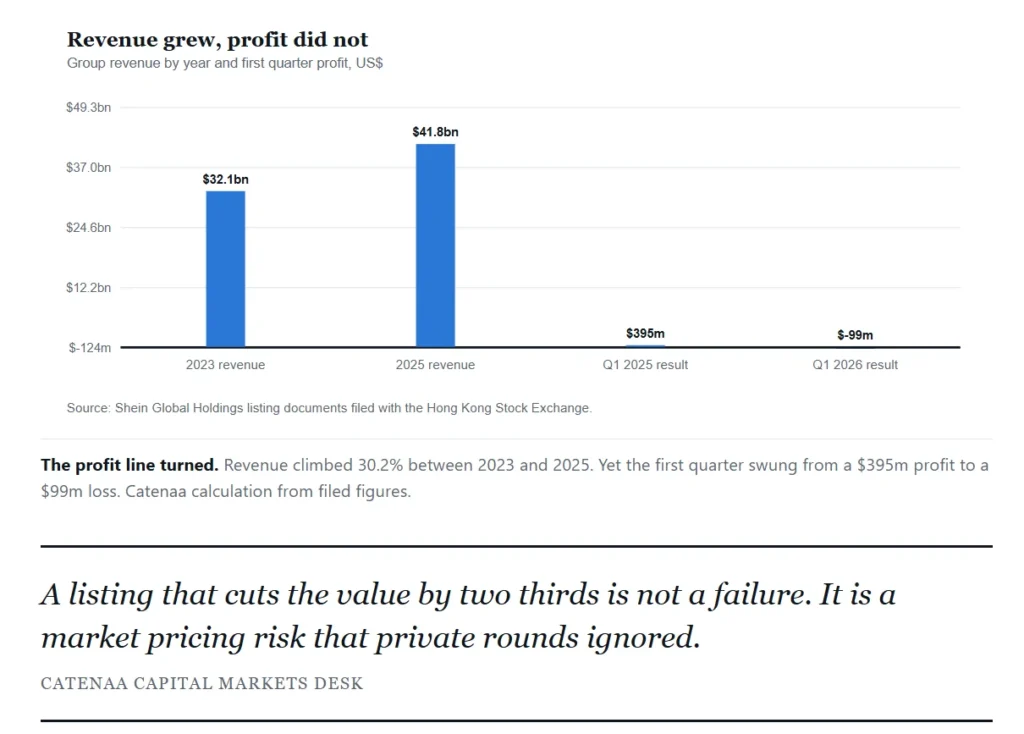
Revenue rose from $32.1bn in 2023 to $41.8bn in 2025, yet the first quarter of 2026 showed a $99m loss.
Seven cornerstone investors committed about $383m, roughly 22.5% of the offer.
The deal ranks as the largest new share sale in Hong Kong this year.
What the price tells you
Valuation carries the whole story here. For example, private buyers valued the company at $98.2bn in 2022. Then the figure settled near $64bn through 2023 and into April 2024. Each step down came without a public trade.
The listing resets that number hard. At the top of the range, the group prices at close to $27bn. So public buyers demand a 72.5% discount from the peak mark.
Ambition shrank along the way, too. Indeed, early investor meetings pointed to a $30bn to $40bn target. Even that softer goal proved too high in the end.
Growth slowed before the discount arrived
The financial record explains much of the gap. Revenue reached $41.8bn in 2025, up from $32.1bn two years earlier. However, the pace of growth fell sharply across that span.
Profit tells a starker story. Notably, the group earned $395m in the first quarter of 2025. In the same quarter of 2026, it lost $99m instead. That swing exceeds $490m.
Trade policy sits behind much of the squeeze. Washington ended the small parcel duty exemption for Chinese imports in May 2025. Consequently, the company raised prices and absorbed the cost it had once avoided.
Geography now drives the mix. Europe delivered $14.8bn of 2025 revenue, or 35.4% of the total. Meanwhile, sales to the rest of the world rose from $3.73bn to $4.10bn in the first quarter. Clearly, the group is steering away from America.
Who is buying the Hong Kong IPO
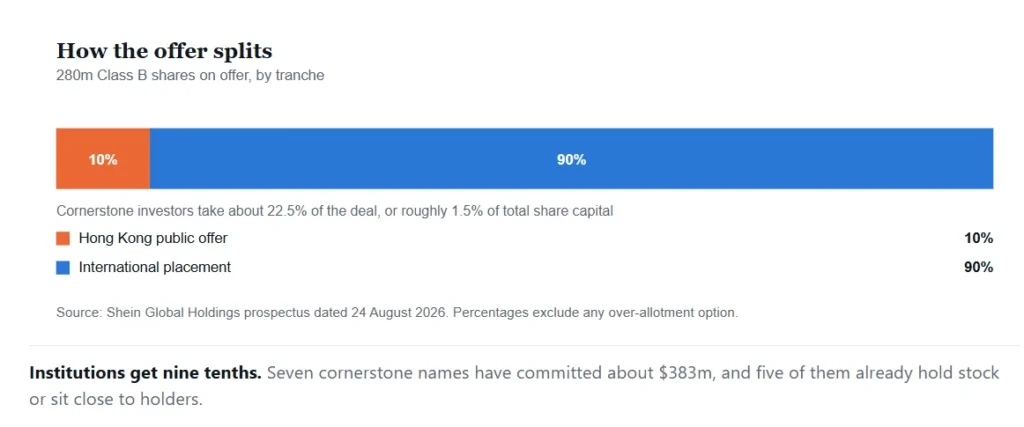
The book leans heavily on big funds. Ninety percent of the shares go to the international placement. By contrast, only 10% reaches the Hong Kong public offer.
Cornerstone support looks solid on paper. Seven investors committed about $383m, or roughly 22.5% of the deal. Yet five of them already hold stock or sit close to current holders.
That overlap matters for signal quality. Existing backers have an interest in a clean debut. Therefore, the order book tells you less about fresh demand than the raw number suggests.
Three global banks act as joint sponsors. Likewise, they have worked on this listing across three continents and several years. Above all, they now need a stable first week of trading.
The market backdrop helps
Venue matters as much as price. Earlier attempts in New York and London stalled on rules and politics. By comparison, Hong Kong offered a route that regulators on both sides could accept.
Hong Kong has had a strong year for new issues. Market tallies put proceeds at about $41bn so far, against roughly $17bn a year earlier. Consequently, appetite for large deals has returned.
The deal leads the local table. For instance, it beats a $751m offering from a self-driving firm in July. Across Asia, it ranks third, behind two large mainland listings.
Timing still carries risk. Global chip stocks fell on Monday, and Asian benchmarks followed. In short, the pricing window opens in a jumpy market. Sentiment can turn inside a week.
What to watch on debut
Three signals will matter most for this Hong Kong IPO. First, where the price lands inside the range on 31 August. A print at the bottom would flag thin demand.
Second, the retail subscription multiple. Hong Kong deals often draw enormous public interest, and weak retail cover reads badly. Additionally, the size of any over-allotment exercise will show how firm the book felt.
Third, watch the first fortnight. Cornerstone lock-ups and index eligibility both shape early trading. Readers can follow every filing through the HKEXnews portal and the offering announcement.
Company filings round out the picture. Meanwhile, Shein reported more than 2m apparel styles as at 31 March 2026. Its corporate site carries the group filings, while exchange statistics track wider listing volumes.




