

August 28, 2026 – Record data centre sales lifted revenue by 106%, yet thinner margins and rising memory costs now shape the debate.
In Summary
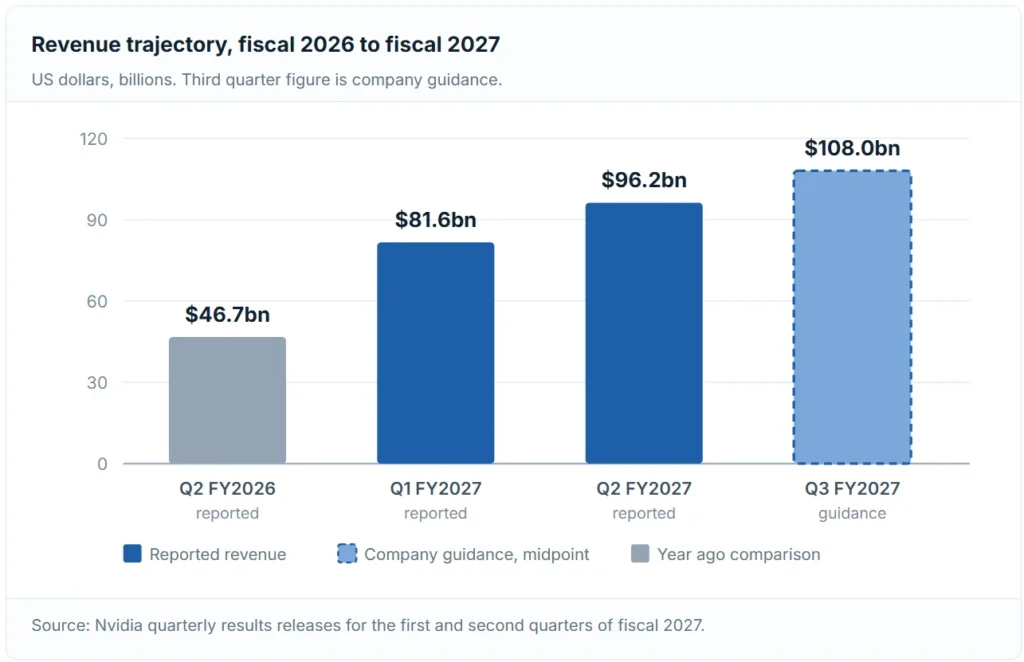
Nvidia posted second-quarter revenue of $96.2 billion, up 106% from a year earlier.
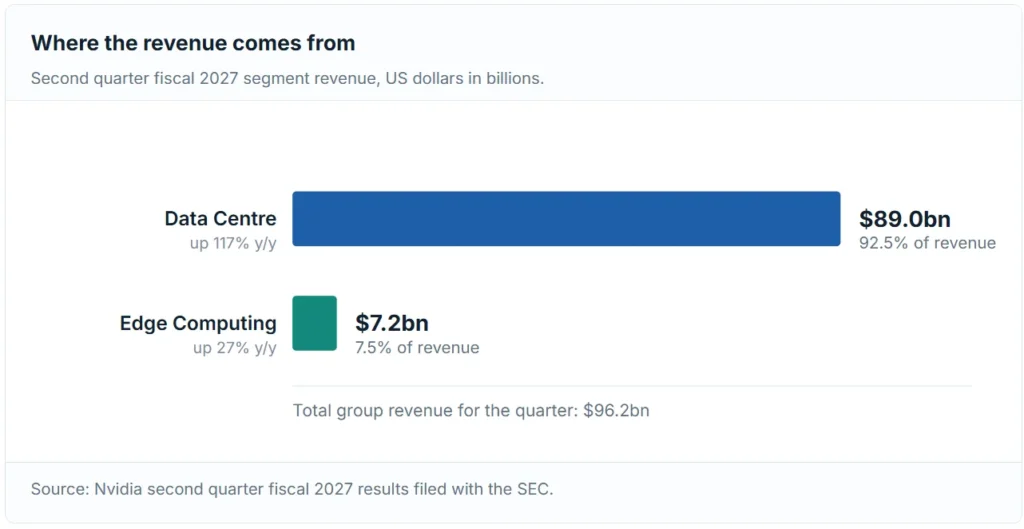
Data centre sales reached $89.0 billion and now make up about 93% of the group total.
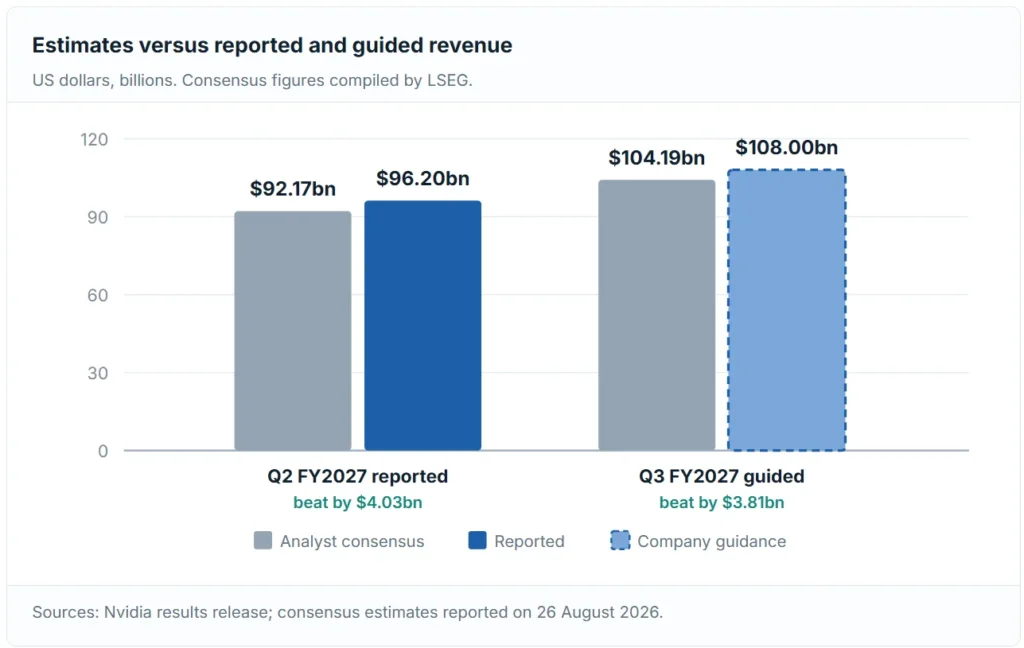
Third quarter Nvidia guidance of $108.0 billion topped the $104.19 billion consensus.
Gross margin guidance slipped to 74.0% because memory prices keep climbing.
The outlook assumes zero data centre compute revenue from China.
Nvidia has cleared another high bar. The chip designer reported revenue of $96.2 billion for the second quarter of fiscal 2027. That total rose 106% year on year and 18% from the prior quarter. Moreover, the firm guided to $108.0 billion for the current period. Analysts had modelled roughly $104.19 billion, so the forecast landed well clear of the street.
Data centre demand does the heavy lifting
Data centre revenue hit $89.0 billion in the quarter. That line grew 117% from a year ago and 18% from Q1. So the unit now makes up about 93% of group sales. Edge computing added $7.2 billion, a gain of 27%. Nvidia thus stays a one-market firm in sales terms.
Profits scaled with the top line. GAAP operating income reached $63.7 billion, up 124%. Net income came in at $59.7 billion. Diluted GAAP earnings hit $2.46 per share. On an adjusted basis, the figure was $2.22 against a $2.10 estimate.
The guidance beats, but margins send a warning
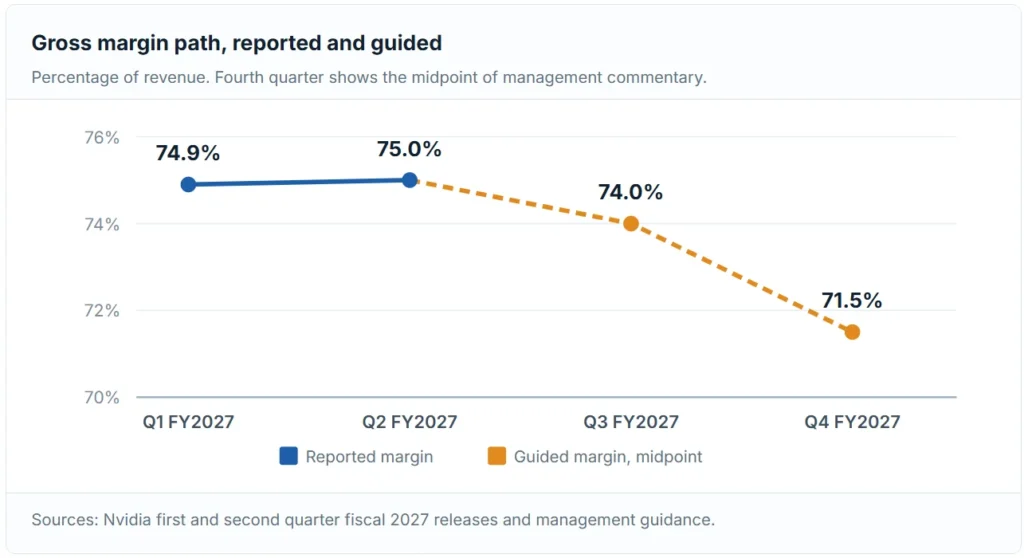
Third quarter revenue guidance sits at $108.0 billion, plus or minus 2%. However, gross margin guidance eased to 74.0% from 75.0%. Indeed, memory pricing is the culprit here. The firm flagged extreme conditions across the memory supply chain. Also, the team sees a fourth-quarter margin near 71% to 72%.
Chief executive Jensen Huang framed the moment plainly. “AI has reached its inflection point,” he said in the release. He added that compute has now become revenue. Even so, supply rather than demand now sets the ceiling.
China sits outside the forecast
Nvidia excluded China from its outlook entirely. The release states that no data centre compute revenue from the country is assumed. That choice strips out a big swing factor. Investors thus get a cleaner read on demand elsewhere. Any policy thaw would then land as upside, not as a shortfall.
How the print compared with expectations
Both headline numbers beat the street view. Revenue beat the $92.17 billion estimate by about 4.4%. Adjusted earnings topped forecasts by 12 cents. Similarly, the outlook beat came to about $3.8 billion. Such gaps look small in percent terms. In cash terms, though, they top the quarterly sales of most listed chipmakers.

Margin path becomes the swing factor
Gross margin was held at 75.0% during the quarter. The outlook points lower from here. High-bandwidth memory sits at the centre of the squeeze. After all, every AI chip needs large stacks of it. Suppliers have tight capacity, so prices keep firming. Nvidia expects relief in 2028 as prices reset.
Huang also pointed to roughly 70% revenue growth in fiscal 2028. Notably, few firms of this size have ever grown that fast. In fact, the forecast rests on how much supply the chain can ship. Demand, by contrast, looks well ahead of it.
Cash returns stay heavy
Shareholders got $26.0 billion in the quarter. A buyback plan worth $99.0 billion still stands. The board set a dividend of $0.25 per share. Payment then falls due on 1 October 2026. Such payouts show that cash flow still runs ahead of spending needs.
Market reaction was mixed
Shares closed at $209.66 on 26 August 2026. That price put its market value near $5.08 trillion. Notably, the stock slipped at first in extended trading. Later, it firmed as buyers weighed the outlook against the margin path. Year to date, the shares have added about 14%. Several rivals have run far harder.
The read for investors
Three signals stand out from this quarter. First, demand for AI compute has not cooled at all. Second, input costs have become a real margin risk. Third, China now sits outside the forecast as pure upside. Above all, Nvidia sells every unit it can build.
The next test comes with the fourth-quarter print. Watch the memory remarks closely. Look also at whether the guided margin low holds near 71%. Should pricing power return in 2028, this dip looks short-lived. If not, the market will start pricing in a slower profit path.




