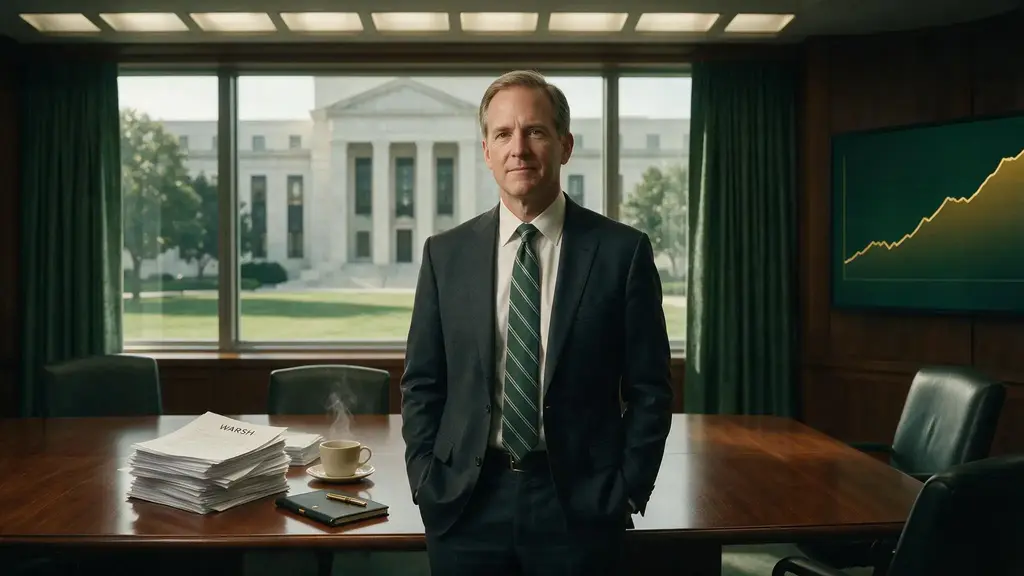


Catenaa, Monday, August 31, 2026-Federal Reserve Chairman Kevin Warsh has warned that US inflation is not slowing meaningfully enough, reinforcing expectations that the central bank may need to tighten monetary policy further.
Warsh said policymakers need convincing evidence that underlying inflation is moving clearly and rapidly toward the Fed’s 2% objective. Without that confidence, he indicated that the central bank still has more work to do.
The comments came during Warsh’s first major address at the Federal Reserve’s annual Jackson Hole gathering since taking over as chairman in May.
His remarks stopped short of committing the Fed to an interest-rate increase at its September meeting. They nevertheless gave financial markets a clearer indication that Warsh is prepared to act if inflation fails to improve.
Bloomberg reported that investors responded by increasing expectations for additional monetary tightening. The reaction reflected relief that the chairman had given markets a clearer view of the conditions that could lead the Fed to raise rates.
Warsh stressed that the Fed’s 2% inflation objective remains fixed rather than something policymakers can adjust according to economic circumstances.
That position matters because inflation has remained above target despite earlier monetary tightening and periods of slower price growth.
Recent data have shown some improvement in headline measures, but Warsh said those figures have not convinced him that underlying inflation trends have changed sufficiently.
His distinction between temporary improvement and a sustained decline is likely to become central to Fed policy over the coming months.
Policymakers generally look beyond individual monthly inflation reports because volatile categories can temporarily distort the overall rate. They instead examine broader trends across services, wages, housing and other parts of the economy to determine whether inflation is becoming entrenched.
Warsh also said interest rates remain the Fed’s main instrument for carrying out its mandate.
That signals little appetite for relying on unconventional policies if inflation remains elevated. The benchmark federal funds rate would remain the central mechanism for restraining demand and bringing price pressures under control.
Higher interest rates increase borrowing costs across the economy. Mortgages, business loans, credit cards and corporate financing can all become more expensive as monetary policy tightens.
The intention is to reduce demand enough to slow price increases without causing an unnecessarily severe economic contraction.
That balance has become increasingly difficult for policymakers.
Some parts of the US economy have already shown the effects of higher borrowing costs, particularly housing and other interest-sensitive sectors.
At the same time, consumer spending and business investment have shown enough resilience to raise questions over whether monetary conditions are sufficiently restrictive.
Warsh suggested that overall financial conditions do not yet appear tight enough to assume inflation will automatically return to target.
That assessment could strengthen the case for another rate increase if upcoming data fail to show clearer progress.
The Fed’s next decisions will therefore depend heavily on inflation, employment and broader economic indicators released before policymakers meet again.
Warsh avoided giving markets a predetermined policy path.
Instead, he framed his position around the evidence required before the Fed can be confident that inflation is returning to 2%.
That approach gives the central bank flexibility to respond if economic conditions change while making clear that persistent inflation would require action.
The message also marks an important early test for Warsh’s leadership.
A new Fed chairman must establish credibility with financial markets while maintaining the institution’s independence and avoiding unnecessary volatility in expectations.
Inflation credibility is particularly important because consumers and businesses can adjust behavior when they expect prices to continue rising.
If households anticipate persistent inflation, they may bring purchases forward. Workers may seek larger wage increases, while companies may raise prices more readily.
Those behaviors can make inflation more difficult to control.
Central banks therefore try to prevent expectations from becoming detached from their official targets.
Warsh’s emphasis on the 2% goal appears designed partly to reinforce that credibility.
His comments also have consequences beyond the US economy.
Higher US rates can strengthen the dollar, raise global borrowing costs and affect capital flows into emerging markets.
They can also influence cryptocurrency markets.
Bitcoin and other digital assets have often responded to changes in expectations for US monetary policy because higher interest rates can reduce investors’ willingness to hold assets that do not generate conventional yield.
Tighter financial conditions can also reduce the liquidity available for speculative and risk-sensitive markets.
The effect is not always immediate or uniform. Crypto prices increasingly respond to institutional flows, regulatory developments and asset-specific factors alongside monetary policy.
Still, a renewed Fed tightening cycle would represent an important change in the macroeconomic environment for digital assets.
Warsh’s remarks therefore give investors a relatively clear condition to watch.
The issue is no longer simply whether inflation has declined from previous highs. The question is whether the decline is strong and consistent enough to convince policymakers that the 2% target is approaching without further intervention.
Until that evidence emerges, Warsh has signaled that the option of additional monetary tightening remains open.
Background: Kevin Warsh became Federal Reserve chairman in May 2026, succeeding Jerome Powell and taking control of US monetary policy after several years dominated by the fight against inflation. The Fed seeks maximum employment and stable prices, with policymakers defining price stability as inflation averaging around 2% over time. Interest-rate increases generally slow economic activity by making credit more expensive, while rate cuts support borrowing and demand. Fed policy also influences Treasury yields, currencies, equities and digital assets worldwide because the US dollar remains central to global finance. The annual Jackson Hole symposium in Wyoming is closely watched because Fed leaders have historically used the gathering to signal changes in monetary-policy thinking. Warsh’s latest speech was his first major Jackson Hole address as chairman.




