

September 02, 2026 – Kevin Warsh used Jackson Hole to bury forward guidance. Traders answered within minutes, and September hike odds now sit near two-thirds.
In Summary
Warsh told Jackson Hole that transparency about future decisions is “not a virtue unto itself”.
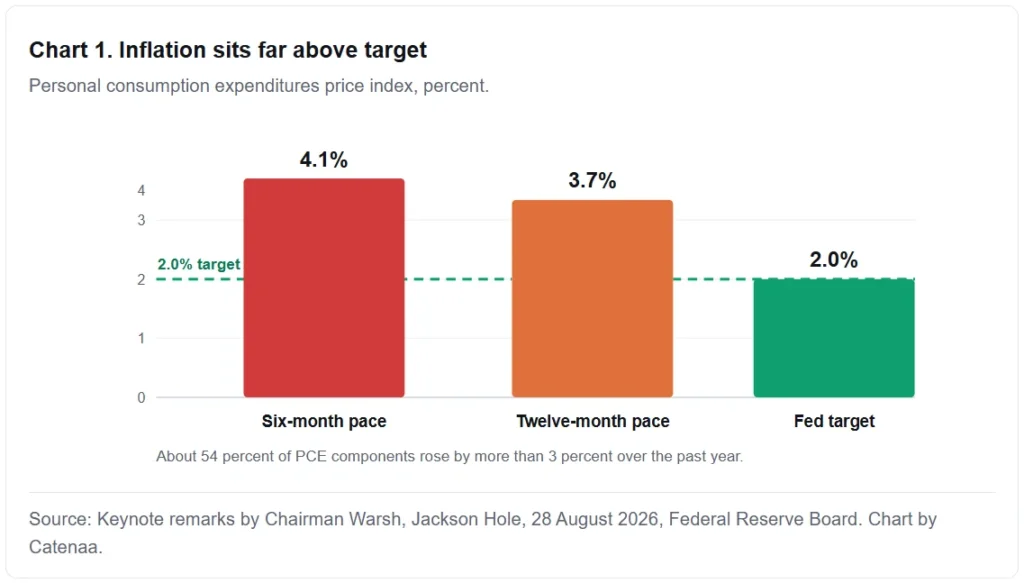
Twelve-month PCE inflation stands at 3.7 percent, while the six-month pace runs at 4.1 percent.
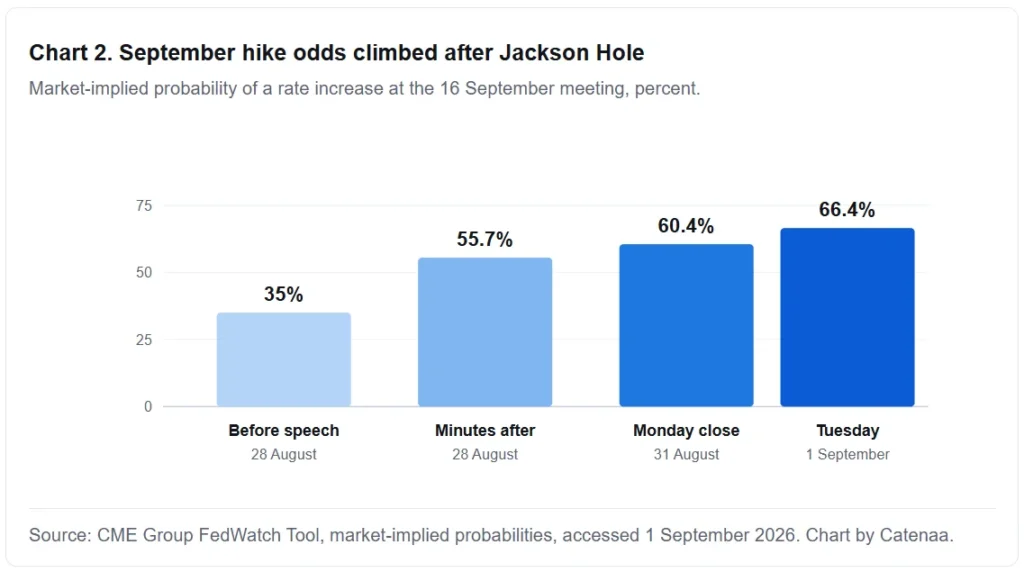
Market-implied odds of a September hike rose from about 35 percent to roughly 66 percent.
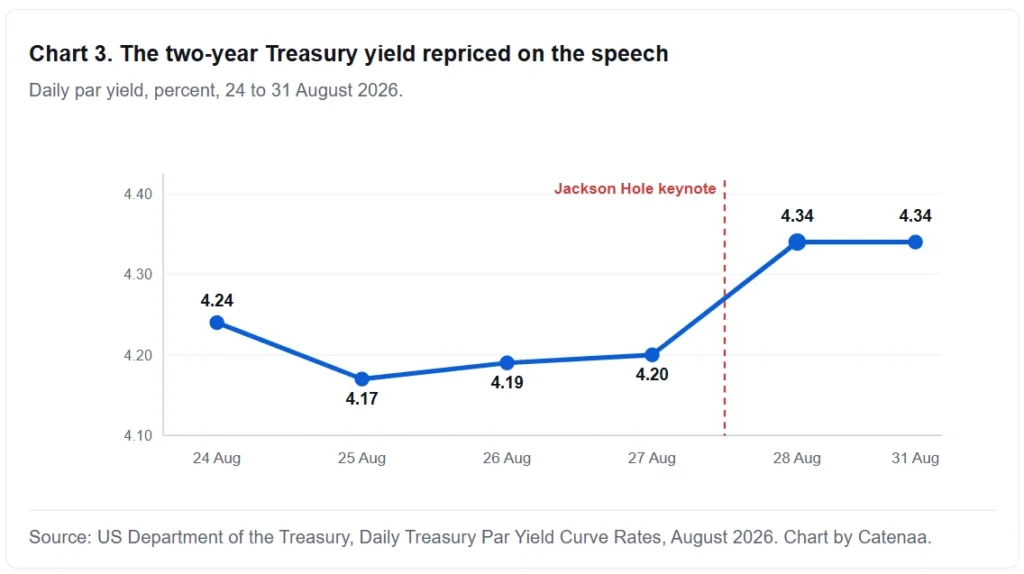
The two-year Treasury yield jumped to 4.34 percent on 28 August from 4.20 percent a day earlier.
Three policymakers already dissented in July, preferring an immediate quarter-point increase.
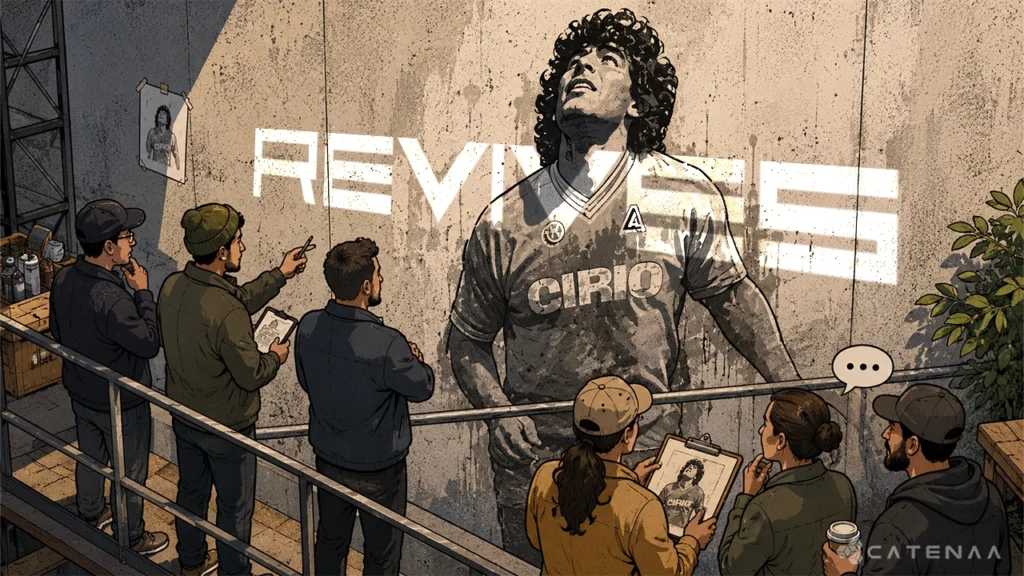
Central bankers rarely borrow from football. Mervyn King did exactly that in 2005. His Mais Lecture described Diego Maradona’s second goal against England in 1986. Maradona ran “virtually in a straight line”, yet he beat five defenders.
Defenders moved because they expected him to swerve. King argued that interest rates work the same way. Expectations do the heavy lifting, so the policy rate barely needs to move.
Warsh rejects the straight line
Kevin Warsh now runs the Federal Reserve. His first Jackson Hole keynote attacked that equilibrium. Forward guidance, in his framing, has become a crutch. Warsh warned that overcommitment can lead “markets, businesses, and households astray”.
He also described a “hall-of-mirrors” dynamic. Markets read the Fed, while the Fed reads markets. Neither side then reads the economy. Consequently, Warsh promised discipline instead of promises. He closed with a pointed line. “I stand here today committed to a discipline, not to a decision,” Warsh said.
The inflation case behind the hawkishness
Numbers supported the tone. Headline personal consumption expenditures inflation runs at 3.7 percent over twelve months. The six-month annualised pace sits higher, at 4.1 percent. Both readings exceed the 2 percent target by a wide margin.
Breadth looks equally uncomfortable. Roughly 54 percent of PCE components rose more than 3 percent over the past year. Inflation, therefore, looks general rather than narrow.
The real economy is not asking for help
Warsh described solid activity alongside the price problem. Business capital spending grows by nearly 9 percent, the fastest since 2021. Corporate profits climbed more than 20 percent from a year earlier. Private domestic final purchases advanced about 3 percent. Unemployment held at 4.1 percent.
Such data weakens the argument for patience. Moreover, the Chairman set a clear bar for cutting. Policymakers must feel confident inflation moves toward target “clearly and at sufficient speed”.
Why the analogy still bites
King’s football story described a benign world. Inflation sat near target, and credibility did the work. Expectations anchored themselves, so policy rates could stay unusually still.
Conditions today differ sharply. Prices run well above target, and breadth remains wide. A central bank cannot coast on expectations when the public sees rising prices weekly. Warsh therefore argues for action rather than choreography.
Critics see a cost in that approach. Less guidance means more volatility around each meeting. Bond desks must now price genuine uncertainty again. Some strategists welcome the change, since it restores information value to data releases.
Markets repriced within minutes
Futures traders moved almost immediately. Odds of a September increase stood near 35 percent before the speech. They reached 55.7 percent within minutes. Pricing then firmed to 60.4 percent on Monday and about 66 percent by Tuesday morning.
Front-end yields moved first
Treasury data captured the shift cleanly. The two-year yield closed at 4.20 percent on 27 August. It finished at 4.34 percent on 28 August, then held there on 31 August. Short maturities carry the most policy sensitivity, so the move looks deliberate.
Longer tenors followed at a slower pace. The ten-year rose to 4.75 percent, while the thirty-year reached 5.25 percent. Therefore, the curve steepened modestly at the long end.
Cross-asset damage was broad
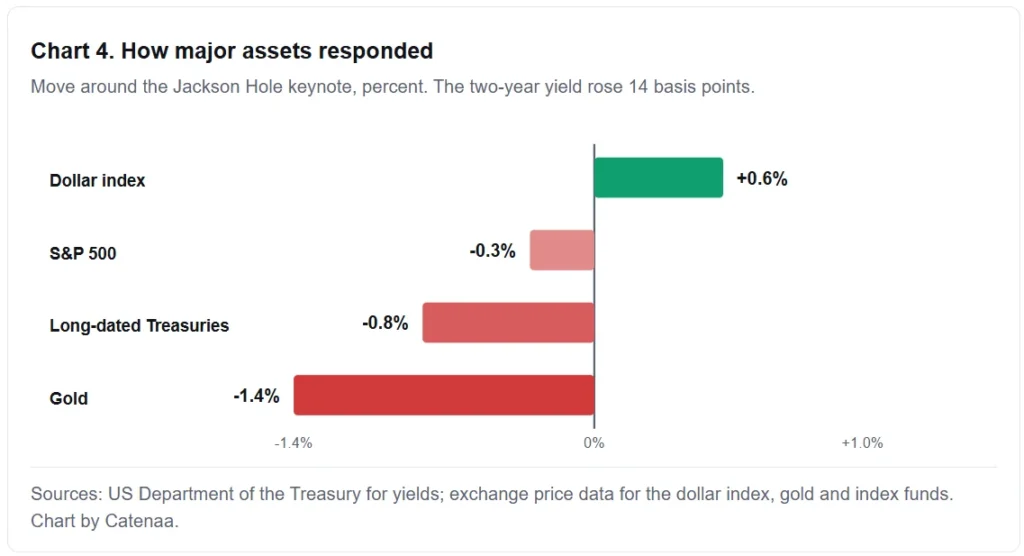
Risk assets took the message poorly. The dollar index gained 0.6 percent to 99.66. Gold slipped 1.4 percent to about $4,418.80 an ounce. Equity benchmarks eased around 0.3 percent, while long-dated Treasury funds fell 0.8 percent.
Gold reacted most sharply, which fits the pattern. Higher real yields raise the cost of holding assets that pay no income. Currency strength then compounds the drag for overseas buyers.
Policymakers were already split
Warsh did not create this hawkish turn alone. The July 2026 policy statement held the target range at 3.50 to 3.75 percent. Beth Hammack, Neel Kashkari, and Lorie Logan each dissented. All three preferred a quarter-point increase at that meeting.
Three dissents represent a meaningful minority. A hawkish chair plus three existing dissenters changes the arithmetic quickly. Only two further votes would then be needed for a move.
Politics adds a further layer. A tighter policy stance sits awkwardly with the Treasury borrowing programme. Analysts have flagged friction since the speech.
What to watch before 16 September
Two data points now carry outsized weight. August payrolls arrive on 4 September. Consumer price figures follow on 11 September. Soft prints would cool the hike narrative, whereas firm prints would cement it.
Investors should also watch the guidance itself. Warsh wants fewer signals and more discipline. Markets, however, still trade on signals. That tension will define the next few quarters of policy communication.