

August 27, 2026 – Core prices rose 3.3% over the year through July. Second quarter growth survived revision almost untouched.
In Summary
The PCE price index rose 0.2% in July and 3.7% over 12 months.
Core PCE held at 3.3% a year, far above the Federal Reserve’s 2% goal.
Real consumer spending barely moved, up less than 0.1% for the month.
Second quarter GDP stayed at a 1.5% annual rate after revision.
Company profits jumped $400.9 billion, which cushioned margins.
Prices refuse to break lower
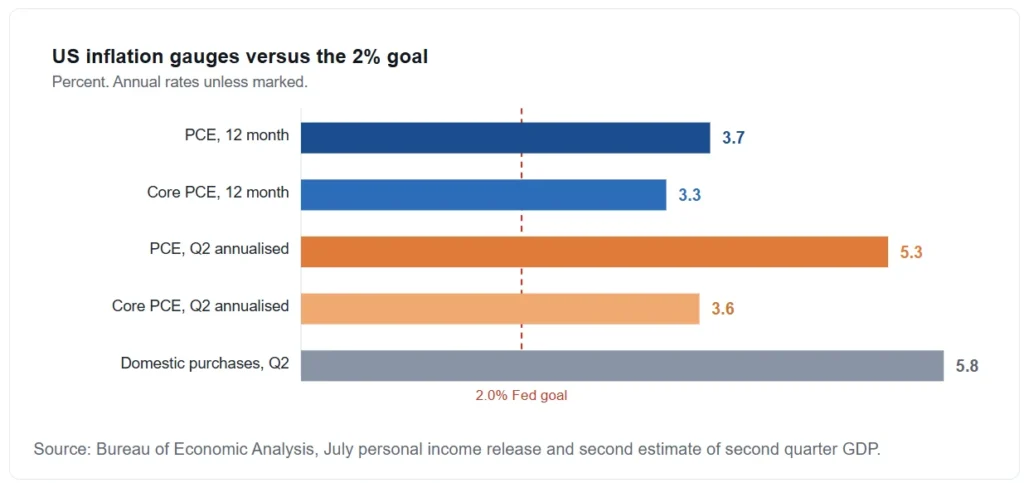
The Bureau of Economic Analysis published July income data on 26 August 2026. According to the BEA personal income release, the PCE price index rose 0.2% for the month. Over 12 months, the gauge gained 3.7%. Core PCE, which strips out food and energy, also rose 0.2%. Its annual pace held at 3.3%.
Both readings sit well above the Federal Reserve’s 2% longer-run objective. Moreover, the gap has proved lasting rather than brief. Rate setters therefore face a familiar problem. Inflation is neither racing higher nor fading away.
Households earn more, yet spend cautiously
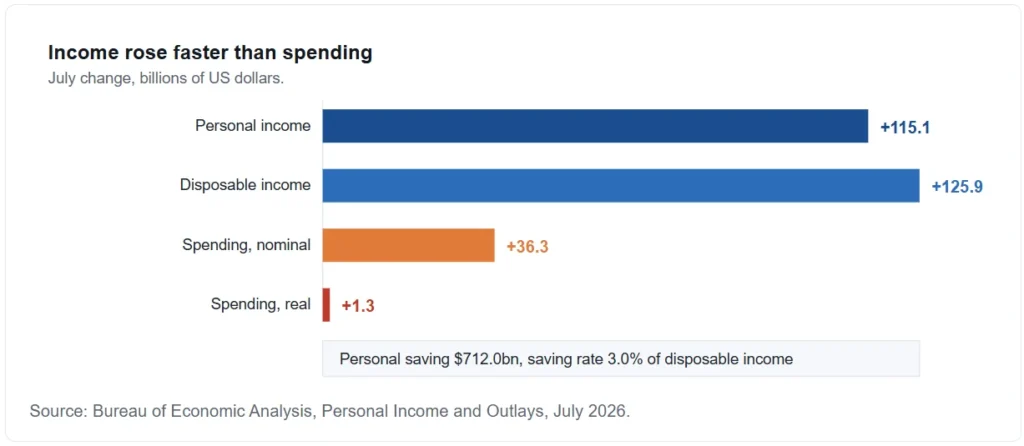
Personal income climbed $115.1 billion in July, up 0.4%. Disposable personal income rose $125.9 billion, or 0.5%. However, cash spending rose by only $36.3 billion. That works out at 0.2%.
After prices, real spending rose just $1.3 billion. In percentage terms, the move stayed below 0.1%. Pay, social benefits, and asset income drove the gain. Shoppers, by contrast, kept their wallets close.
Services carry the basket
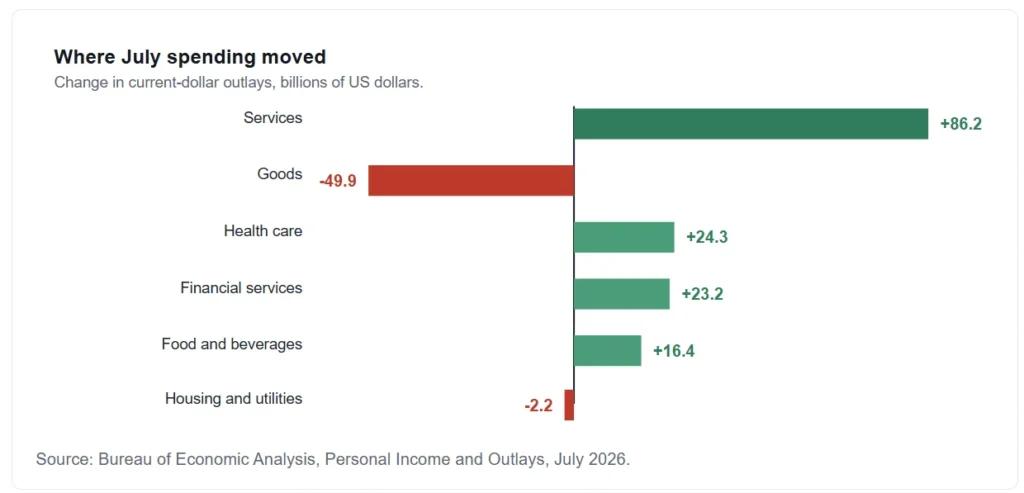
Outlays on services increased by $86.2 billion during July. Goods spending fell by $49.9 billion over the same month. Health care added $24.3 billion. Finance and insurance added $23.2 billion. Food and drink supplied $16.4 billion. Housing and utilities, meanwhile, slipped $2.2 billion.
The savings buffer stays thin
Personal savings totalled $712.0 billion in July. It equalled 3.0% of disposable income. So households carry a slim cushion against a job market shock. Any drop in hiring would hit demand fast.
Growth held at 1.5%
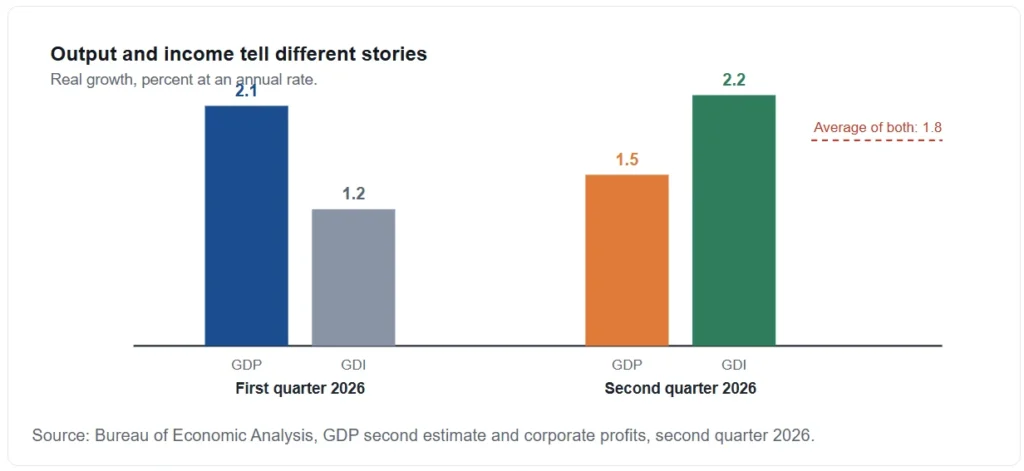
Separately, the agency left second-quarter growth at a 1.5% yearly rate. The second estimate of GDP moved the figure by less than 0.1 percentage point. First-quarter growth had reached 2.1%. Consumer spending, exports, and investment lifted output. Government spending fell. Imports rose, which trims measured GDP.
The income side looks stronger
Real gross domestic income rose 2.2%, up from 1.2%. Blending the two measures gives 1.8%. Real final sales to private domestic buyers rose 4.2%, revised up 0.3 points. That gauge strips out trade and stock swings. Core demand therefore, looks firmer than the headline suggests.
Quarterly price gauges ran hot
Within the quarter, prices climbed faster than the annual figures imply. Gross domestic product prices rose 5.8%, revised up 0.1 point. Headline PCE prices rose 5.3%, a further 0.2 points higher. Excluding food and energy, the measure rose 3.6%. Import costs and tariffs explain much of that gap.
The gap between quarterly and annual prices
Two price stories now run side by side. Yearly PCE inflation sits at 3.7%, which looks high but steady. The quarterly annualised rate of 5.3% looks far worse. That gap reflects a burst of price rises in the spring.
Economists treat these short-run gauges with care. They turn short bursts into scary headline numbers. Even so, the trend deserves attention.
Profits absorbed the squeeze
Company profits from current output jumped $400.9 billion in the second quarter. They had raised only $74.4 billion in the first. Firms therefore kept pricing power despite softer volumes. That strength helps shares, yet it keeps price pressure alive.
Three risks ahead
Three risks now stand out. Tariffs could push goods prices higher again. Weak hiring could cut income growth. A thin savings rate could then force spending cuts. Each risk feeds the others.
What the data means for policy
Sticky core inflation at 3.3% blocks any quick easing cycle. Growth near 1.5% is slow, though not a slump. A 3.0% savings rate also leaves little room for error. Analysts will now watch jobs data and the next PCE price index update closely. The path of rates depends on which side breaks first.
Markets have already priced in a slow easing cycle. Any upside surprise in core prices would unwind that view. Conversely, a weak payroll print would revive cut expectations quickly.




