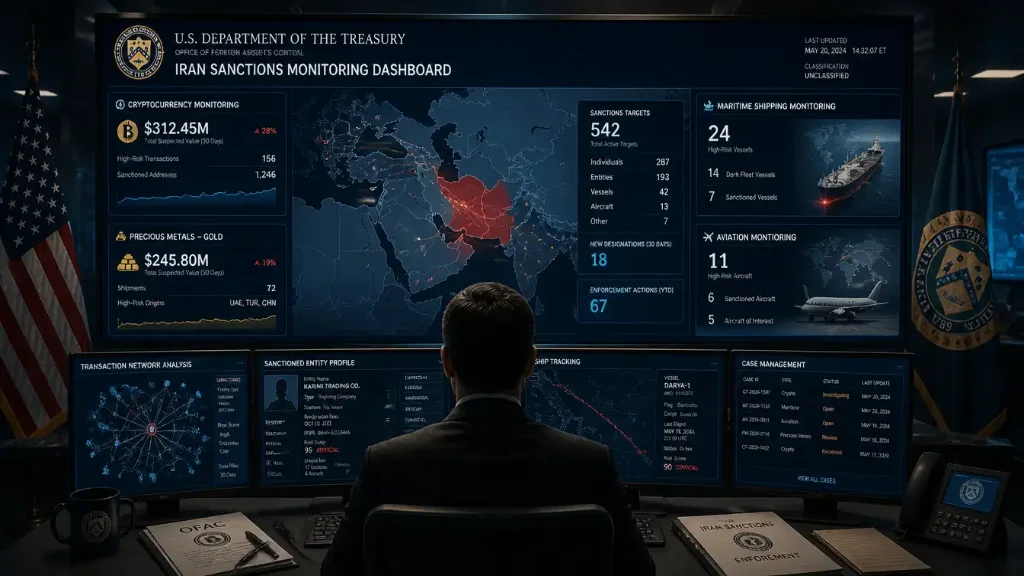


Catenaa, Monday, August 24, 2026- The United States is expanding sanctions against Iran across cryptocurrency, gold, aviation, technology and shipping as Washington seeks to cut revenue channels supporting Tehran’s economy.
Treasury Secretary Scott Bessent announced the expanded campaign Monday as part of what administration officials have described as an economic pressure offensive against Iran.
The measures increase the risk of secondary sanctions for foreign companies, financial institutions and intermediaries that continue conducting business with sanctioned Iranian entities.
Unlike primary sanctions, secondary sanctions can target non-US companies even when their transactions do not directly involve American persons or businesses.
That gives Washington a wider tool for discouraging overseas firms from maintaining financial or commercial relationships with Iran.
Digital assets are becoming a larger part of the enforcement effort.
The Treasury included several cryptocurrency addresses in its latest sanctions action, reflecting US concerns that Iran can use blockchain-based transfers to move funds outside conventional banking channels.
One sanctioned address was linked to Arman Kahzadian, whom Treasury said gained control of a bitcoin wallet containing more than $30,000 in 2023.
The action follows earlier US moves against Iran-linked cryptocurrency infrastructure.
In June, Washington sanctioned Nobitex, Iran’s largest cryptocurrency exchange.
US authorities accused the platform of helping facilitate sanctions evasion and transactions connected to the Islamic Revolutionary Guard Corps and other sanctioned activity.
Bessent said in May that the United States had seized nearly $1 billion in cryptocurrency linked to Iran.
Those actions show Washington increasingly treating blockchain addresses and crypto platforms in the same manner as bank accounts, shipping companies and commercial entities.
The latest strategy goes beyond freezing assets held under US jurisdiction.
Washington is also seeking to change the behavior of overseas companies.
Bessent said countries and businesses dealing with targeted Iranian sectors would face deadlines to end identified activity.
Treasury, the State Department and US military officials are also engaging foreign governments and other stakeholders over implementation.
The approach could place banks, commodity traders, shipping companies and technology suppliers in difficult positions.
A company may operate outside the United States but still depend on access to dollar clearing, American financial institutions or US markets.
Secondary sanctions can make that access vulnerable.
That gives the United States leverage over transactions that would otherwise occur beyond its direct jurisdiction.
Iran has historically relied heavily on energy exports for foreign currency.
Successive US administrations have targeted oil sales, shipping networks, financial intermediaries and companies accused of helping Tehran move revenue overseas.
The latest campaign broadens that effort.
Gold can serve as an alternative store of value and settlement asset when access to foreign currency is restricted.
Shipping networks can disguise the origin or destination of sanctioned cargo.
Technology can support both commercial activity and military-linked industries.
Digital assets add another route for moving value without relying entirely on correspondent banks.
Washington’s strategy appears aimed at reducing Iran’s ability to shift between those channels when one becomes harder to use.
Cryptocurrency can help move funds internationally, but public blockchains also create records that investigators can analyze.
Bitcoin and many other crypto networks store transactions on publicly accessible ledgers.
Authorities can follow transfers between addresses even when the identity behind a wallet is initially unknown.
Blockchain intelligence companies increasingly work with governments and financial institutions to connect addresses with exchanges, individuals and sanctioned entities.
That has made wallet addresses a routine feature of sanctions enforcement.
Once an address is identified, regulated exchanges can block transactions connected to it.
The process does not prevent every transfer.
Users can move funds across additional wallets, use decentralized platforms or attempt to obscure transaction trails.
However, sanctioned crypto becomes harder to convert into conventional currency when major exchanges and financial intermediaries screen wallet activity.
The latest announcement comes during the continuing US-Iran confrontation and follows months of expanding economic restrictions.
Washington has already targeted Iranian oil revenue and shipping activity.
The addition of broader digital asset measures suggests authorities see cryptocurrency as part of Iran’s wider financial infrastructure rather than a separate enforcement issue.
Iran has faced years of restrictions on access to international banking.
That environment has encouraged greater interest in alternative settlement methods, including cryptocurrency and trade conducted outside dollar-based channels.
For US officials, the challenge is preventing those alternatives from weakening the effect of existing sanctions.
The secondary sanctions element could have consequences beyond Iran.
Companies in Asia, the Middle East and other regions may need to review transactions involving Iranian counterparties, shipping routes and digital asset addresses.
Crypto businesses face the same compliance burden.
Centralized exchanges can screen customers and blockchain addresses against sanctions databases.
Wallet providers and decentralized platforms face more complex questions because transactions may occur without a traditional financial intermediary.
The increasing use of blockchain analytics gives regulators more tools to identify flows after they occur.
It also raises pressure on crypto companies to screen transactions before funds are moved or converted.
The effectiveness of Washington’s expanded campaign will depend on how consistently foreign businesses respond.
Secondary sanctions work largely by forcing companies to choose between maintaining relationships with sanctioned entities and retaining access to the US financial system.
That leverage can be powerful.
It can also encourage sanctioned countries to develop alternative trade and payment networks that reduce dependence on Western financial infrastructure.
Cryptocurrency is one part of that contest.
Digital assets can move across borders without conventional bank transfers, but the public nature of many blockchains can also make those movements easier to trace.
The result is an increasingly sophisticated enforcement race.
Iran and other sanctioned actors are searching for new ways to preserve access to capital.
US authorities are expanding their ability to follow those flows across banks, ships, commodity markets and blockchain networks.
The latest measures show that cryptocurrency is now firmly inside that sanctions battlefield.