

September 06, 2026 – One strong jobs report has reopened a debate most desks thought settled. However, the Fed itself sounds far from united with 10 days to go.
In Summary
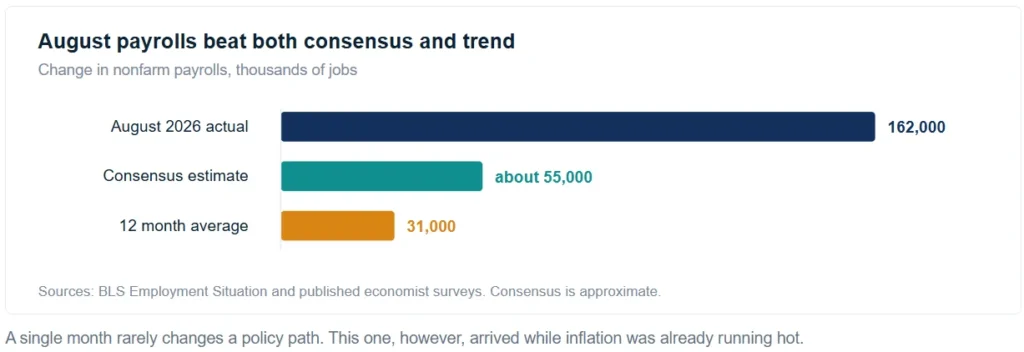
August payrolls rose 162,000, roughly three times the consensus estimate.
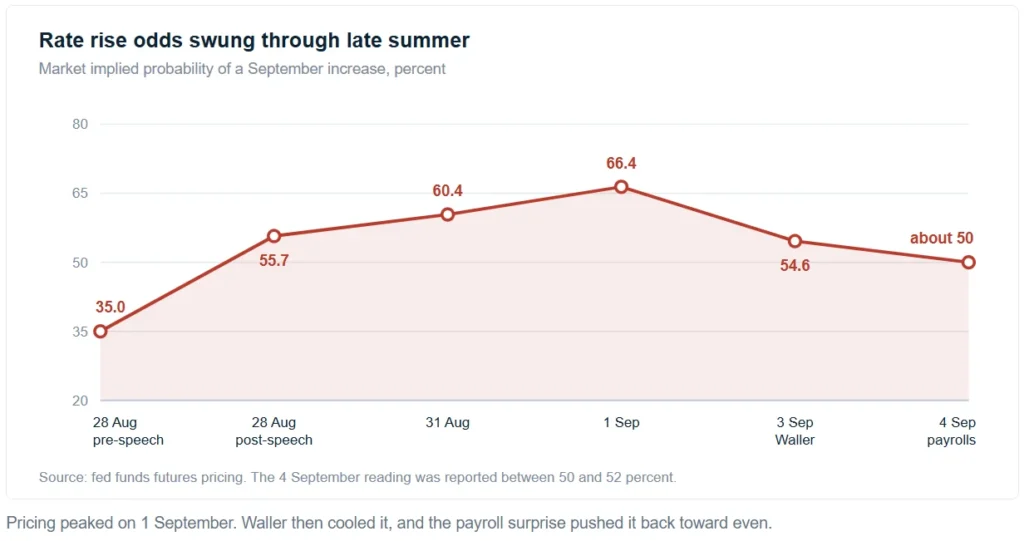
Market implied odds of a September rise now sit close to a coin toss.
Chair Kevin Warsh warned at Jackson Hole that the Fed still has work to do.
Governor Christopher Waller said he leans toward holding if inflation keeps cooling.
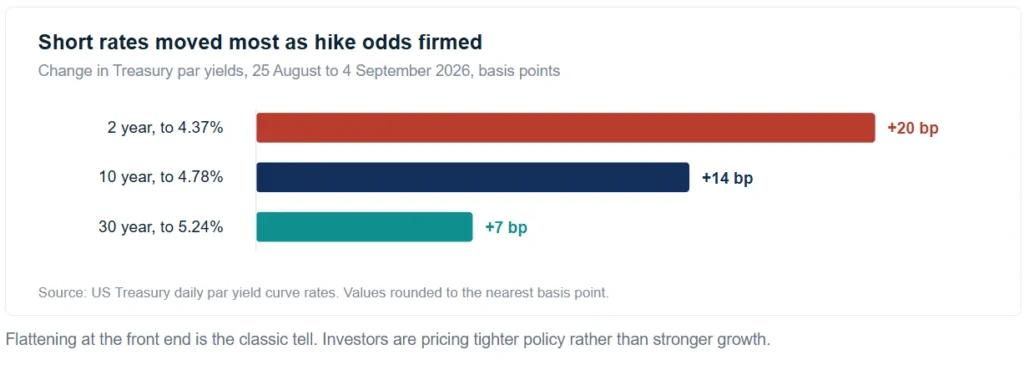
Two year Treasury yields have climbed 20 basis points since 25 August.

A job’s number nobody forecast
The August report landed well above every mainstream estimate. Nonfarm payrolls rose by 162,000. Most economists had pencilled in figures near 55,000. Unemployment held steady at 4.1 percent. Revisions added another 55,000 jobs across June and July.
Context matters here. The 12-month average gain sits at just 31,000. August therefore came in more than five times that pace. Hiring is concentrated in restaurants and local government schools. Information services, by contrast, shed 23,000 roles.
Read the headline with care
Caution is warranted all the same. Response rates to the payroll survey have fallen for years. Revisions have grown unusually large as a result. July was first printed as a loss of 23,000 jobs. It now shows a gain of 21,000. Seasonal school hiring adds further noise in August.
The Fed sounds divided
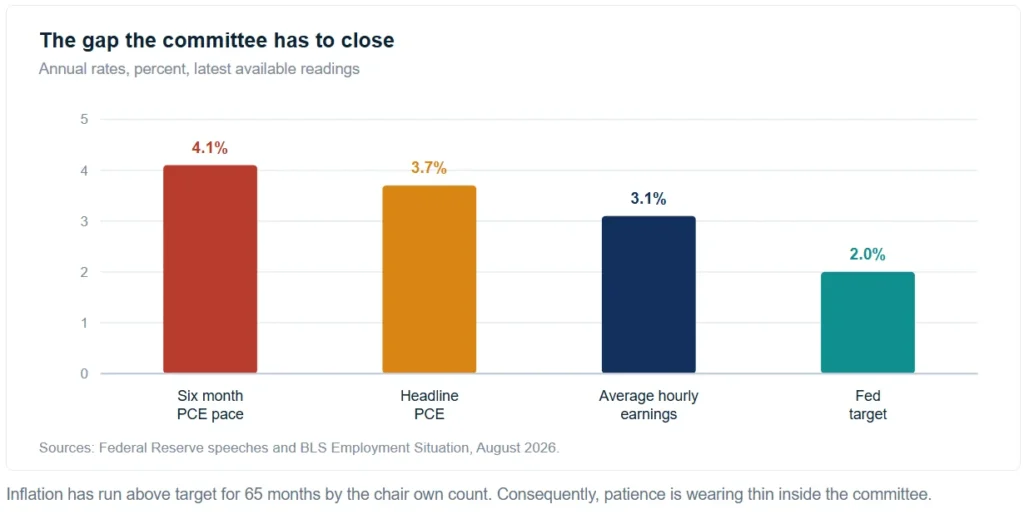
Chair Kevin Warsh set a hawkish tone at Jackson Hole. He noted that headline PCE inflation stands at 3.7 percent. The six-month reading runs hotter at 4.1 percent. Warsh said the committee must feel confident about the path. Otherwise, in his words, the Fed has work to do.
Warsh told the symposium he stands committed to a discipline, not to a decision.
Governor Christopher Waller struck a softer note days later. He said three-month core inflation has fallen steadily since February. Back then, the reading stood at 4.76 percent. Given further progress, Waller would support holding rates. Two senior voices, therefore, point in opposite directions.
The committee already split once
July showed the strain clearly. Officials held the target range at 3.50 to 3.75 percent. Three members dissented in favour of a rise. That vote split was the widest in years. Another close call now looks very likely.
Where the strategists stand
Joe Brusuelas, chief economist at RSM, wants action. He argues the committee sits a little behind the curve. To defend credibility, in his view, officials need to hike.
R.J. Gallo of Federated Hermes leans the same way. He says the market is drifting toward a rise. A hike could also calm long-dated yields. That outcome would ease political pressure on the chair.
Macquarie has already moved its call. The bank pulled its forecast from December to September. It now expects a second increase in the first quarter of 2027. Other desks remain unconvinced.
Nick Panitsas of Farther offers the honest answer. On the bond market, he says, nobody really knows. Steve Sosnick of Interactive Brokers points to supply. Rate-sensitive buyers face a flood of corporate paper. Issuers had not needed that funding in years.
Politics sits in the room
The administration has pressed publicly for cheaper money. Warsh took the chair with a hawkish reputation. A rise would test that pressure head on. Gallo suggests a hike could help the chair anyway. Lower long yields would ease the interest burden. Short-term pain might therefore buy longer-term calm.
Bonds have already moved
The Treasury curve tells the clearest story. Two-year yields closed at 4.37 percent on 4 September. They stood at 4.17 percent on 25 August. Ten-year yields rose to 4.78 percent over the same stretch. Thirty-year yields ended at 5.24 percent.
The inflation problem behind it all
Wages are not keeping pace with prices. Average hourly earnings rose 3.1 percent over the year. Headline PCE inflation ran at 3.7 percent. Workers therefore lost ground in real terms. That gap explains much of the public mood. Consumers, of course, notice the shortfall at the till. As a result, confidence readings have stayed weak.
What a rise would mean for markets
Assets would not react in one direction. Banks usually gain from wider short-term spreads. Housing would feel the squeeze fastest. Mortgage costs already sit at 13-month highs. Growth stocks carry the heaviest duration risk. Gold, meanwhile, has leaned on hopes of easier policy. In short, the decision would ripple well beyond bonds.
One more variable deserves a mention. Tariff policy still feeds into goods prices. Therefore, the inflation path is not purely domestic. Officials hold limited control over that channel. Because of it, forecasts carry unusually wide error bars.
The dollar and the wider world
Foreign markets watch this meeting too. A higher policy rate usually lifts the dollar. Emerging market borrowers then face steeper costs. Commodity prices, meanwhile, often soften in dollar terms. Central banks in Asia would face fresh pressure. Therefore, the decision travels well beyond Washington.
What happens next
One data point still stands in the way. August consumer prices arrive on 11 September. The committee meets on 15 and 16 September. Soft numbers would hand Waller the argument. A firm print would hand it to Warsh.
Positioning looks unusually two-sided. Futures pricing sits near even. Prediction market bettors put the odds at 53 percent for a rise. Rarely does a meeting arrive with so little consensus. Volatility around the decision should therefore be high.
Finally, consider a simple checklist. First, watch the consumer price print on 11 September. Second, track the two-year yield for direction. Third, follow the dollar for confirmation. Above all, avoid heavy positioning into the vote. Volatility, after all, cuts in both directions.




