

September 17, 2026 – Three July dissents, a hot energy bill, and a two-year yield near 4.7% point to the first increase since 2023. Here is what the data say before Wednesday’s decision.

In Summary
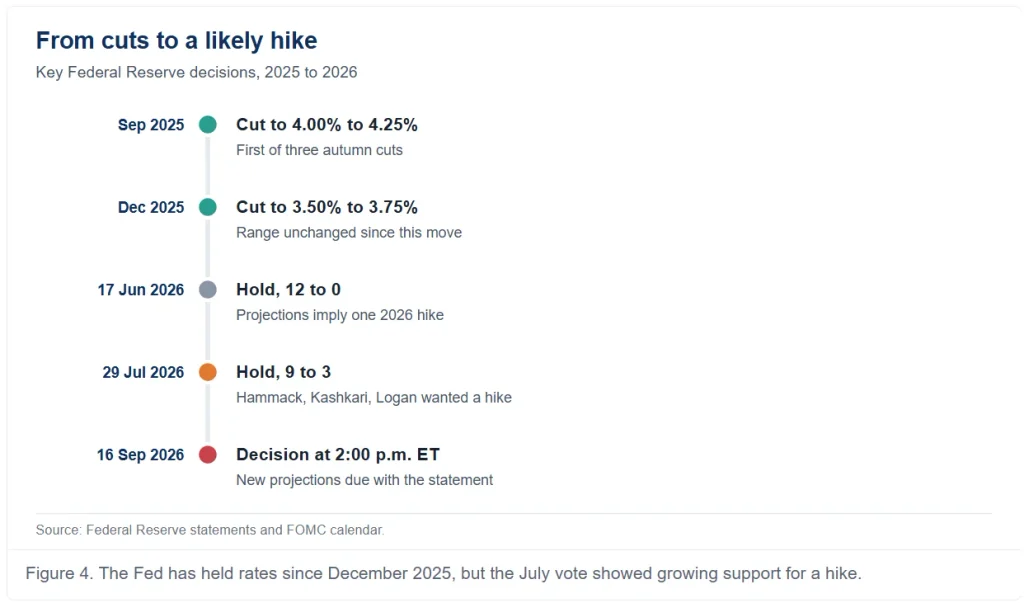
The Fed announces its decision at 2:00 p.m. ET on 16 September, with new projections.
Three officials already voted for a quarter-point hike in July.
Headline CPI runs at 3.4%, but core CPI has slowed to 2.4%.
June projections put the 2026 funds rate at 3.8%, implying one hike.
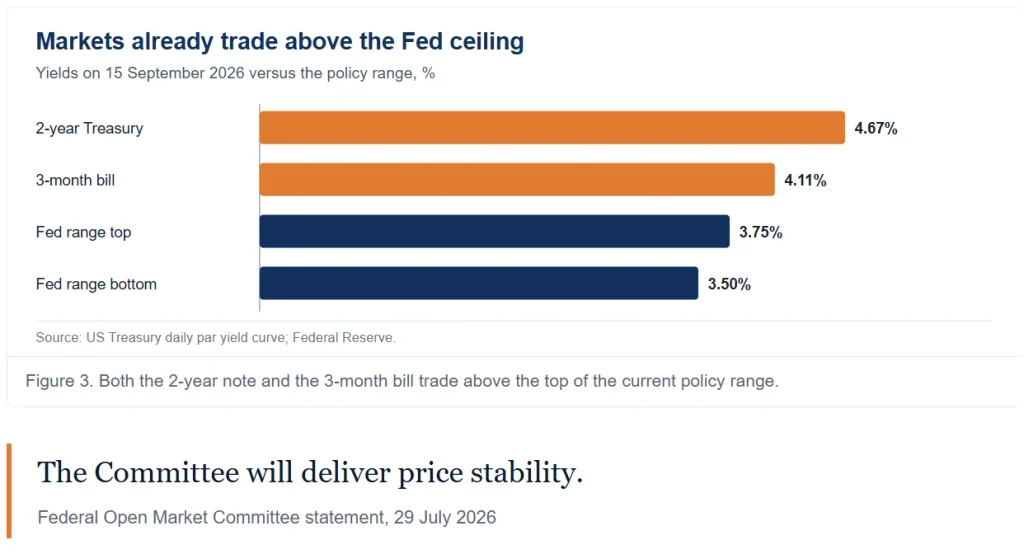
The 2-year Treasury yield sits 92 basis points above the policy ceiling.
The Federal Reserve looks set to deliver its first Fed rate hike since July 2023 on Wednesday. Officials will publish the decision at 2:00 p.m. Eastern time. Moreover, the mood has shifted quickly since July, when three officials already wanted higher rates.
The federal funds target range sits at 3.50% to 3.75%. It has stayed there since December 2025, after the last of three autumn cuts. Now, however, an energy shock has pushed inflation back above 3%, and markets want a response.
Why a Fed rate hike is back on the table
The July policy statement passed on a 9-to-3 vote. Beth Hammack, Neel Kashkari, and Lorie Logan each preferred a quarter-point increase. Three hawkish dissents send a clear message. In addition, the statement said inflation “remains elevated” and promised that the Committee “will deliver price stability.”
That wording matters. Officials linked the price surge to supply shocks in sectors such as energy. Yet they never called those shocks temporary. As a result, investors read the July hold as a pause rather than a final verdict.
Inflation data gave the hawks fresh support
The latest consumer price report did little to calm nerves. Headline prices rose 0.4% in August and 3.4% over the past year. Energy costs jumped 16.3% from a year earlier, while gasoline climbed 27.4%.
Still, the picture below the surface looks milder. Core inflation, which strips out food and energy, rose 0.3% in August. Over 12 months, core prices gained just 2.4%, the slowest pace this year. So the Fed faces a classic dilemma, with a supply shock lifting headline prices while underlying inflation cools.
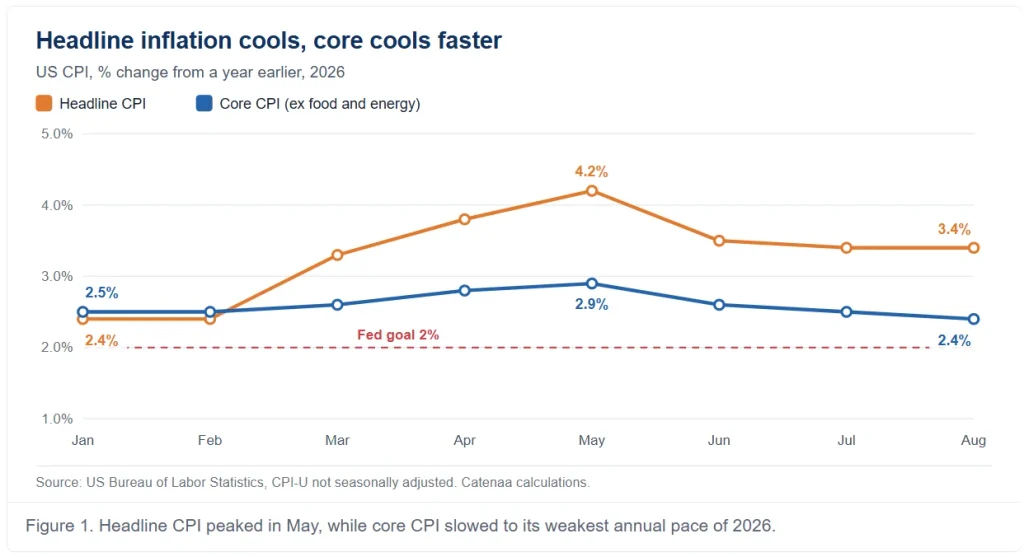
Headline inflation peaked at 4.2% in May, after energy prices spiked 10.9% in March alone. Since then, it has eased to 3.4%. However, it still runs a full percentage point above its January reading.
June projections already hinted at higher rates
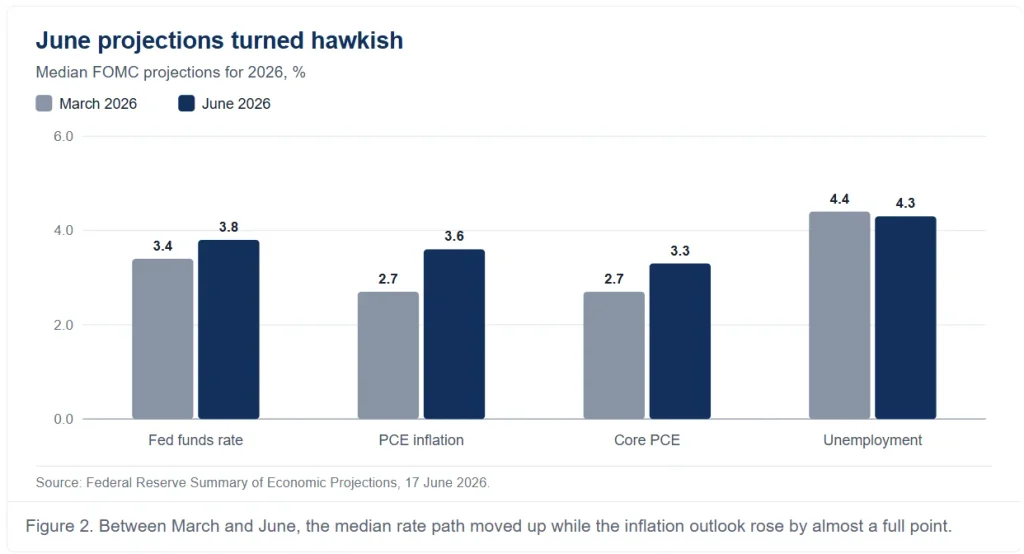
Policymakers flagged this turn three months ago. In their June economic projections, the median official saw the funds rate at 3.8% by the end of 2026. That figure points to a quarter-point rise from today. By contrast, the March median of 3.4% signalled a cut.
The same survey lifted the inflation outlook sharply. Officials raised their 2026 forecast for PCE inflation to 3.6% from 2.7%. They also lifted core PCE to 3.3% from 2.7%. Meanwhile, growth held up, with GDP at 2.2% and unemployment at 4.3%.
Bond markets have moved first
Treasury traders have not waited for the Fed. The two-year yield closed at 4.67% on 15 September, according to Treasury yield curve data. That sits 92 basis points above the top of the Fed range. It also compares with 3.47% on 2 January, a rise of 1.2 points this year.
Short-term bills tell the same story. The three-month bill yielded 4.11%, well above the 3.75% policy ceiling. In other words, money markets already expect tighter policy over the coming months.
The case for patience
Not every signal favours a hike. Core inflation has slowed for three straight months, from 2.9% in May to 2.4% in August. Food prices rose only 0.1% last month. Moreover, shelter inflation cooled to 3.0% over the year.
Doves can also argue that higher rates cannot pump more oil. Even so, most officials seem to fear a different risk. High energy costs could feed into wages and inflation expectations if the Fed waits too long.
What to watch on Wednesday
First, watch the vote count. A hike with dissents in favour of a hold would expose a split committee. Second, study the new rate projections. A higher median for 2026 or 2027 would signal further moves.
Third, check the August retail sales report, due at 8:30 a.m. before the decision. Strong spending would help the hawks. Finally, the Fed meeting calendar lists two more meetings this year, in late October and early December.
What it means for investors
A quarter point move would raise borrowing costs for households and firms. Credit cards and floating-rate loans usually reset within weeks. On the other hand, savers would earn more on cash and money market funds. Mortgage rates track longer bond yields, so they may react less directly.
For crypto and equity traders, the tone may matter more than the move itself. A hike paired with calm guidance could steady markets. Conversely, a hawkish rate path could extend the recent pressure on risk assets.