

September 12, 2026 – Euro area inflation reached 3.3% in August. Policymakers answered with a second quarter-point rise in three months.
In Summary
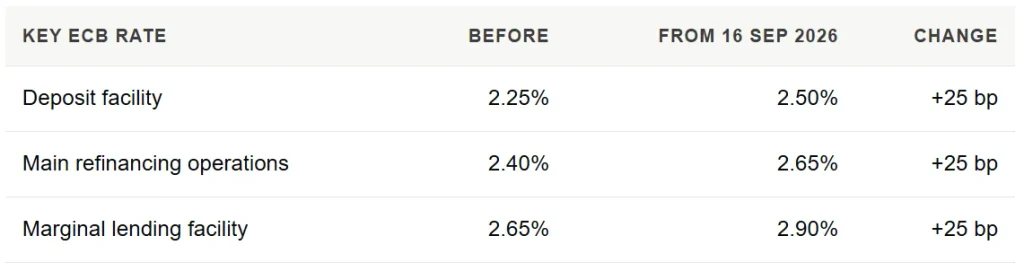
The ECB lifted all three key rates by 25 basis points on 10 September 2026.
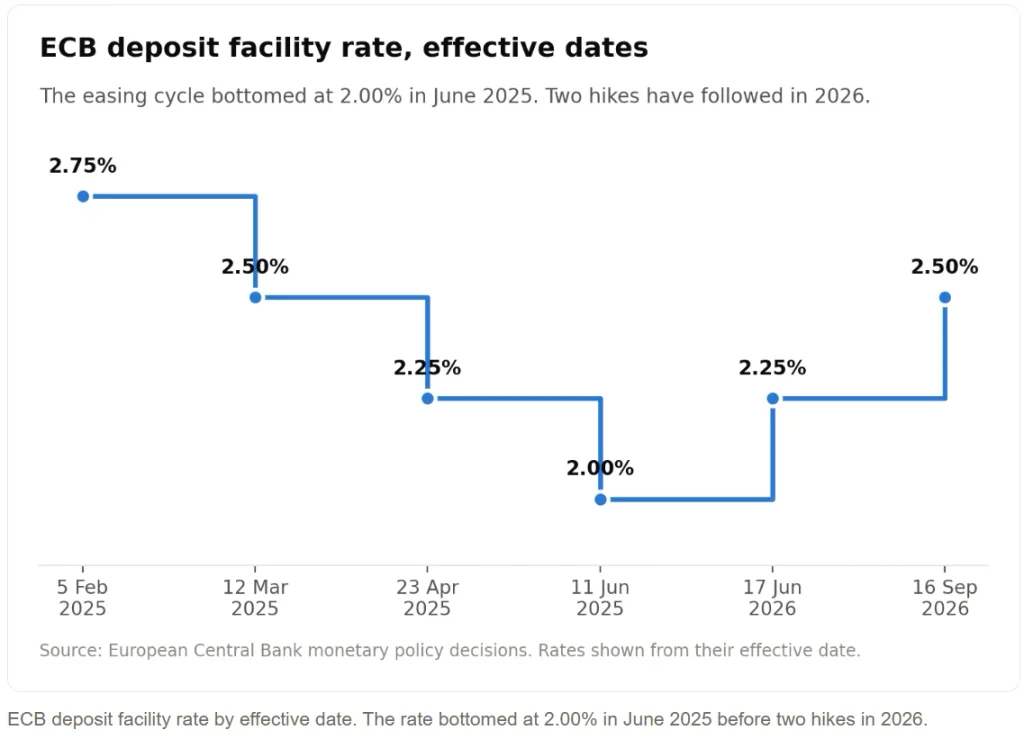
Its deposit facility rate rises to 2.50% from 16 September.
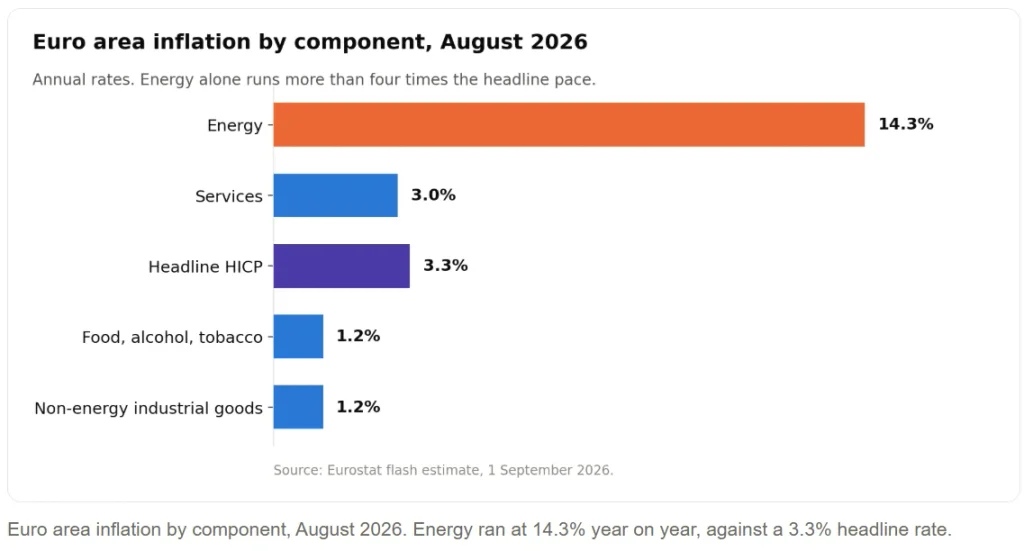
Euro area inflation reached 3.3% in August, with energy up 14.3%.
Staff now see price growth above target until 2028.
Markets are pricing in roughly a 61% chance of another increase in October.

The European Central Bank raised borrowing costs again on Thursday. Its Governing Council lifted the three key rates by 25 basis points. The deposit facility rate therefore moves to 2.50%. Main refinancing operations climb to 2.65%. Meanwhile, the marginal lending facility reaches 2.90%. All three levels apply from 16 September 2026.
Energy costs forced the decision. Furthermore, the Council warned that the Middle East conflict continues to exert upward pressure on prices. Inflation should stay well above 2% for an extended period. That language marks a sharp break from the easing cycle of 2025.
Energy does almost all the damage
Eurostat put euro area annual inflation at 3.3% in August, up from 2.9% in July. Energy inflation jumped to 14.3% from 10.3%. By contrast, the quieter components barely moved. Services eased to 3.0%. Food, alcohol, and tobacco held at 1.2%. Non-energy industrial goods matched that pace.
So the shock looks narrow rather than broad. Core inflation actually slipped to 2.4% in August. Yet the Council worries about what comes next. Costly crude feeds into transport, chemicals, farming, and packaging within months. Wage demands then follow.
History explains the caution. During 2022, the Council read an energy spike as temporary. Prices then peaked above 10%. No one on the Council wants that outcome again. Acting early, therefore, costs less than acting late.
A second hike in three months
Thursday brought the second rise of the year. Back in June 2026 the Council raised rates by a quarter point, ending a run of cuts. Afterwards, it paused. In July, the deposit rate stayed at 2.25% while officials waited for clearer data.
The pause has now ended. Consequently, the euro area has seen two hikes in one year, a pattern last recorded in 2023. Traders read the move as hawkish. According to money-market pricing, roughly 61% odds attach to another quarter point on 29 October.
Traders also price it close to 35 basis points higher by December. That pricing implies one more move this year, plus a fair chance of two. Bund yields rose on the news. Bank stocks held up better than industrials.
Projections drift away from the target
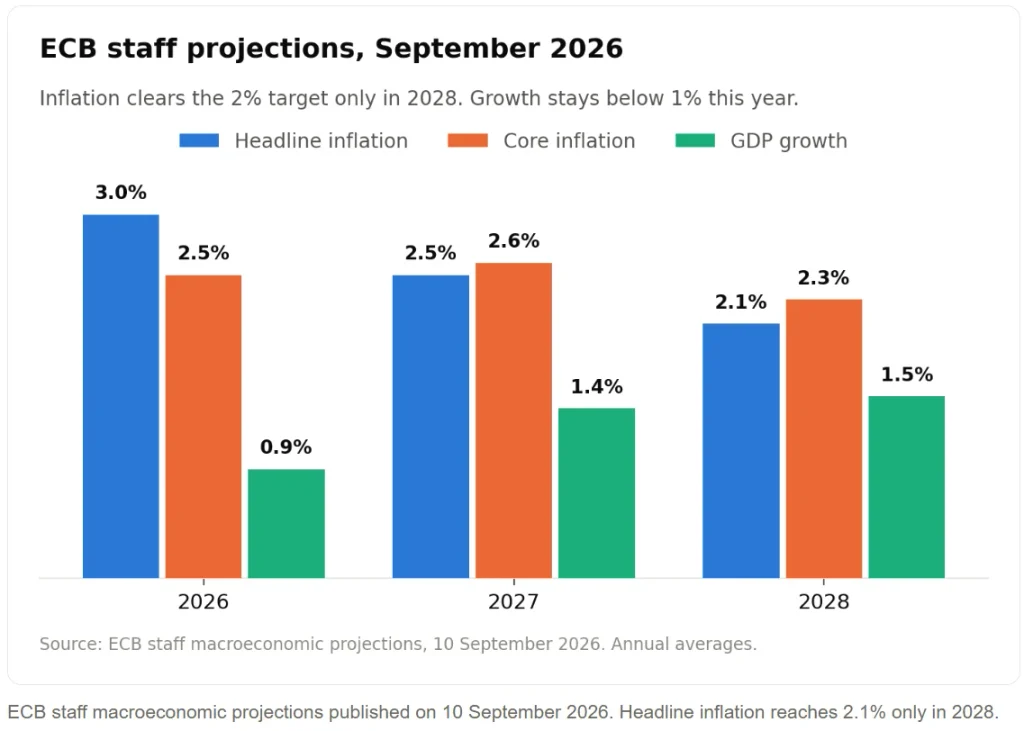
New staff forecasts explain the urgency. Headline inflation averages 3.0% this year, unchanged since June. However, the 2027 estimate rose to 2.5%. The 2028 figure climbed to 2.1%. Core inflation stays above target across the whole horizon.
Growth tells a harder story. Staff expects a 0.9% expansion in 2026. Growth then builds slowly, reaching 1.4% next year and 1.5% in 2028. Christine Lagarde called the economy resilient. Even so, she flagged upside risks to prices and downside risks to output.
That mix defines a stagflation squeeze. Tighter policy cools demand, though it cannot produce a single extra barrel of crude. Officials accept the trade-off because credibility matters more than one weak quarter.
Credit conditions turn harder
Higher policy rates travel fast through the euro area lending. Most corporate loans in the bloc reprice off short-term benchmarks. Firms with floating debt will therefore feel the increase within one quarter. Mortgage borrowers in Spain and Portugal, where variable rates dominate, face the same mechanism.
Banks gain in the short run. Wider deposit margins lift net interest income. Credit quality still worsens when energy costs squeeze thin-margin borrowers. Hauliers, chemical plants and food processors sit closest to that pressure.
Risk teams should watch three exposures. Energy-hungry industry comes first. Leveraged firms with 2027 debt maturities follow. Finally, southern European mortgage books carry the fastest repricing. Each group reacts in its own way to the same 25 basis points.
The bloc is pulling apart
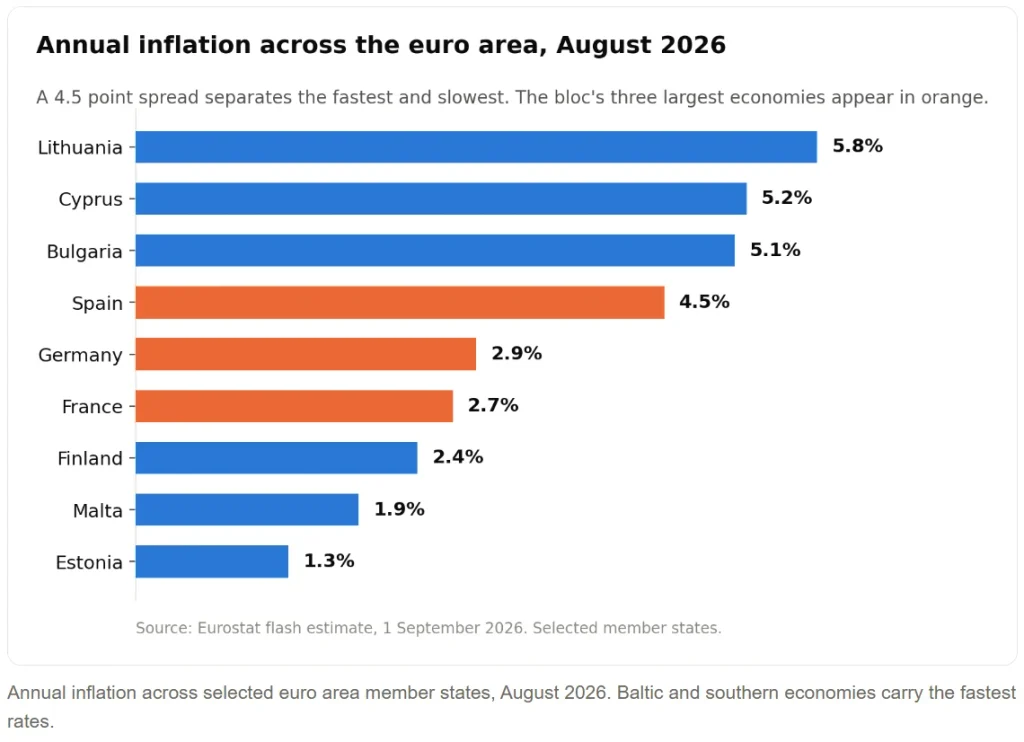
National figures show a widening gap. Lithuania recorded 5.8% in August. Cyprus reached 5.2%, while Bulgaria printed 5.1% in its first year inside the euro. Spain sat at 4.5%.
At the other end, Estonia managed just 1.3%. Malta reported 1.9% and Finland 2.4%. Germany came in at 2.9%, with France at 2.7%. In short, a single policy rate now serves economies that are 4.5 points apart.
That gap makes the Council’s job harder. A rate suited to Spain looks punishing in Estonia. Energy weights explain much of the spread, because heating and fuel bulk larger in some baskets. A shared currency no longer softens the split.
What to watch next
Three questions now dominate. First, will oil hold above $100 a barrel through the winter? Second, do wage settlements start chasing headline prices? Third, how far can the Council tighten before weak growth forces a rethink?
Autumn wage rounds in Germany and the Netherlands will answer the second question. Agreed pay has tracked near 3% through 2026. A jump toward 4% would harden the hawkish case sharply. Unions already cite the energy bill in their claims.
The combined statement gives no promises. Instead, the Council repeated its meeting-by-meeting approach and ruled out pre-commitment. Bond investors should therefore read every energy print as a policy signal. For borrowers across the bloc, cheap money has clearly gone.




