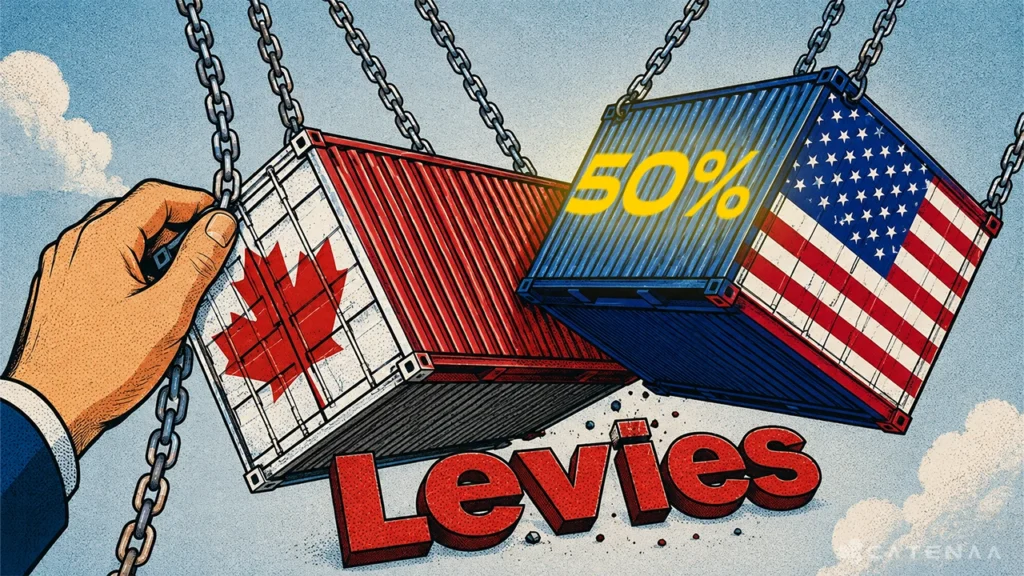


August 24, 2026 – Ottawa will match Washington dollar for dollar from 8 September. Roughly $28 billion of Canadian exports already face a 50% American duty.
In Summary
Canada will impose matching tariffs on United States goods from 8 September 2026.
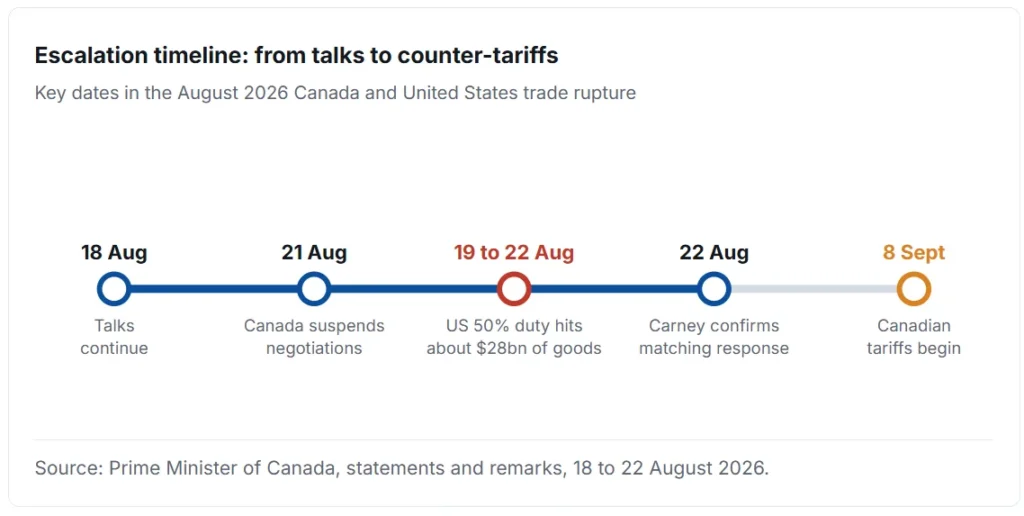
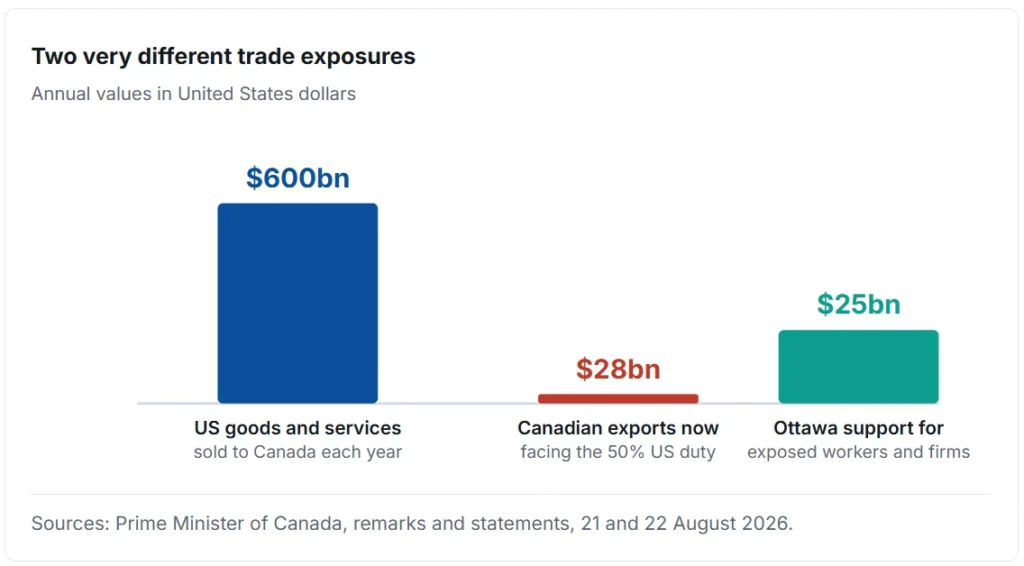
Washington has already applied a 50% duty to about $28 billion of Canadian exports.
Ottawa targets steel, dairy, appliances, farm equipment, pulp and paper, plus electronics.
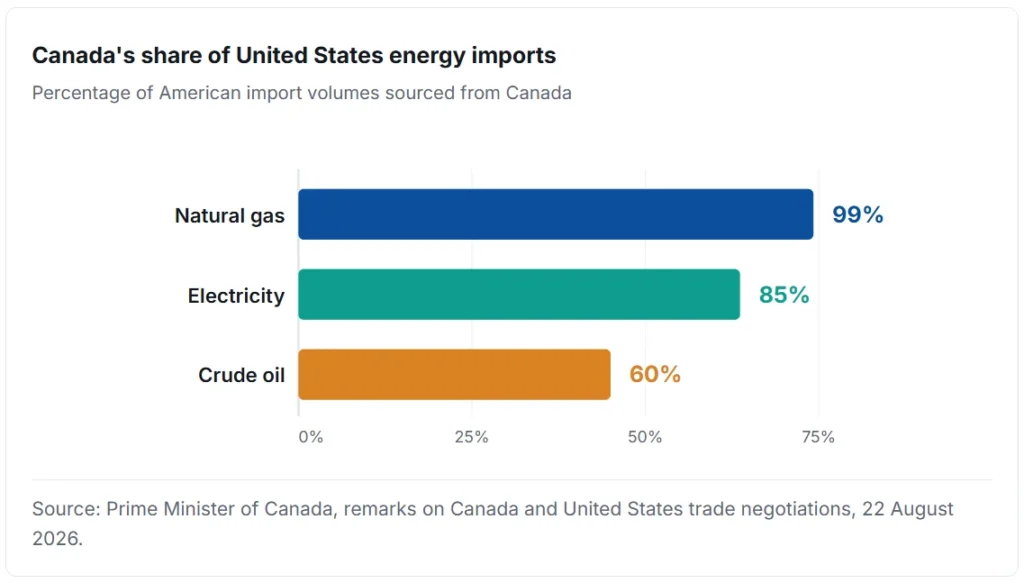
Canada supplies 99% of American natural gas imports and 60% of crude oil imports.
Americans sell close to $600 billion of goods and services to Canada each year.
Canada will retaliate against the United States tariffs from 8 September 2026. Prime Minister Mark Carney set out the plan in Ottawa on 22 August. Washington had already applied a 50% duty to a wide band of Canadian exports. Ottawa now intends to answer that pressure dollar for dollar.
The move ends the longest calm spell since the dispute began. Moreover, it removes the assumption that continental trade rules still shield most shipments.
Talks collapsed after late-stage demands
Negotiators had worked through most of the month. Even so, Washington tabled fresh terms in the closing days. Carney called those terms unfair and uneconomic in a statement on 21 August. He also said the changes questioned the reliability of any final deal.
Ottawa had entered the round with three goals. First, it wanted tariff-free access preserved for most exporters. Second, it sought lower American duties on key industries. Third, it aimed to protect smaller firms. None of those goals survived the final round.

Which sectors Ottawa will tax
Six categories sit at the centre of the Canadian list. Steel leads, followed by dairy and household appliances. Agricultural equipment, pulp and paper products, and electronics complete the group. Carney confirmed the start date during his Ottawa remarks on 22 August.
The list is not random. Each one maps onto US factory towns with political weight. Canada has used the same targeting logic before. Its earlier counter-tariff schedules, published by the Department of Finance Canada, followed an identical design.
Energy stays Canada’s quiet leverage
Ottawa has not touched energy flows. Yet the dependency numbers matter for both capitals. Canada supplies 99% of American natural gas imports. It also provides 85% of imported electricity and 60% of imported crude oil.
Those shares explain why the Canadian list avoids fuel. Any energy step would raise US input costs at once. As a result, Ottawa keeps that option in reserve.
Exposure runs in both directions
The trade balance cuts against simple views here. Americans sell close to $600 billion of goods and services to Canadians annually. That figure works out at roughly $1.6 billion every day. Canada also ranks as the largest customer for 26 states.
Vehicles illustrate the point sharply. Canada buys more American cars than the United Kingdom, Japan, and China combined. So a long standoff would bite factory belts on both sides.
Ottawa is spending to absorb the shock
Public money now sits beside the tariff answer. Carney pointed to $25 billion set aside for exposed workers and businesses. He also cited nearly $500 billion of private investment across 27 nation-building projects. A $51 billion communities fund adds further cushioning.
Trade diversity is the second pillar. Canada has signed more than 20 trade and security agreements across five continents. One deal with the United Arab Emirates closed in 47 days. Ottawa also extended steel and aluminium safeguards in June 2026.
What markets should watch next
The 8 September start date is the first checkpoint. What is more, the published product list will reveal what surgical Ottawa intends to be. Input-heavy trades face the clearest margin risk on both sides.
Currency desks will watch the Canadian dollar closely. Meanwhile, food and appliance prices offer an early read on pass-through. Carney insists Canada holds the stronger medium-term hand. The next quarter of trade data will test that claim. Earlier signals had pointed toward a deal, as his 18 August statement showed.