

September 05, 2026 – August hiring came in at three times the forecast. Traders now split almost evenly on a September rate rise.
In Summary
US payrolls rose 162,000 in August against forecasts near 55,000.
The jobless rate held at 4.1 percent for a second month.
June and July were revised up by a combined 55,000 jobs.
Average hourly pay rose 3.1 percent over the year, below headline inflation.
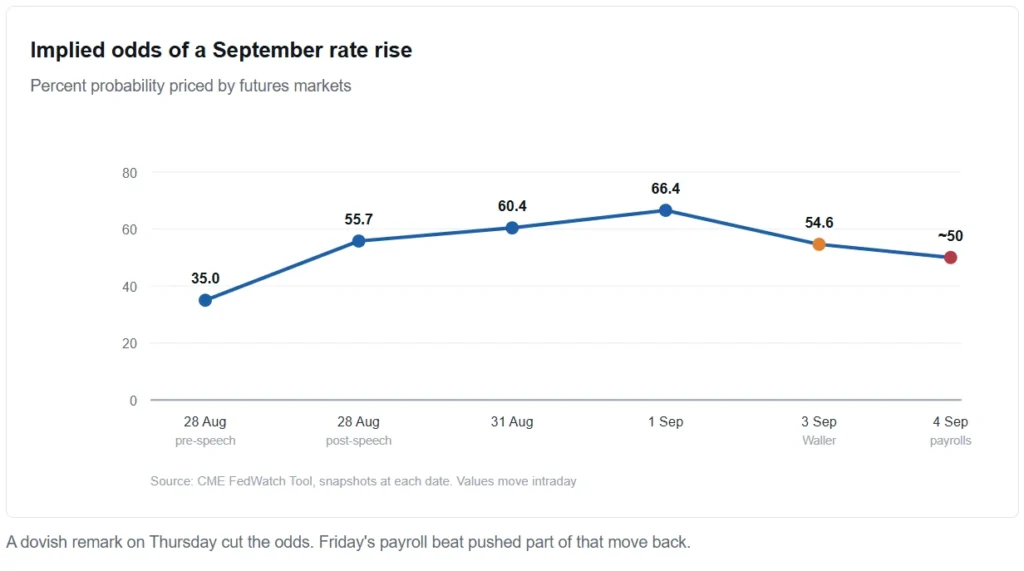
Odds of a September hike sat near 50 percent after the release.
The two-year Treasury yield touched a 52-week high of 4.374 percent.

US payrolls rose by 162,000 in August. Forecasts had clustered near 55,000, so the beat was wide. Meanwhile, the jobless rate held at 4.1 percent. Bond yields rose, and stocks slipped, since traders read the print as hawkish.
The Bureau of Labor Statistics also lifted its two prior months. That change matters as much as the headline. It turns a stalling job market into one that still adds workers.
The print beat every forecast on the street
Economists polled before the release looked for about 56,000 jobs. Estimates ranged from a loss of 25,000 to a gain of 121,000. August therefore landed above the top of that range. A private payroll gauge on Wednesday had shown just 38,000 new roles, the weakest month of the year.
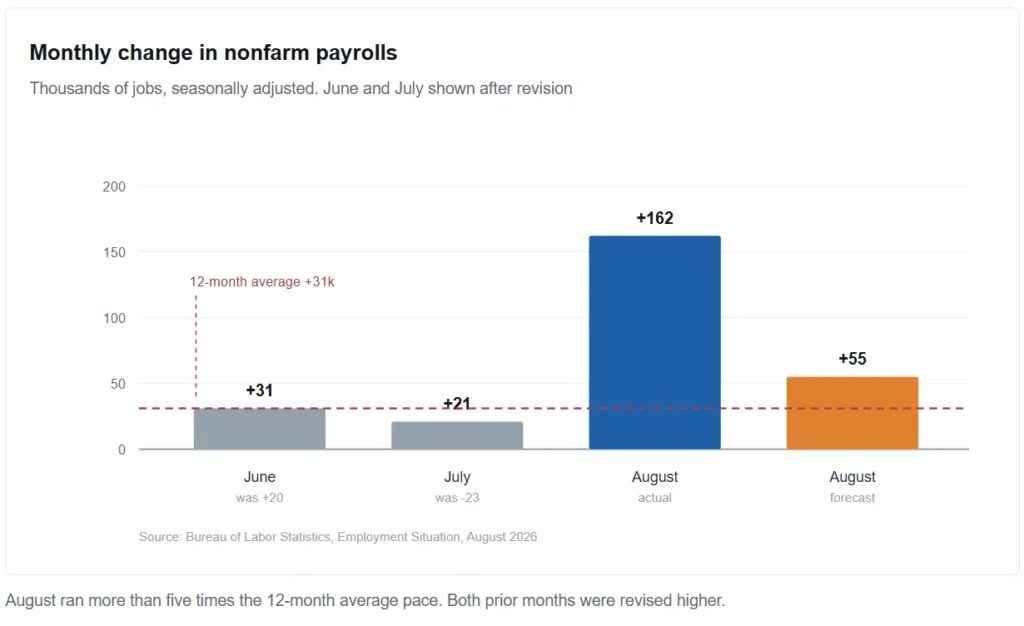
Context still matters. The 12-month average gain sits at only 31,000 jobs. August ran more than five times that pace. One month rarely sets a trend, so the September print will test it.
Revisions rewrote the recent trend
Firstly, June moved up by 11,000 jobs to a gain of 31,000. July swung from a reported loss of 23,000 to a gain of 21,000. Those two changes add 55,000 jobs to the record. Because of them, the summer no longer looks like the start of a downturn.
Where the jobs came from
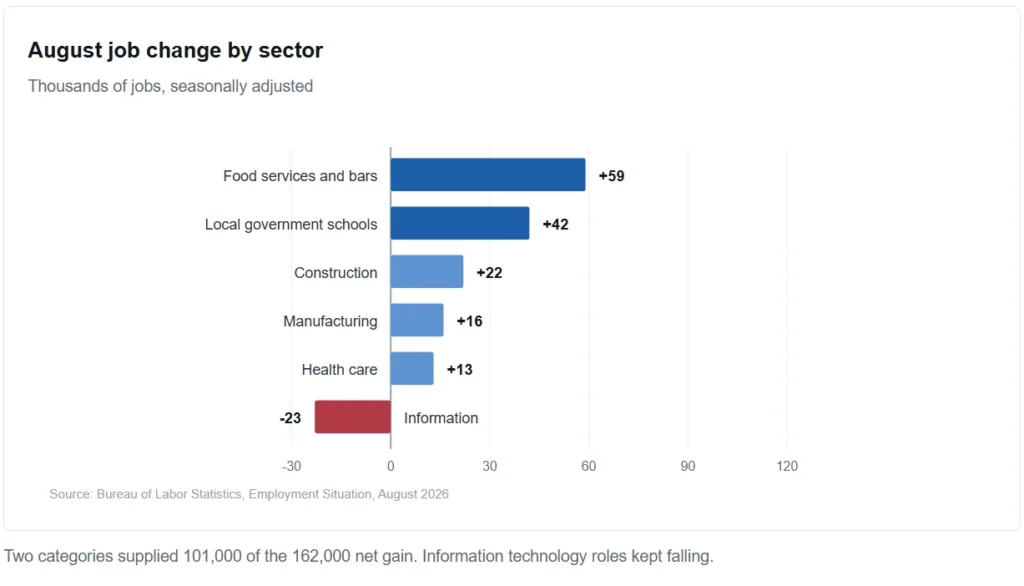
Growth was narrow rather than broad. Restaurants and bars added 59,000 roles, the single largest gain. Meanwhile, local government schools added 42,000 as the term began. Construction added 22,000, and factories added 16,000.
One sector fell hard. Information shed 23,000 jobs in the month. Health care added only 13,000, well below its recent run rate. So the mix leans on low-wage service work and seasonal hiring in schools.
Pay still trails prices
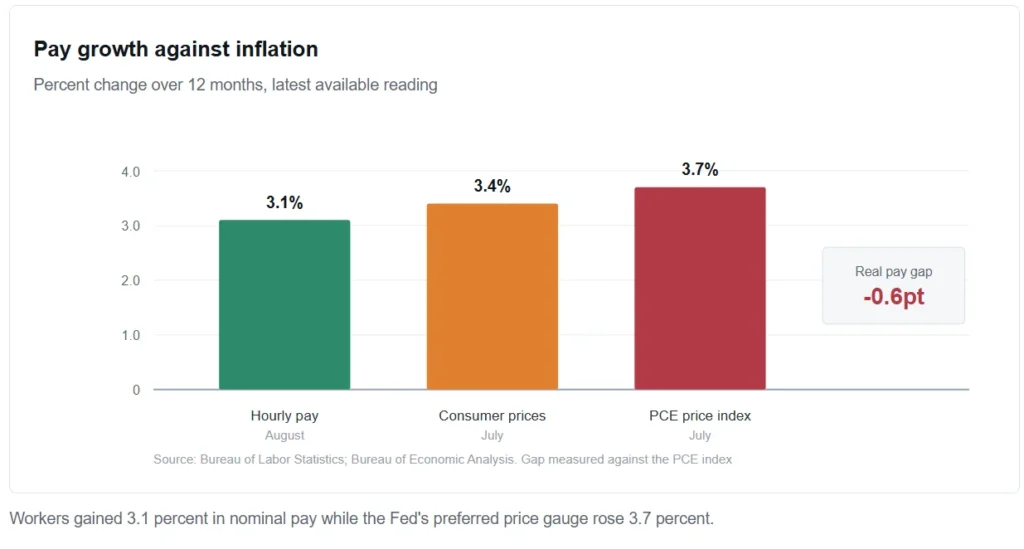
Average hourly pay rose 10 cents to $37.75. That equals a gain of 0.3 percent on the month. Over the year, pay is up 3.1 percent. Headline consumer prices rose 3.4 percent in July, so real pay is still shrinking.
The wider household data looked softer. Labour force participation edged up to 61.6 percent, yet it remains 0.5 points below January. Long-term unemployment reached 1.9 million people, or 27.0 percent of all jobless workers. Therefore, the labour market is tight at the margin but weak underneath.
Markets moved within minutes
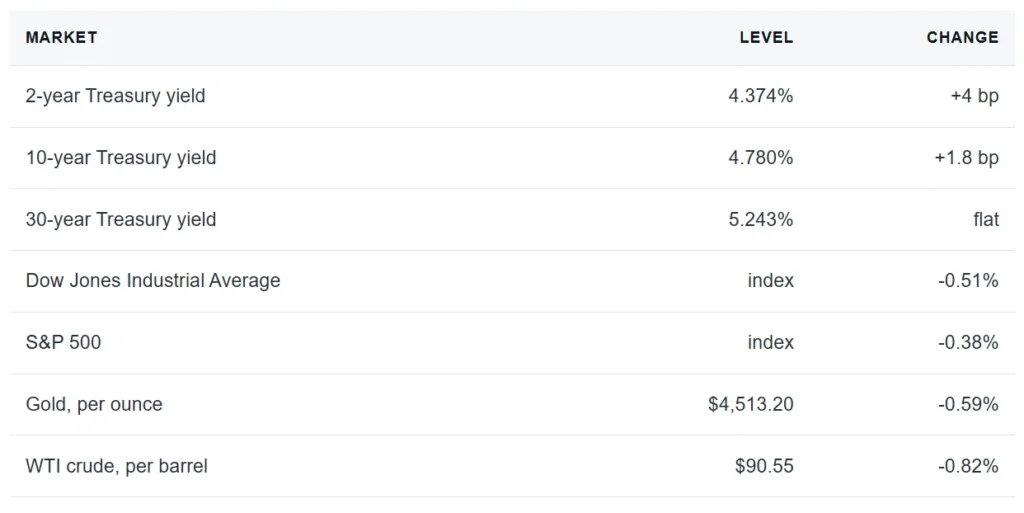
Traders sold bonds and trimmed equity risk. Consequently, the two-year Treasury yield rose four basis points to 4.374 percent, a fresh 52-week high. The ten-year paper reached 4.78 percent. Long bonds, however, held at 5.243 percent.
Equities gave background. The Dow fell 0.51 percent while the S&P 500 slipped 0.38 percent. Small caps bucked the move, with the Russell 2000 up 0.25 percent. Gold eased 0.59 percent to $4,513.20 an ounce, and West Texas crude settled 0.82 percent lower at $90.55.
The Fed now faces a close call
Policy has been on hold since late July at 3.50 to 3.75 percent. Three voters dissented, then in favour of a rise. Governor Christopher Waller said on Thursday he was inclined to keep rates steady. As a result, his remark pushed the odds down to about 55 percent.
Friday reversed part of that move. Futures pricing settled near a coin toss for the 15 to 16 September meeting. Bill Adams of Fifth Third Commercial Bank put it plainly. He said the report focuses the Fed squarely on inflation at its next meeting.
The cost of money keeps rising
Households feel the shift first through housing. Freddie Mac put the average 30-year mortgage rate at 6.71 percent this week. Moreover, that marks the highest level in 13 months. Higher Treasury yields feed straight into that number.
Two dates now matter more than the rest. August consumer prices land on 11 September. The rate decision follows on 16 September. A hot inflation print would settle the argument quickly.