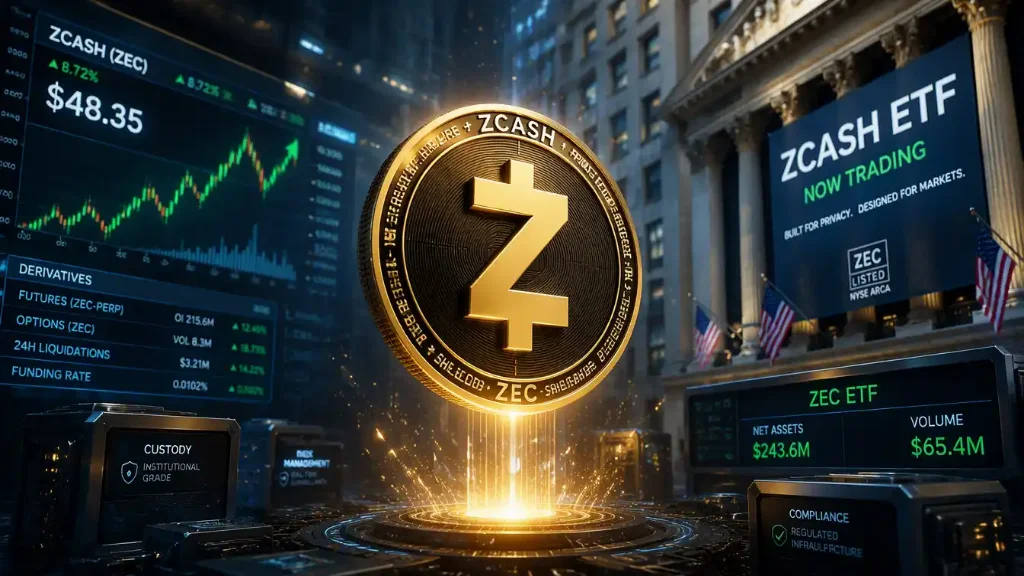


Catenaa, Saturday, August 29, 2026-Zcash surged to its highest level in eight years over the weekend as traders increased leveraged bets and Grayscale moved closer to converting its existing Zcash trust into a US exchange-traded fund.
ZEC briefly reached about $855 Saturday before trading near $819, according to market data cited by The Block.
The privacy-focused cryptocurrency gained more than 22% during the previous 24 hours and had risen more than 30% over the week.
Its market capitalization reached about $13.8 billion, placing ZEC among the largest cryptocurrencies by market value.
The rally followed Grayscale’s latest amended filing seeking to convert the Grayscale Zcash Trust into an exchange-traded fund.
Grayscale submitted its fifth amended registration statement Friday.
The filing proposes renaming the existing investment vehicle The Zcash ETF and sets an annual sponsor fee of 2.5%.
If regulators allow the conversion, the product would become the first US exchange-traded fund designed to directly track the price of ZEC.
The proposal comes as asset managers expand beyond bitcoin and ether into funds linked to a broader range of cryptocurrencies.
US products already offer exposure to several altcoins, including Solana, XRP, Litecoin, Dogecoin and BNB.
Their performance has varied sharply.
Bitcoin exchange-traded funds attracted nearly $2 billion in net inflows over the latest week cited in The Block’s report.
XRP products received about $40 million, while Solana funds attracted roughly $28 million.
That gap shows regulatory approval alone does not guarantee strong investor demand.
For Zcash, however, the prospect of an ETF has already become an important market narrative.
The strongest evidence of increased speculation appeared in derivatives markets.
ZEC futures generated more than $9.5 billion in trading volume over 24 hours, according to Coinglass data cited by The Block.
Spot exchanges recorded about $1.06 billion during the same period.
That means futures turnover was roughly nine times greater than spot trading.
Open interest reached about $1.8 billion, equivalent to approximately 13% of Zcash’s market capitalization.
The imbalance suggests traders are increasingly using leveraged contracts to position for further price moves.
Futures can amplify both gains and losses because traders can take positions larger than the capital committed as collateral.
High open interest can also make markets more vulnerable to rapid liquidations when prices reverse.
The current rally therefore reflects more than investors simply buying ZEC and holding it.
A large portion of activity is occurring through derivatives.
Another potential source of demand comes from Digital Currency Group.
An earlier Grayscale filing disclosed that DCG International Investments Ltd., a subsidiary of Grayscale’s parent company, was considering acquiring about 200,000 ZEC through the trust.
The discussions remain nonbinding.
DCG could ultimately acquire more, fewer or no shares.
When the plan was first disclosed, the proposed ZEC position was valued at roughly $110 million.
At prices near $819, 200,000 ZEC would be worth about $164 million.
The increase illustrates how quickly the economics of the potential transaction have changed during the latest rally.
A purchase of that size would also represent a noticeable amount of available ZEC supply.
However, investors should not treat the discussions as a completed transaction.
No binding commitment has been announced.
The rally represents a sharp reversal from conditions only two months ago.
ZEC fell roughly 60% in June after developers disclosed a serious vulnerability affecting the Orchard shielded pool.
The flaw created a risk that counterfeit ZEC could be produced.
Prices dropped from about $630 to around $250 as investors reacted to the disclosure.
Developers later patched the weakness and addressed the affected pool through subsequent network upgrades.
At Saturday’s peak, ZEC had more than tripled from its June low.
It also traded roughly 35% above its level before the vulnerability-driven selloff.
The recovery suggests investors have largely moved their attention from the security episode toward institutional access and potential ETF demand.
Zcash occupies an unusual position among large cryptocurrencies.
The network allows users to make transparent transactions similar to Bitcoin, but it also supports shielded transactions designed to conceal information such as transaction amounts and addresses.
That privacy functionality has made Zcash attractive to users seeking stronger financial confidentiality.
It has also created regulatory challenges.
Some cryptocurrency exchanges have restricted or delisted privacy-focused assets because of concerns over anti-money laundering rules and compliance requirements.
A US-listed ETF directly tracking ZEC would therefore represent an important test of how regulated financial markets treat privacy-oriented cryptocurrencies.
It could give investors price exposure without requiring them to directly hold or transact with ZEC.
The latest rally does not guarantee Grayscale’s ETF will receive regulatory clearance.
It also does not show how much investor demand a Zcash fund would attract if launched.
Existing altcoin ETFs demonstrate that results can vary widely even after approval.
For now, futures traders appear to be positioning aggressively ahead of any final decision.
That has produced one of Zcash’s strongest rallies in years.
ZEC remains well below its historical peak of about $3,192.
But its move above $850 has returned the token to price levels last seen in 2018.
The next test will be whether ETF expectations translate into sustained spot demand or whether the futures-driven surge leaves ZEC vulnerable to another sharp reversal.




