

July 30, 2026 – Vanguard’s Strive stake has grown through a broad US index fund. The increase shows how passive portfolios can absorb Bitcoin-linked equities.
Vanguard’s Strive stake has grown through its broad US stock market index fund. The increase brings more Bitcoin-linked equity into mainstream portfolios. Yet the move looks more mechanical than ideological. It reflects how passive investing can spread crypto exposure without a direct Bitcoin purchase. Traditional market infrastructure can now distribute Bitcoin sensitivity across millions of ordinary investment accounts.
In Summary
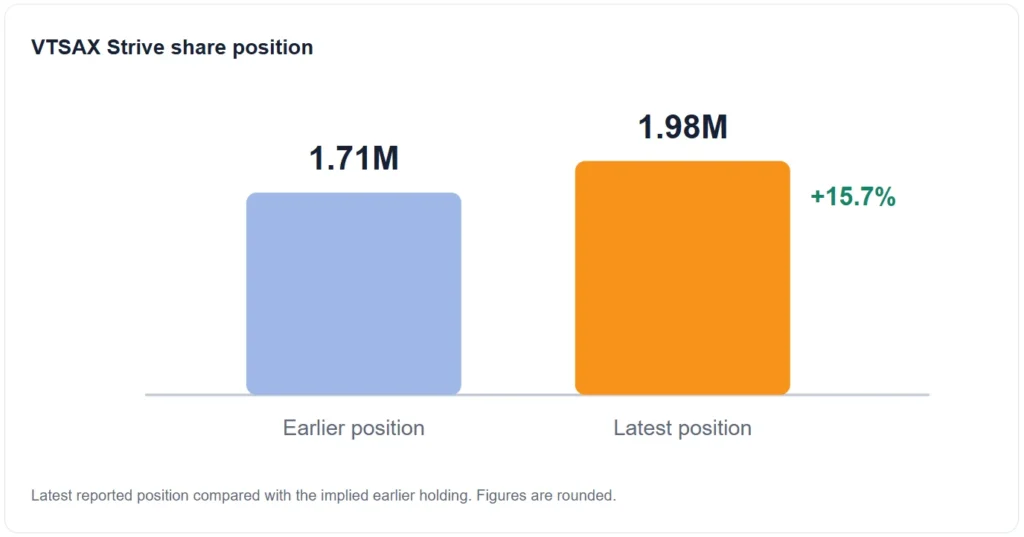
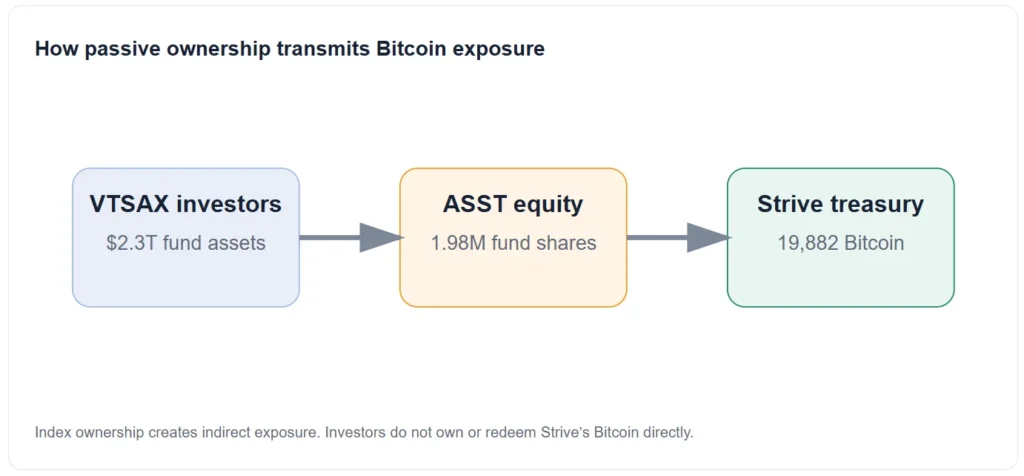
Vanguard’s total market fund added 269,200 Strive shares, lifting its position to about 1.98 million shares.
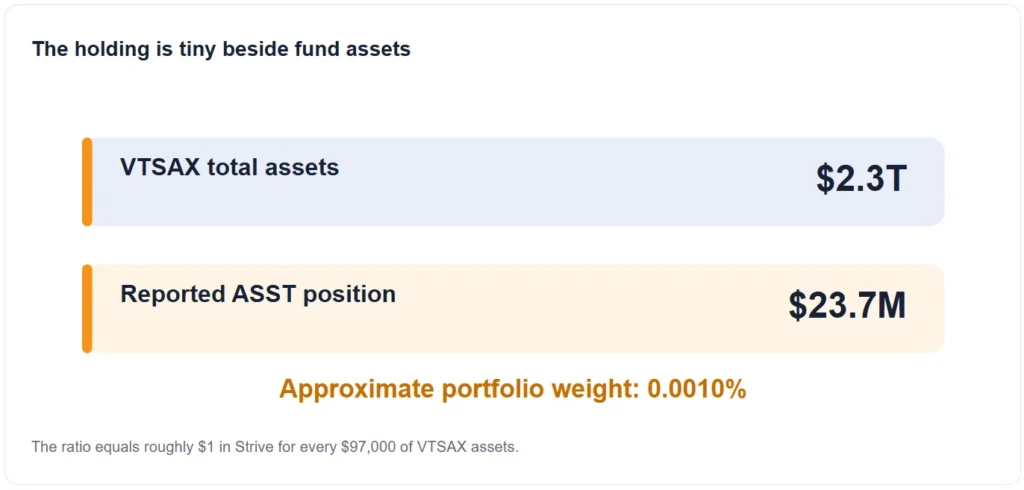
The holding was valued near $23.7 million, equal to roughly 0.001% of the fund’s $2.3 trillion assets.
Strive held 19,882 Bitcoin on July 2, 2026, making its equity highly sensitive to Bitcoin prices.
The investment also carries dilution, preferred dividend, and capital-markets execution risks.
A passive fund creates indirect Bitcoin exposure
The Vanguard Strive stake increased by 269,200 shares through the Vanguard Total Stock Market Index Fund. The fund’s position reached about 1.98 million shares, worth roughly $23.7 million.
That increase equals about 15.7% from the earlier 1.71 million-share position. However, the dollar exposure remains tiny beside the fund’s scale. Vanguard reported $2.3 trillion in total fund assets on June 30, 2026.
Therefore, the Strive position represents approximately 0.001% of fund assets. That equals about $1 invested in Strive for every $97,000 held by the fund.
This context matters. The transaction does not necessarily show an active bullish view on Bitcoin. The fund tracks the CRSP US Total Market Index. That benchmark uses transparent, rules-based methods and quarterly reconstitution.
Consequently, changes in market value, share float, or index eligibility can alter holdings. The purchase appears consistent with passive index maintenance. It is not proof of a discretionary crypto allocation.
Why Strive carries strong Bitcoin sensitivity
Strive combines asset management with a Bitcoin treasury strategy. Its balance sheet has expanded rapidly since its September 2025 public listing.
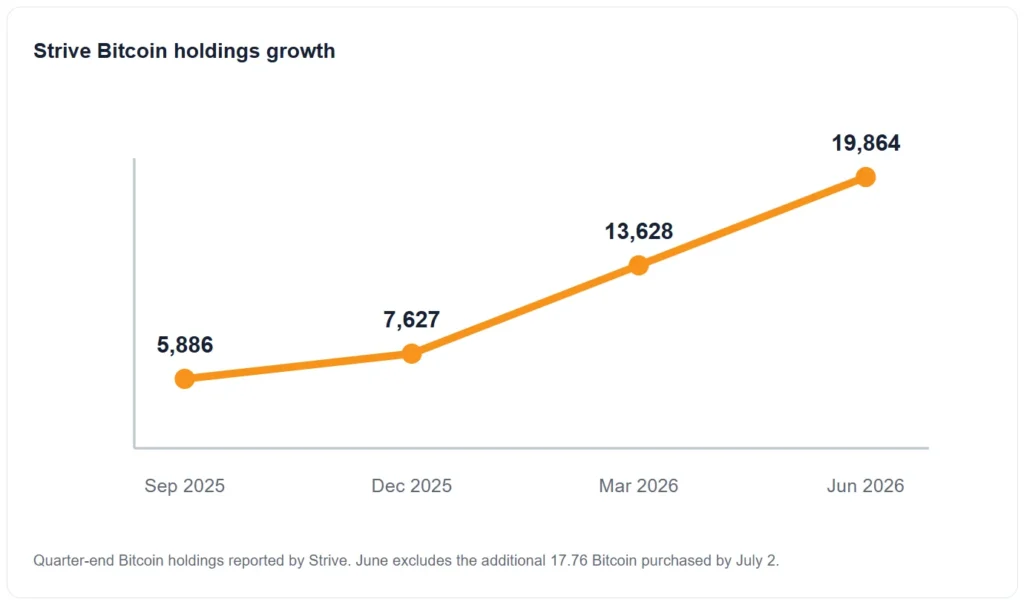
Strive held 5,886 Bitcoin at September 2025. Holdings rose to 7,627 Bitcoin by December. They then reached 13,628 Bitcoin in March 2026.
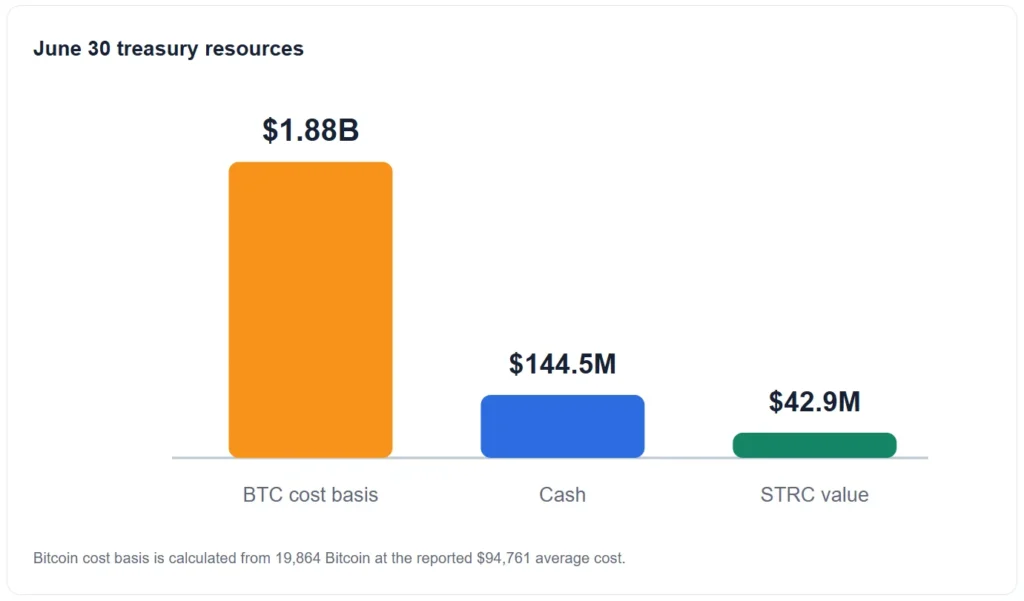
By June 30, Strive held 19,864 Bitcoin. The company reported an average acquisition cost of $94,761 per Bitcoin. That implies a total acquisition cost near $1.88 billion.
Strive added another 17.76 Bitcoin by July 2. Total holdings then reached 19,882 Bitcoin. Cash and equivalents stood at $153.4 million on that date.
As a result, ASST shares offer amplified exposure to Bitcoin movements. Rising Bitcoin prices can improve asset values and access to financing. Falling prices can weaken both at once.
The structure adds equity and funding risks
Bitcoin holdings alone do not determine ASST’s value. Investors must also examine the company’s expanding capital structure.
Class A shares increased from 71.86 million on June 26 to 72.95 million on July 2. That rise shows how treasury growth can involve common-share dilution.
Strive also funds purchases through preferred stock. Preferred investors receive senior dividend and liquidation claims. Common shareholders remain behind those claims.
The company has warned that its Bitcoin-focused metrics are not traditional return measures. They exclude several liabilities and financing effects. Therefore, investors should focus on audited statements and per-share economics.
What the Vanguard Strive stake really signals
The Vanguard Strive stake illustrates how Bitcoin exposure can be incorporated into diversified portfolios indirectly. Passive funds buy eligible public companies according to index rules.
That process can broaden ownership across retirement accounts and long-term portfolios. However, it does not remove the underlying risks.
Strive remains exposed to Bitcoin volatility, refinancing conditions, dilution, and preferred dividend costs. Its asset management business provides some operating diversification. Still, Bitcoin dominates the investment narrative.
What investors should watch next
Investors should track Bitcoin per common share, not only the company’s total Bitcoin balance. A rising treasury can still disappoint when share issuance grows faster.
They should also monitor cash reserves and preferred dividend coverage. Those figures affect Strive’s ability to avoid forced financing during weak markets.
Finally, compare ASST’s market value with its underlying Bitcoin and other net assets. A large premium can magnify losses when sentiment reverses.
For markets, the larger message is structural. Crypto-linked companies are becoming embedded within conventional equity benchmarks. Investors may gain exposure without selecting a Bitcoin product.
That trend supports wider institutional integration. Nevertheless, investors should separate passive ownership from active conviction. Vanguard’s position is meaningful as a transmission channel, not as a large portfolio bet.