

Catenaa, Sunday, August 23, 2026- Tether’s USDT remains the dominant stablecoin for business transactions on crypto payments platform NOWPayments, but USDC is gaining ground rapidly as companies increasingly use digital dollars for operational payments rather than simple checkout transactions.
NOWPayments said USDT accounted for 66.92% of stablecoin transaction volume processed through its platform during the first half of 2026.
USDC remained much smaller, but its transaction count jumped 209.02% year over year, while transaction volume increased 101.63%.
The divergence points to two different competitive strengths emerging in the stablecoin market.
USDT retains the deeper transaction base and higher-value transfer activity.
USDC is growing faster from a smaller base and appears to be gaining traction among businesses seeking stablecoin infrastructure compatible with regulated European markets.
The figures apply only to transactions processed through NOWPayments and should not be treated as measurements of the entire global stablecoin market.
USDT remained well ahead of USDC despite weaker activity compared with a year earlier.
NOWPayments reported that USDT transaction count declined 1.55% during the first half compared with the same period in 2025.
Transaction volume fell 14.99%.
Even after those declines, USDT represented 41.32% of stablecoin transaction count and nearly two-thirds of stablecoin transaction value on the platform.
The difference between those two shares suggests USDT remains especially important for larger transfers.
That fits Tether’s broader position as a highly liquid dollar-denominated asset widely used across exchanges, wallets and international crypto markets.
For businesses, that liquidity can matter when stablecoins are used for supplier payments, treasury transfers or settlement between counterparties operating in different countries.
USDC showed the opposite trend.
Its share of stablecoin transaction count on NOWPayments increased to 4.94% from 2.88%, while its share of transaction volume rose to 8.95% from 5.52%.
Those percentages remain far behind USDT.
But the pace of growth suggests USDC is becoming a more important payment and settlement asset on the platform.
NOWPayments did not identify the individual reasons customers selected one stablecoin over another.
Its data therefore cannot establish that regulation alone caused USDC’s growth.
However, Circle’s regulatory positioning in Europe gives USDC an advantage with businesses and service providers that need to operate within MiCA-supervised infrastructure.
That could become increasingly important as exchanges, custodians and payment companies adjust their stablecoin offerings to European regulatory requirements.
The more notable shift may be how businesses are using stablecoins.
Crypto payments were once discussed mainly as an alternative method for customers buying goods and services.
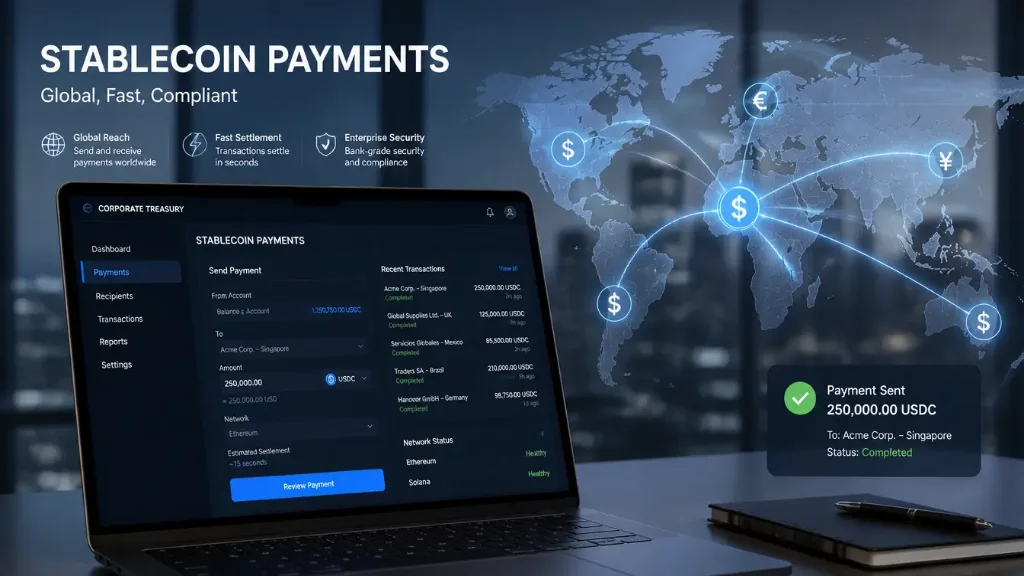
NOWPayments says stablecoins are increasingly being retained and reused inside businesses after the initial payment.
Companies can receive stablecoins from customers and later use them for supplier settlements, contractor payments, affiliate commissions, marketplace withdrawals and treasury transfers.
That reduces the need to convert every incoming crypto payment immediately into fiat currency.
For businesses operating across borders, stablecoins can also reduce dependence on banking hours and correspondent banking networks.
The result is a payment asset beginning to function as operating capital.
The competition is also not limited to USDT versus USDC.
Businesses must decide which blockchain carries the stablecoin.
NOWPayments supports USDT on networks including Tron, Ethereum, BNB Smart Chain and Polygon.
USDC is available through networks including Ethereum, Base, Polygon and Arbitrum.
That creates another layer of choice involving transaction fees, settlement speed and compatibility with counterparties.
A business may prefer USDT but choose one network for low-cost transfers and another for deeper ecosystem access.
The same applies to USDC.
Stablecoin infrastructure is therefore increasingly becoming a combination of asset choice and network choice.
MiCA is beginning to influence that decision.
USDC has established a clearer route through Europe’s regulated crypto market.
USDT remains widely held and transferred globally, but some European crypto service providers have restricted certain services involving stablecoins that do not meet their interpretation of MiCA requirements.
That does not mean European individuals or businesses are broadly prohibited from holding or transferring USDT.
It means regulated intermediaries can face different obligations when offering stablecoin-related services.
For businesses relying on exchanges, custodians and payment processors, those intermediary rules can shape which stablecoin is easiest to use operationally.
USDC’s growth may therefore reflect a market where regulatory compatibility is becoming almost as important as liquidity.
Catenaa View
The NOWPayments figures suggest the stablecoin contest is becoming less about identifying a single winner.
USDT and USDC are increasingly serving different strengths within the same digital dollar economy.
USDT’s advantage is scale.
Its deep liquidity, global availability and entrenched role in crypto markets make it difficult to displace, particularly for larger international transfers.
USDC’s advantage is momentum.
Its growth on NOWPayments, combined with its stronger position within regulated European infrastructure, gives businesses another reason to support it alongside USDT.
This creates a different type of competition from the one seen between cryptocurrencies seeking market dominance.
Businesses do not necessarily need to choose one stablecoin exclusively.
A company can hold USDT for counterparties requiring deep global liquidity while using USDC where regulatory infrastructure or particular blockchain networks make it more convenient.
That makes stablecoins increasingly resemble payment rails rather than competing consumer brands.
The winning business model may therefore be multi-stablecoin.
Payment processors, exchanges and corporate treasury systems capable of moving between USDT, USDC and different blockchain networks can route transactions according to cost, liquidity, regulation and recipient preference.
What Comes Next
The next test will be whether USDC’s rapid growth continues after its initial expansion from a smaller base.
A 209% increase in transaction count is easier to achieve from a relatively modest starting point than from USDT’s much larger installed base.
USDT’s declining transaction volume on NOWPayments also bears watching.
If that decline continues while USDC keeps gaining share, the gap could narrow.
If USDT activity stabilizes, its existing liquidity advantage could preserve its leadership for much longer.
Either way, the data points to an important change.
Stablecoins are no longer being used only to enter and exit cryptocurrency markets.
They are increasingly being embedded inside the daily financial operations of businesses.
Stablecoins are blockchain-based digital assets designed to maintain a stable value, most commonly against the U.S. dollar. USDT, issued by Tether, remains the largest dollar stablecoin by global circulation, while Circle-issued USDC is another major asset used across exchanges, payment networks and decentralized finance. NOWPayments operates crypto payment and payout infrastructure supporting hundreds of digital assets and more than 30 stablecoins. Its latest analysis compares USDT and USDC activity processed through its own platform during 2025 and the first half of 2026 and does not represent the entire global stablecoin market.