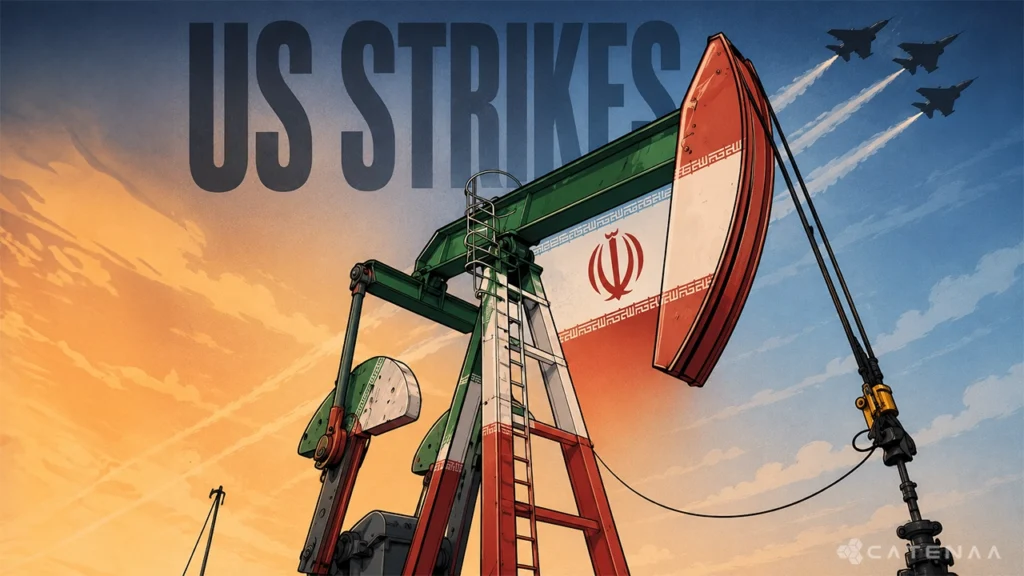


Catenaa, Thursday, July 23, 2026- The United States has carried out a ninth consecutive night of military strikes against Iranian targets, intensifying a campaign aimed at weakening Tehran’s ability to threaten commercial shipping through the Strait of Hormuz, one of the world’s most important energy corridors.
The latest operations, conducted by US Central Command, have targeted more than 300 military sites since the campaign began on July 11. The strikes focused on air defense systems, missile launch facilities, radar installations, drone infrastructure and coastal surveillance assets that support Iran’s military presence along the Persian Gulf.
The Pentagon also confirmed the operational use of one-way maritime attack drones alongside conventional air strikes, marking the first known deployment of the technology in the current conflict.
The military campaign comes months after Iran declared the Strait of Hormuz closed, escalating tensions in a waterway that carries about one-fifth of global oil shipments. Continued attacks and security risks have kept traders focused on the possibility of further disruptions to crude oil exports.
While the conflict has no direct connection to blockchain networks or digital assets, its economic effects could extend into cryptocurrency markets through higher energy prices and inflation.
Any sustained increase in oil prices could complicate central bank efforts to control inflation, potentially delaying interest rate cuts. Higher borrowing costs typically reduce investor appetite for risk-sensitive assets, including cryptocurrencies.
Market participants are increasingly watching oil futures alongside traditional crypto indicators as geopolitical developments influence broader financial markets.
Analysts say the conflict’s greatest impact on digital assets is likely to remain indirect unless shipping disruptions intensify or the confrontation expands across the region. A prolonged interruption to energy supplies could trigger wider market volatility, affecting equities, commodities and cryptocurrencies alike.
For now, investors are monitoring developments in the Strait of Hormuz as closely as they watch movements in Bitcoin and other major digital assets.
The Strait of Hormuz links the Persian Gulf with the Gulf of Oman and the Arabian Sea. It is the primary export route for crude oil and liquefied natural gas from several Gulf producers. Because such a large share of global energy trade passes through the narrow waterway, any military escalation in the region has historically influenced oil prices, inflation expectations and global financial markets. Although cryptocurrencies are not directly affected by military operations in the Gulf, macroeconomic shifts driven by energy prices have often influenced investor demand for digital assets.