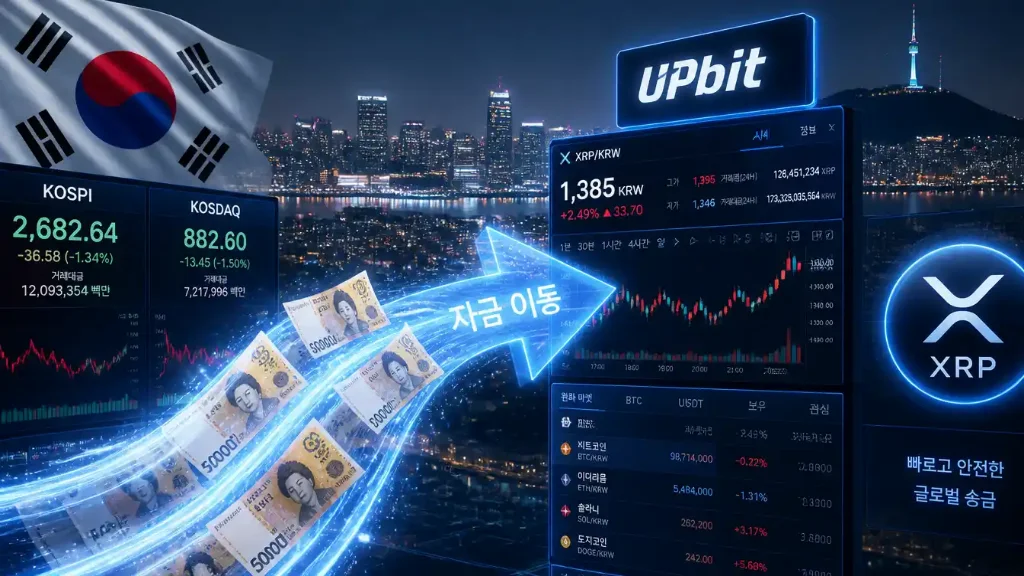


Catenaa, Sunday, August 30, 2026- Trading volume on South Korea’s Upbit cryptocurrency exchange surged 273% as bitcoin’s latest rally drew retail investors back toward digital assets after months of weaker activity.
Upbit processed about $1.84 billion in cryptocurrency trades over 24 hours, according to CoinGecko data cited by The Block.
The total was the exchange’s highest daily trading volume since mid-March.
XRP led activity with about $418.9 million in trades.
Bitcoin, Tether’s USDT and ether followed among the most actively traded assets.
Bithumb, South Korea’s second-largest cryptocurrency exchange, also recorded a sharp increase.
Its 24-hour trading volume rose about 133% to $934.9 million.
XRP was the most actively traded cryptocurrency on Bithumb as well.
The jump follows months of weaker Korean cryptocurrency activity.
A prolonged crypto downturn during the first half of 2026 pushed many domestic investors toward the stock market.
South Korea’s benchmark KOSPI climbed to record levels as investors piled into semiconductor companies benefiting from demand linked to artificial intelligence.
Samsung Electronics and SK Hynix were among the major beneficiaries.
The shift hurt the country’s two largest crypto exchanges.
Upbit and Bithumb each reported operating revenue declines of about 50% during the first half of the year.
Upbit’s net profit fell 74%.
Bithumb moved from profit to a net loss.
Those results reflected a sharp reduction in the trading fees that remain central to exchange earnings.
The latest volume increase suggests that trend can reverse quickly when cryptocurrency prices accelerate.
Bitcoin’s latest move appears to be one of the main catalysts.
The cryptocurrency rose more than 8% over 24 hours to around $78,500 when The Block reported the surge.
The broader crypto market gained about 7%.
Bitcoin had spent much of the year lagging the strong performance of South Korean equities.
That difference created a potential catch-up trade once cryptocurrency prices began rising again.
The rally has also been supported by renewed institutional demand in the United States.
Spot bitcoin and ether exchange-traded funds attracted a combined $2.6 billion during their strongest week since October.
Bitcoin ETFs alone drew about $1.9 billion.
Higher prices and stronger ETF demand helped change sentiment across global crypto markets.
South Korean retail investors appear to be responding.
Korean crypto traders have historically been highly sensitive to momentum.
That can make domestic trading activity rise quickly once global prices begin moving.
Presto Research associate researcher Min Jung told The Block that it was too early to describe two days of increased activity as a full rotation from stocks into crypto.
However, she said a sustained rally could attract substantially more Korean capital.
The argument rests on relative returns.
KOSPI has already posted strong gains this year, while cryptocurrency prices spent much of 2026 under pressure.
Investors seeking the next higher-return market may therefore begin shifting toward digital assets if the rally continues.
Korean retail investors have historically tended to follow returns rather than remain committed to one asset class.
That behavior can amplify existing market moves.
The dominance of XRP trading is also notable.
Bitcoin often dominates global cryptocurrency markets by value, but South Korean exchanges have repeatedly shown strong demand for altcoins.
XRP has long been one of the most actively traded cryptocurrencies among Korean investors.
Its liquidity and established won trading pairs have helped maintain that position.
The latest figures show the pattern continuing even during a bitcoin-driven market rally.
XRP accounted for more than one-fifth of Upbit’s reported 24-hour trading volume.
It also ranked first on Bithumb.
That suggests returning Korean traders are not limiting their exposure to bitcoin.
Instead, the rally is already spreading into assets with historically strong domestic followings.
A full rotation out of equities has not yet occurred.
South Korean stocks remain attractive after the semiconductor-led rally.
Artificial intelligence investment continues to support demand for memory chips and related technology companies.
KOSPI volatility has also increased since late June, but many investors remain heavily exposed to the sector.
The emerging competition is therefore between two markets offering different momentum stories.
Korean equities have already delivered strong gains.
Crypto investors increasingly believe digital assets may now have more room to recover.
That difference could become more important if bitcoin remains above recent breakout levels.
South Korean trading activity matters beyond the country’s borders.
Korean exchanges account for a notable share of global retail cryptocurrency activity, particularly in altcoins.
Sharp increases in won-denominated trading can therefore add liquidity and momentum to rallies that began elsewhere.
Jung said Korean capital historically tends to enter after a rally starts rather than trigger the initial move.
Once it arrives, however, the additional demand can accelerate price movements.
That pattern may be developing again.
Global crypto prices began rising first.
Korean exchange volume then increased sharply.
If prices continue higher, another wave of domestic investors could follow.
One day of strong volume does not establish a lasting recovery for Korean exchanges.
Trading activity can fall as quickly as it rises if cryptocurrency prices reverse.
Upbit and Bithumb also remain exposed to the broader economic factors that weakened their first-half results.
The latest numbers nevertheless mark a sharp change from the subdued trading conditions seen earlier this year.
Upbit’s 273% increase and Bithumb’s 133% rise show that retail interest has not disappeared.
It shifted elsewhere when returns were stronger.
Now that bitcoin and other cryptocurrencies are rallying, that capital is beginning to look back.
For the wider market, South Korea could become an important source of additional momentum if the global rally lasts.




