


September 13, 2026 – Builders Bank would hold digital assets under federal supervision. It would take no deposits and write no loans.

In Summary
Block filed with the OCC to establish Builders Bank and Trust, N.A.
The bank would custody bitcoin and stablecoins under federal supervision.
It would take no deposits, so it would carry no FDIC deposit insurance.
Lee Woolley would chair the board and serve as president and chief executive.
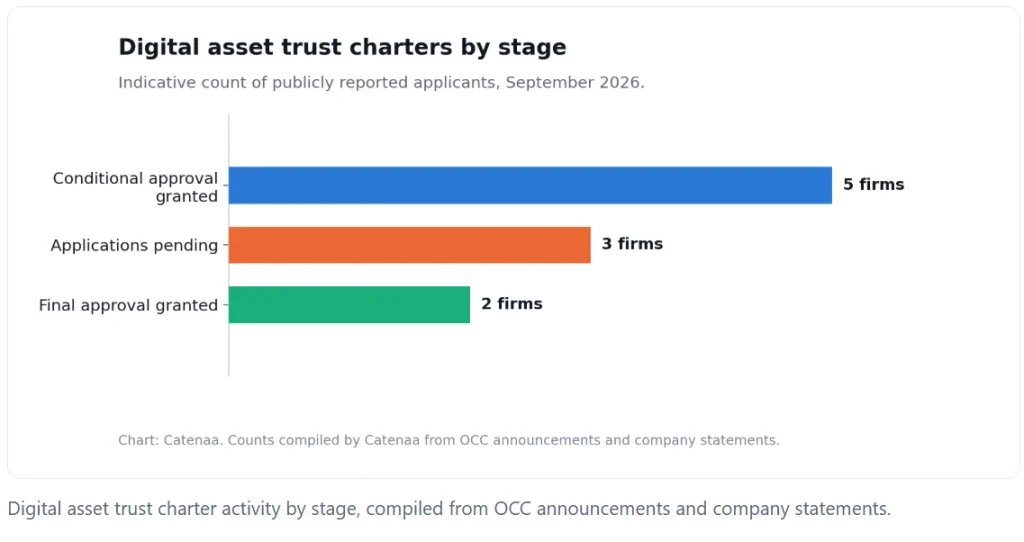
The OCC conditionally approved five digital asset trust charters in 2025.
Block wants a trust bank charter, and the paperwork is now public. The company filed its application on 4 September with the Office of the Comptroller of the Currency. The proposed entity is Builders Bank and Trust, N.A. Its main office would sit in Sioux Falls, South Dakota. Moreover, Block announced the move on 8 September.
The scope stays narrow on purpose. The filing describes a de novo national bank with no deposit-taking. It would carry no deposit insurance from the FDIC either. Block would own it through two intermediate holding companies. So the parent funds it entirely.
The application names four activities. First, custody and safekeeping of bitcoin and other digital assets. Second, buying and selling for clients on a riskless principal basis. Third, handling client instructions to deposit, withdraw, and transfer. Fourth, stablecoin settlement and transfer services.
That design is a feature, not a gap. A bank that holds no deposits cannot suffer a run. It also needs far less capital. Therefore, the risk sits in controls and key handling, rather than in a balance sheet.
Why a trust bank charter appeals now
State-by-state licences are slow and messy. Custody firms often hold dozens of permits at once. A national charter swaps that patchwork for one rulebook. Therefore, the appeal is as practical as it is symbolic.
Big clients care about this too. A pension fund cannot easily buy from a firm with fifty licences. It wants one named federal watchdog. Hence, the charter doubles as a sales tool.
Lee Woolley would serve as board chair, president, and chief executive. He now leads digital asset strategy at Block. His background includes senior roles at Northern Trust and BNY Mellon. In addition, he once ran a federal credit union. That profile signals a bank-first approach.
One line in the filing matters for timing. Block asked for the standard review track rather than the fast one. It also seeks Federal Reserve member bank status. Hence, the review will run on the slower path.
The wider context helps explain the rush. Stablecoin rules in the United States now sit on a clearer footing. Banks and payment firms have started to build accordingly. So a charter today looks less exotic than it did two years ago.
Block is not alone in the queue
The OCC cleared five such charters in December 2025. Those approvals covered a mix of new banks and conversions. Since then, several more firms have filed. Kraken’s parent company and a settlement infrastructure provider both submitted applications. Consequently, the queue keeps growing.
Approval never arrives quickly. The OCC reviews each case on its own merits. It also posts outcomes in its weekly licensing bulletin. Readers tracking this should watch that page rather than press coverage.
Timing also depends on the applicant. The filing sets out a three-year de novo period for building the business. Block kept its business plan in a confidential exhibit. Consequently, the public volume shows structure rather than strategy.
What the charter would mean for Block
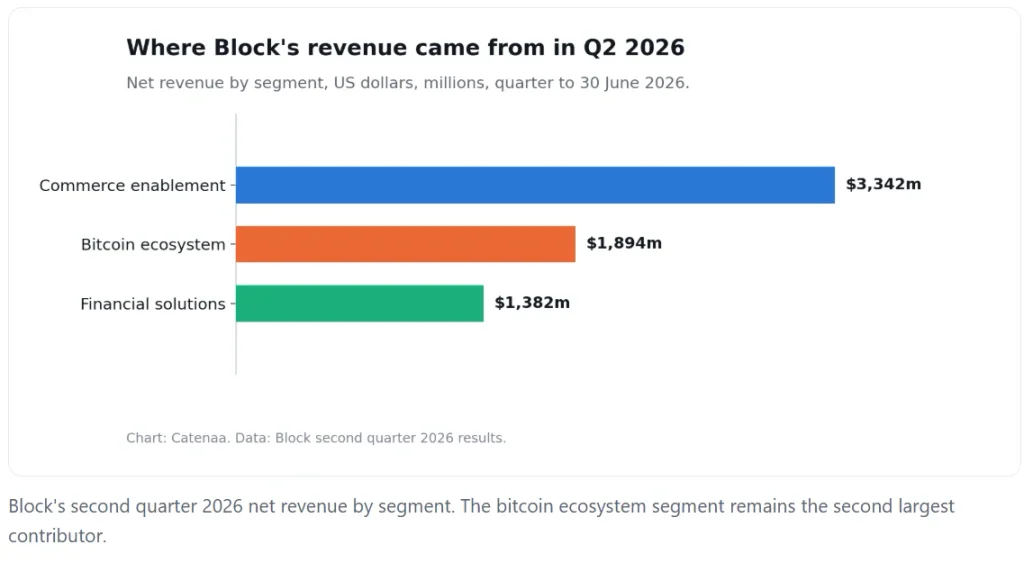
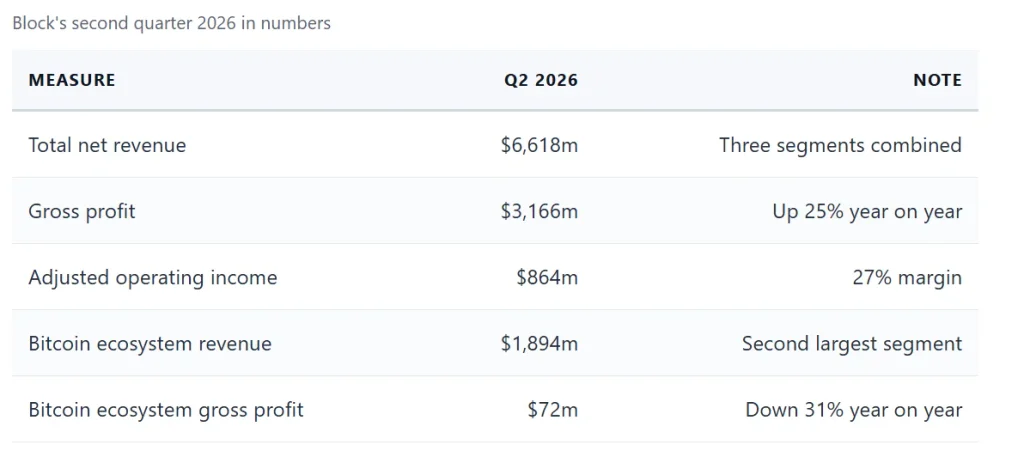
Block already runs large digital asset operations. Its bitcoin segment produced $1.89bn of net revenue in the second quarter. Commerce enablement contributed $3.34bn. Financial solutions added $1.38bn. Hence, custody would sit alongside a business that already touches crypto daily.
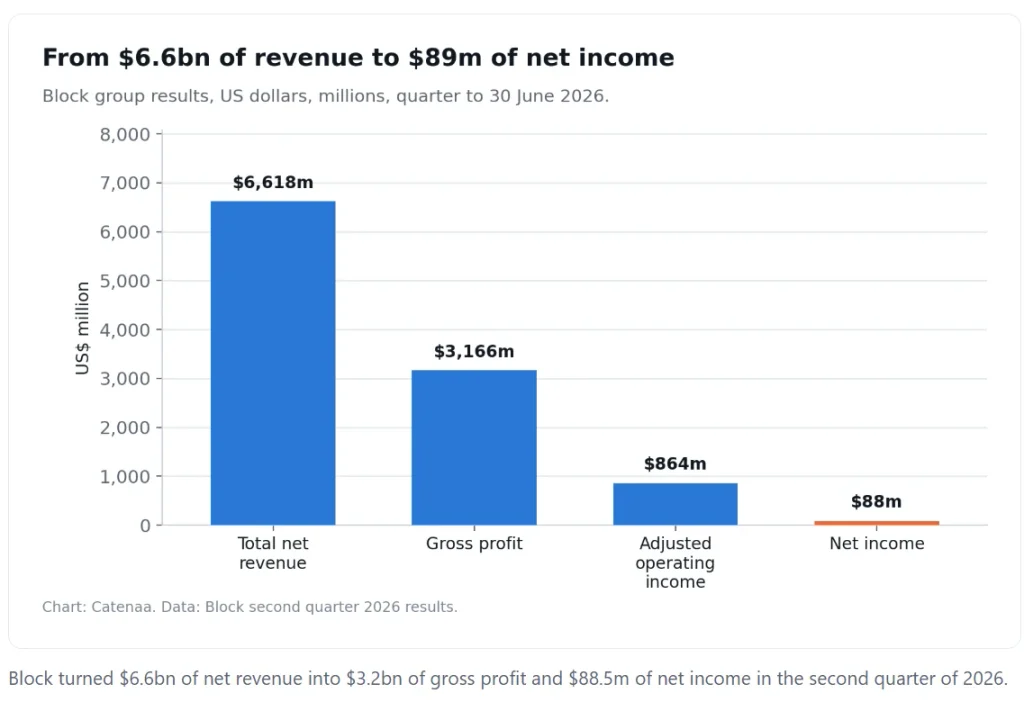
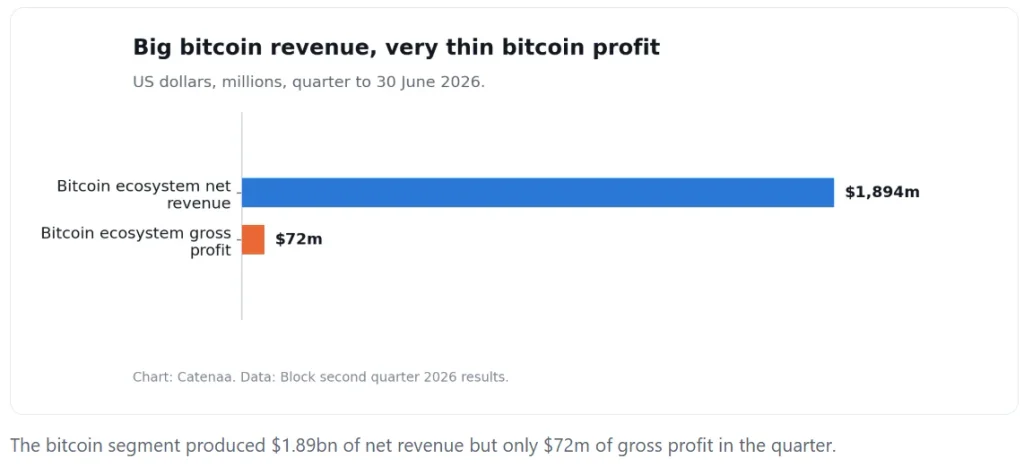
Profitability tells a mixed story. Block reported $3.17bn of gross profit in the second quarter, up 25% on the year. Adjusted operating income reached $864m at a 27% margin. Yet Bitcoin segment gross profit fell 31% to $72m. So revenue scale and profit contribution diverge sharply in that unit.
The risks worth naming
Approval is not certain. Regulators weigh capital, controls, and management quality. Holding bearer assets raises hard questions about keys. Thus, the OCC will probe the design closely.
Bitcoin differs from a share or a bond here. Lose the key, and the asset is gone for good. No registrar can reissue it. Consequently, custody rules for crypto demand more than the old playbook.
Competition forms the second risk. Several rivals already hold approvals. Early movers can sign big clients first. Similarly, older custodians carry long track records. Block must therefore win on price, service, or fit.
Block does hold one clear edge. Millions of people already use its apps. Cash App and Square give it a route to market. In contrast, a pure custody startup must find every client from scratch.
Finally, custody economics stays thin. Fees are measured in basis points, not percentages. Scale drives the business. In short, this looks like infrastructure work, not a quick profit engine.
What to watch next
Three markers matter. First, follow the OCC digital asset licensing page for status changes. Second, watch whether Block reports custody assets once live. Third, track how fast rival charters turn into real client wins.
The bigger test comes later. A charter proves a firm can meet the bar. It does not prove that clients will pay. Until custody balances appear in filings, this stays a licence story rather than a revenue one.