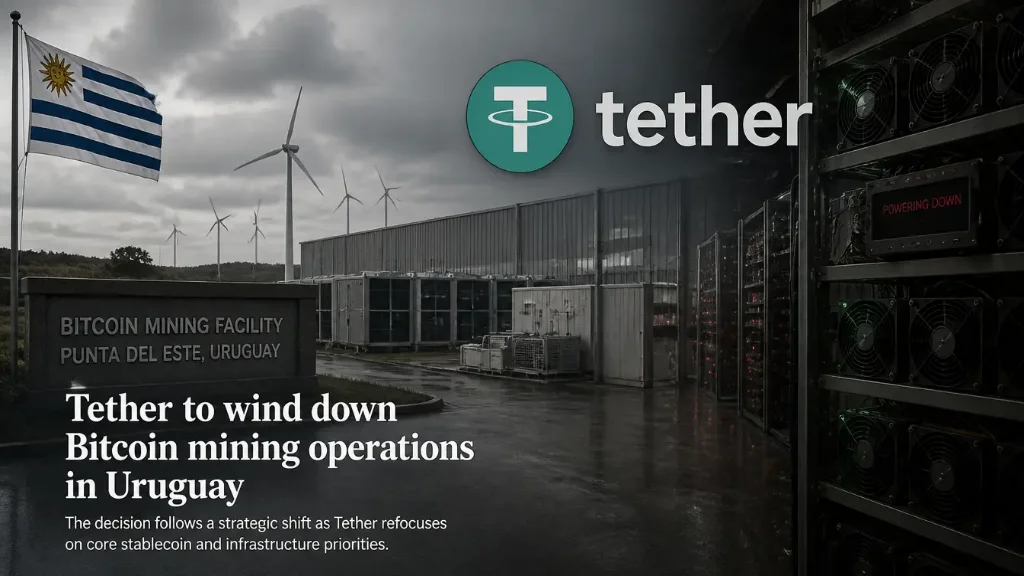


Catenaa, Saturday, August 29, 2026- Tether abandoned an estimated $120 million bitcoin mining project in Uruguay after a dispute with state-owned electricity provider UTE over how much power its two mining sites were entitled to receive, Reuters reported.
The project had been positioned as an entry point for a broader South American mining expansion.
Instead, the disagreement eventually led to unpaid electricity bills, a power cutoff and the closure of the two facilities in Uruguay’s Florida department.
The dispute centered on different interpretations of the electricity contract.
Tether understood an agreed power figure to represent a minimum amount that could be increased as the operation expanded, according to Reuters.
UTE considered the same figure a maximum limit.
The difference became increasingly important as Tether’s mining operation grew and required more electricity.
The facilities initially operated successfully and generated revenue, Reuters reported, citing former contractors.
Problems emerged when demand increased beyond the electricity available under UTE’s interpretation of the agreement.
The sites sometimes operated without sufficient power for days at a time.
Bitcoin mining depends heavily on electricity prices and continuous access to energy.
Mining computers perform large numbers of calculations around the clock, making power availability one of the most important factors in determining whether an operation remains profitable.
Tether and UTE attempted to renegotiate the agreement.
A revised contract was prepared, but Tether representatives did not attend the scheduled signing, according to meeting records reviewed by Reuters.
The relationship deteriorated further after Uruguay’s change of government in March 2025.
Reuters cited people familiar with the negotiations who said new UTE leadership appointed under President Yamandú Orsi took a stricter approach to the existing contract.
Tether did not publicly blame the government for the project’s collapse.
Microfin, Tether’s legal entity in Uruguay, stopped paying electricity bills about two months after the new government took office, Reuters reported.
By June 2025, Microfin had informed UTE that it intended to terminate its contracts.
With electricity bills unpaid and no revised agreement in place, UTE disconnected the mining facilities on July 25, 2025.
Tether later notified Uruguayan labor authorities on Nov. 25 that it would cease operations and dismiss most employees connected to the project.
Neither Tether nor UTE publicly disclosed the total investment.
Reuters cited a person familiar with the project who estimated Tether spent about $120 million.
Tether did not respond to requests for comment from Reuters or The Block.
Tether announced its Uruguay mining venture in May 2023.
At the time, the company highlighted Uruguay’s renewable electricity generation, grid infrastructure and political stability.
The country generates most of its electricity from renewable sources, including wind and hydropower.
That made Uruguay appear attractive to bitcoin miners seeking cleaner energy and reliable infrastructure.
Tether also viewed the country as a potential testing ground for expansion into larger South American markets, according to Reuters.
Brazil, Paraguay and Argentina were among the markets considered for future operations.
The Uruguay setback did not end those ambitions.
Tether has continued investing in energy and mining elsewhere in the region.
Chief Executive Paolo Ardoino said in June 2025 that Tether expected to become one of the world’s largest bitcoin miners.
At the time, the company said it had invested more than $2 billion in energy and mining infrastructure across 15 sites in Uruguay, Paraguay and El Salvador.
The Uruguay facilities were disconnected one month later.
Tether has since pursued other routes into energy infrastructure.
It acquired a 70% interest in renewable energy producer Adecoagro and later agreed to use surplus electricity generated by the company for bitcoin mining.
That model could reduce one of the risks exposed in Uruguay by linking mining activity directly to energy production rather than depending entirely on a negotiated allocation from a state utility.
Tether has also expanded into mining technology.
The company released an open-source operating system for bitcoin miners earlier this year.
It also disclosed an 8.2% stake in Antalpha, a mining finance company linked to mining equipment manufacturer Bitmain.
Tether is separately developing modular bitcoin mining systems with Canaan and ACME Swisstech.
The Uruguay experience highlights a broader challenge facing bitcoin miners.
Mining economics have become increasingly sensitive to electricity prices, network competition and bitcoin market conditions.
Operators compete for the same block rewards while the amount of computing power securing the Bitcoin network continues to change.
The 2024 bitcoin halving also cut the block subsidy from 6.25 BTC to 3.125 BTC.
That forced miners to produce the same amount of computational work while receiving fewer newly issued bitcoins for each block.
Cheap and predictable electricity therefore became even more important.
Uruguay offers reliable infrastructure, but its electricity costs can be less attractive for bitcoin mining than those available in neighboring markets.
Bitcoin miners are also facing competition from another industry for energy and data-center infrastructure.
Artificial intelligence companies require large amounts of electricity for high-performance computing used to train and operate AI models.
Some bitcoin mining companies have begun converting sites into AI and high-performance computing facilities because long-term computing contracts can generate more predictable revenue.
That creates another calculation for energy providers.
Electricity and grid capacity that could support bitcoin miners may also be sold to AI data centers.
Uruguay’s reliable electricity network and telecommunications infrastructure could make the country more attractive for data centers than bitcoin mining if miners cannot obtain sufficiently cheap power.
The competition means mining companies must secure more than access to renewable energy.
They also need contracts that guarantee enough electricity at prices that allow mining equipment to remain profitable.
Tether’s Uruguay experience illustrates how a relatively narrow contractual disagreement can derail a much larger infrastructure investment.
The underlying problem was not a bitcoin protocol failure, mining equipment malfunction or security breach.
It was disagreement over electricity.
For an industry built around enormous energy consumption, that can be enough.
Tether has the financial resources to move capital elsewhere and has continued expanding its mining business across Latin America.
Smaller operators may have fewer options when electricity arrangements fail.
The Uruguay project therefore offers a lesson for an industry increasingly moving from temporary mining facilities toward long-term energy partnerships.
Reliable grids and renewable power can make a country attractive.
But for a large bitcoin mining operation, the wording of the power contract may ultimately matter more.