


September 13, 2026 – The stablecoin issuer will originate loans while Fasanara manages them. USDT moves money across borders.

In Summary
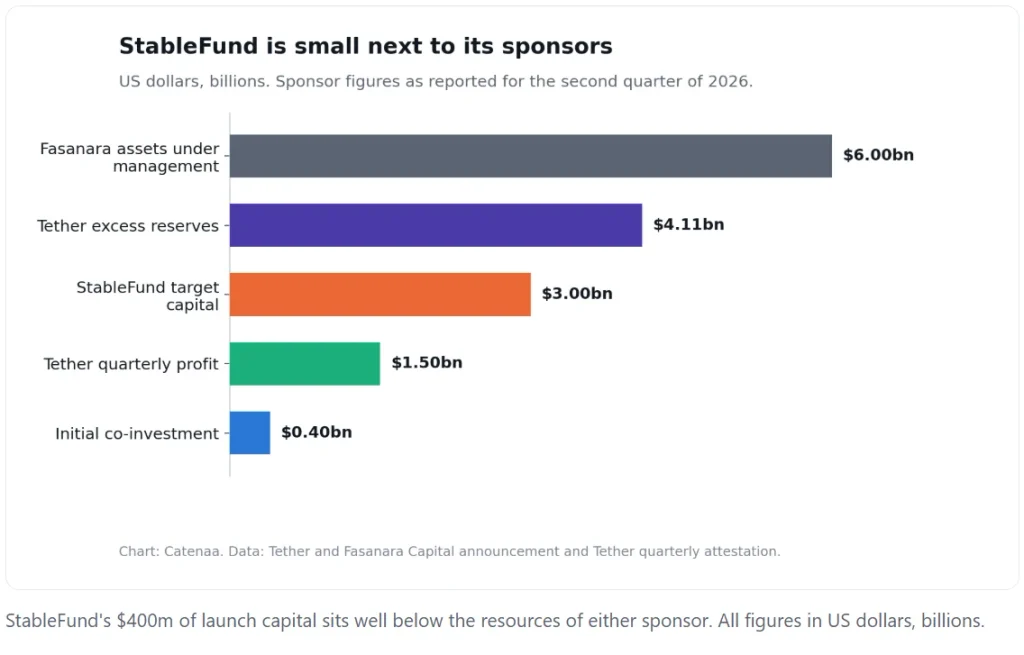
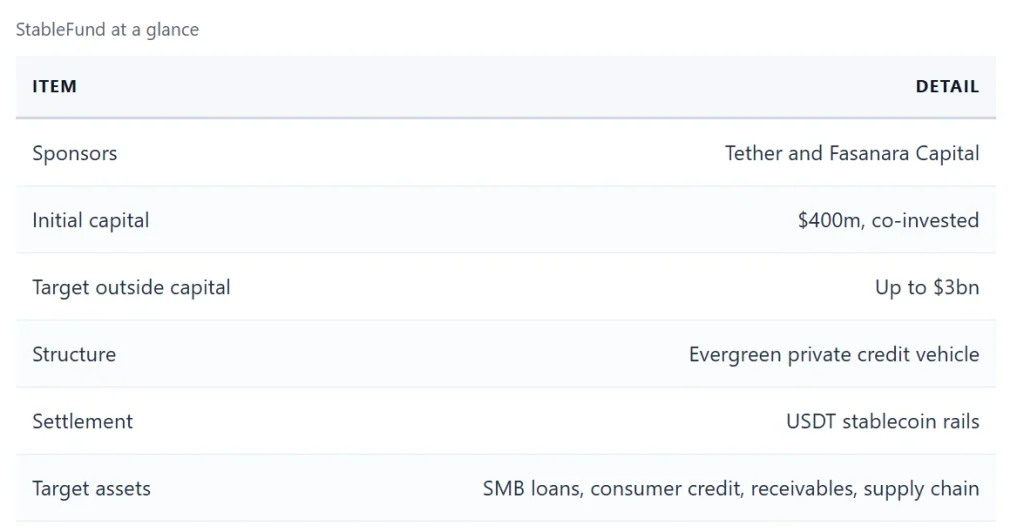
Tether and Fasanara Capital launched StableFund with $400m of their own money.
The vehicle targets up to $3bn of third-party institutional capital.
It will lend to small businesses, consumers, and trade finance borrowers.
USDT provides the settlement layer for cross-border money movement.
Tether reported $184.6bn of USDT in circulation as of 30 June 2026.
Tether has opened a private credit fund, and the design is unusual. The stablecoin issuer announced StableFund on 9 September with Fasanara Capital. Both firms put in $400m of their own money. They now want up to $3bn from outside investors. Moreover, the money will move on stablecoin rails.
The roles split cleanly. Fasanara acts as an investment manager. Tether acts as co-sponsor, originator, and adviser. It also runs the settlement layer. So one side picks the credit, and the other side moves the cash.
What the private credit fund will buy
The stated targets sit in short-dated, asset-backed lending. Small business loans lead the list. Consumer credit follows. Trade receivables and supply chain finance round it out. Hence, the fund avoids long-dated corporate paper.
An evergreen fund never winds down on a fixed date. Instead, it recycles cash as loans are repaid. That suits a short paper well. Therefore, the structure and the assets fit each other neatly.
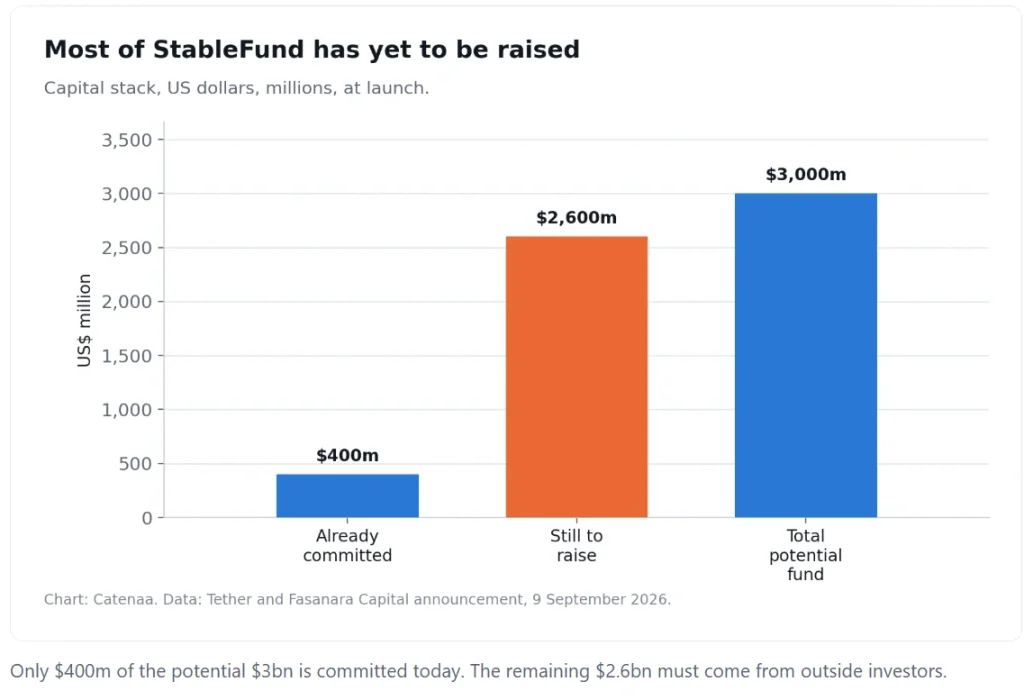
Size remains the open question. Only $400m is committed today. The other $2.6bn must come from pensions, insurers, and family offices. So the launch marks a start line rather than a finish.
That choice matters for risk. Short-duration assets repay quickly. Cash returns often, which suits an evergreen structure. However, short paper also reprices fast when borrowers weaken. So credit selection carries most of the weight.
Why stablecoin rails change the maths
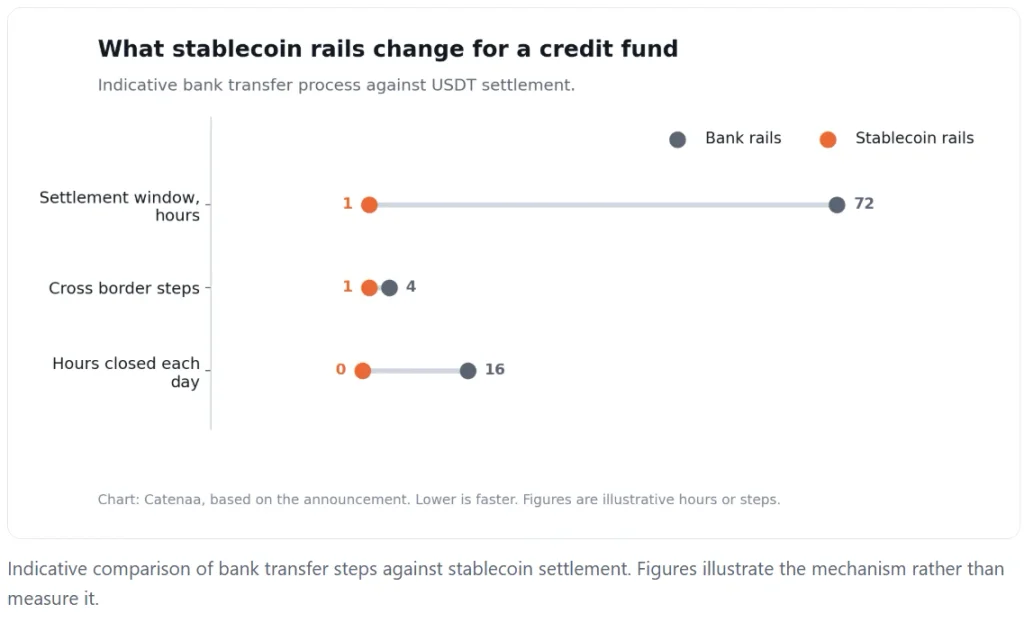
Cross-border lending usually crawls. A wire can take days through a chain of banks. Each hop adds fees and cutoff times. In contrast, USDT settles around the clock. Therefore, cash can reach a borrower faster.
Speed is not a gimmick in trade finance. A shipment waits while money clears. Cut the wait, and working capital works harder. So the rail choice can change the economics of a loan.
Tether frames the opportunity in scale terms. Tether puts the global small business financing gap at $5.7trn, spread across more than 60 countries. That gap is real, and banks have retreated from parts of it. Still, a financing gap exists partly because credit is hard.
Who is actually managing the money
Fasanara is the experienced hand here. Fasanara manages more than $6bn in short-duration, asset-backed strategies. The London firm has run these books for years. Consequently, the fund brings a conventional manager to an unconventional settlement layer.
Paolo Ardoino, who leads Tether, calls USDT money that works everywhere. Francesco Filia, who leads Fasanara, points to the size of the stablecoin network. Both frame the deal as a bridge to real economy borrowers.
The balance sheet behind the sponsor
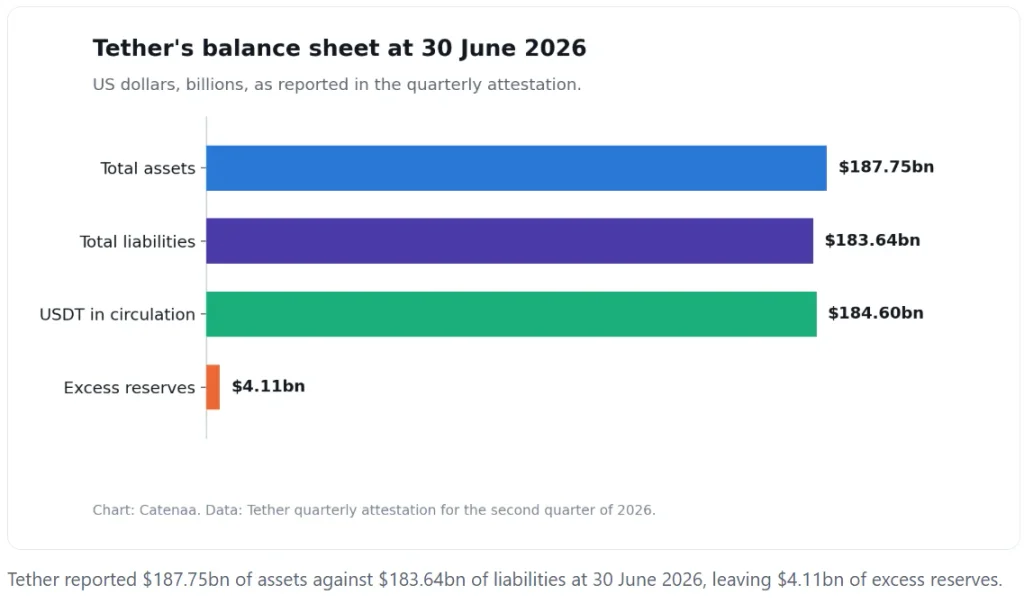
Tether reported $184.6bn of USDT in issue at 30 June 2026. Total assets reached $187.75bn against $183.64bn of debts. Spare reserves therefore came to about $4.11bn. Net operating profit for the quarter reached roughly $1.5bn.
That buffer looks thin next to the size of the book. It equals about 2.2% of liabilities. Short-dated government paper does most of the work. So the model rests on those assets staying liquid under stress.
Risks that deserve attention
Conflicts sit at the centre. Tether originates loans and also runs settlement. It co-invests too. Thus, one party touches sourcing, funding, and payment. Investors should ask how the manager handles that overlap.
Credit quality forms the second issue. Small business lending across 60 countries covers wildly different legal systems. Recovery rates vary hugely. In addition, underwriting at a distance is hard. Diversification helps, yet it never removes the problem.
Currency risk also lurks. A loan settled in USDT still faces local currency moves at the borrower’s end. Readers can track official dollar reference rates to see how much those moves matter. Finally, stablecoin redemption depends on the sponsor’s reserves staying liquid.
What this signals for the sector
Crypto firms keep pushing into regulated finance. Several now seek chartered digital asset institutions. Others build funds instead. In short, the path runs toward familiar structures with digital settlement underneath.
Traditional asset managers have moved the other way. Large credit houses have tied up with crypto platforms over the past year. Hence, the two worlds keep meeting in the middle. This fund is one more step on that road.
Watch three things next. First, see whether outside investors actually commit the $3bn. Second, look for disclosure on loan performance. Third, check whether other stablecoin issuers copy the model. Those answers will show if this becomes a category or stays a one-off.