


July 25, 2026 – Tesla’s digital asset position lost $112 million of reported value during the second quarter. However, the decline did not consume operating cash.
In Summary
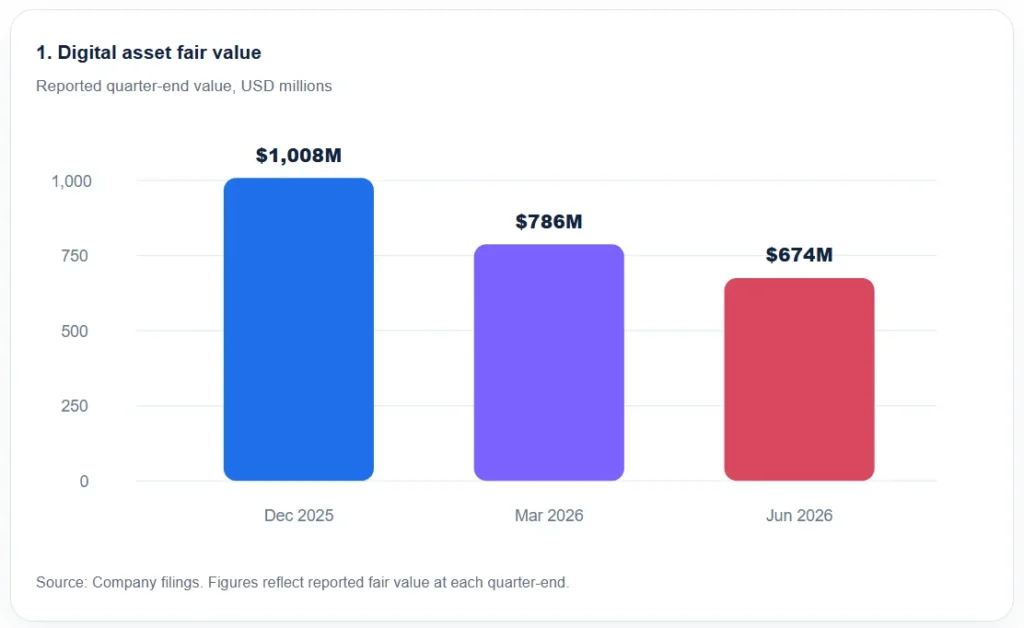
Tesla reported digital assets worth $674 million at June 30, 2026.
The portfolio fell 14.2% from $786 million at March 31.
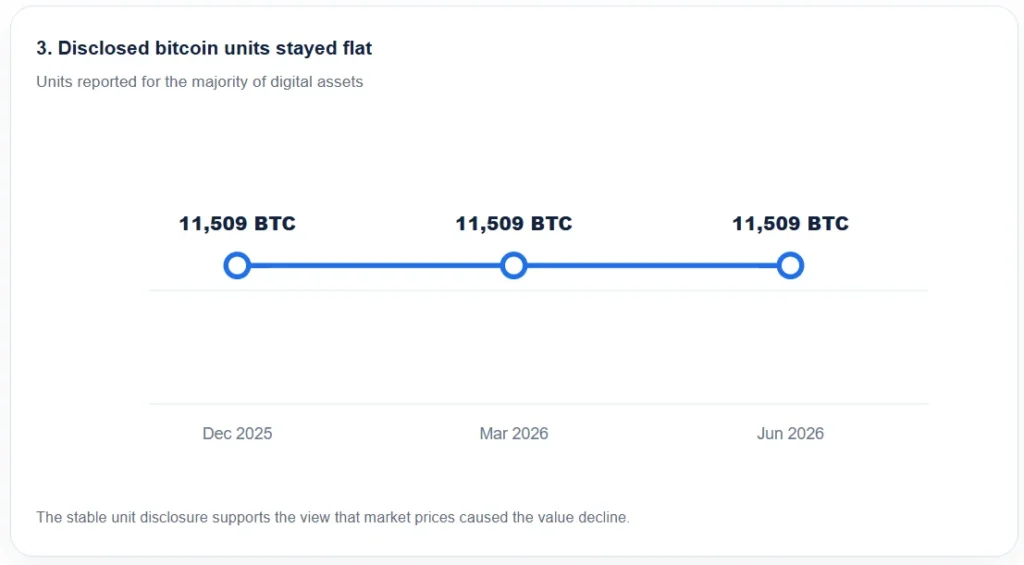
Tesla still disclosed 11,509 bitcoin, suggesting no quarterly reduction.
The accounting loss reflects market prices, not a cash sale.
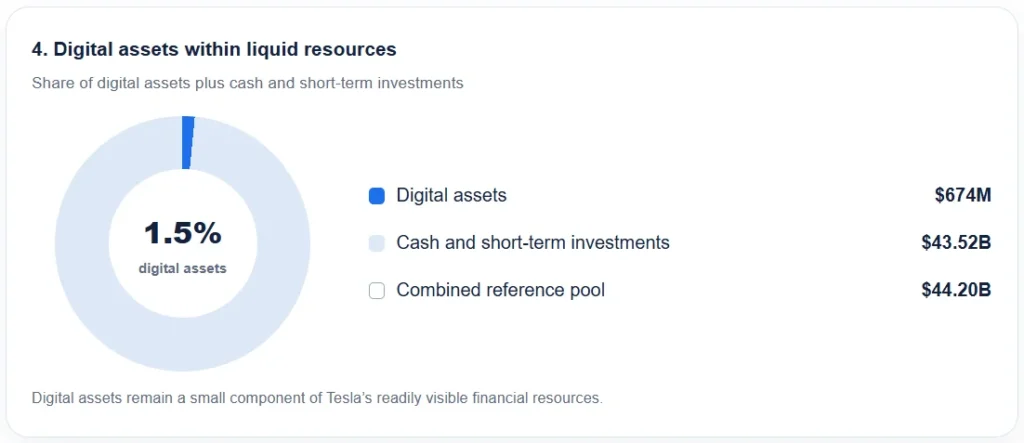
Digital assets remain small beside Tesla’s $43.52 billion liquidity pool.
A falling value, not a sale
Tesla’s crypto portfolio ended June at $674 million after its July 22 results notice. Its quarterly filing showed $786 million three months earlier.
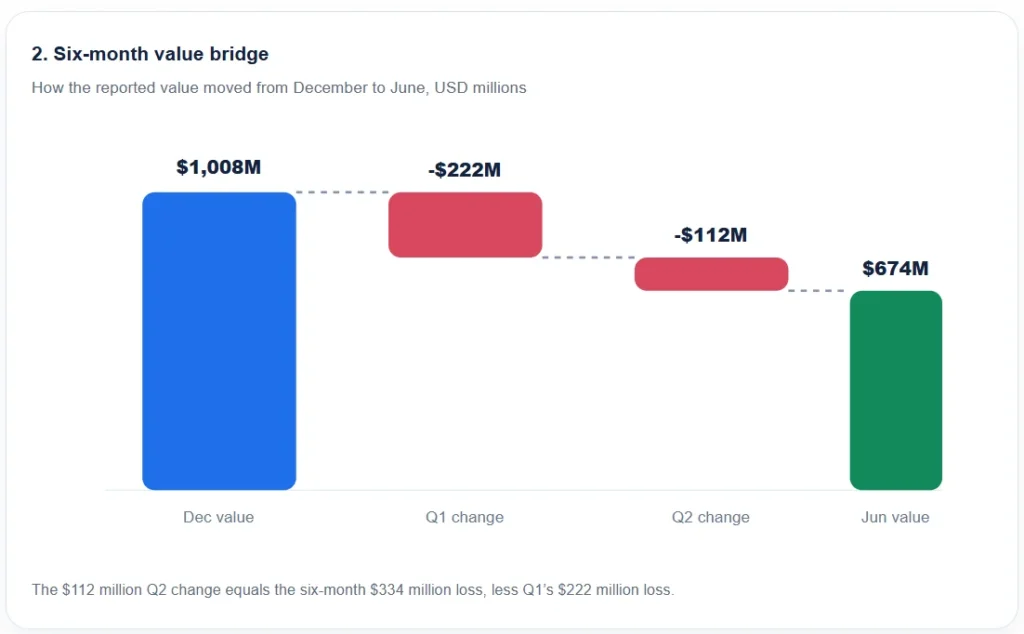
Therefore, the quarter produced a $112 million mark-to-market decline. Tesla’s six-month cash-flow statement reported a $334 million digital asset loss.
The first-quarter filing had already recorded a $222 million loss. Subtracting that amount leaves the second-quarter change of $112 million.
Crucially, Tesla continued to disclose 11,509 bitcoin. The company also reported an acquisition cost of $386 million for most holdings.
This suggests price movement drove the quarterly decline. It does not indicate that Tesla sold bitcoin during the quarter.
Since December, the reported portfolio value has fallen by $334 million, or 33.1%. That decline mirrors the six-month noncash adjustment.
Quarter-end pricing also creates a timing effect. A late market swing can change reported earnings, despite different average prices during the quarter.
Why the loss remains noncash
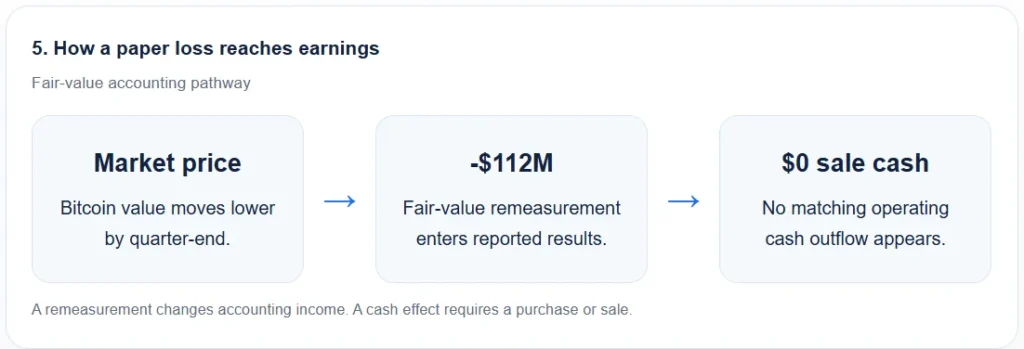
The phrase “paper loss” can sound less important than it is. Yet it describes a real earnings effect without an immediate cash payment.
Current accounting rules require qualifying crypto assets to be measured at fair value each reporting period. Price changes then enter net income.
Tesla adopted that model from January 1, 2024, according to its 2025 annual report. Before the change, accounting rules treated bitcoin more like an indefinite-lived intangible asset.
The older model recorded impairments after price declines. However, it generally ignored recoveries until an asset sale occurred.
Fair-value accounting removes that one-sided treatment. It also makes quarterly earnings more sensitive to bitcoin’s market price.
Still, Tesla’s cash-flow statement adds the noncash loss back when reconciling net income. Cash changes only when Tesla buys or sells assets.
However, the adjustment still affects reported profit and equity. It can also influence headline earnings comparisons across quarters.
Material, but not a liquidity threat
The $112 million decline deserves attention. However, it remains modest beside Tesla’s broader balance sheet.
Tesla reported $43.52 billion in cash, cash equivalents, and short-term investments at quarter-end. Digital assets represented about 1.5% of the combined pool.
The company also generated $28.24 billion in quarterly revenue. Net income reached $1.13 billion during the same period.
Therefore, the crypto decline equaled about 9.9% of quarterly net income. That comparison shows earnings sensitivity, not financial distress.
Tesla’s reported digital asset value also remained above the disclosed bitcoin acquisition cost. The difference was about $288 million at quarter-end.
That gap equals roughly 74.6% of the disclosed cost basis. It provides a valuation cushion against the original purchase price.
However, those figures are not perfectly comparable. The fair-value balance covers digital assets, while the cost disclosure refers mainly to bitcoin.
What investors should watch next
Tesla’s crypto position acts like a visible market-risk line inside a much larger industrial company. That creates three important signals.
First, bitcoin volatility can move reported profit even when vehicle operations remain unchanged. Investors should separate operating performance from treasury remeasurement.
Second, an unchanged coin count keeps Tesla exposed to both rebounds and further declines. Future earnings may therefore swing with quarter-end prices.
Third, the position provides optional liquidity. Tesla can sell bitcoin if capital needs rise, although any sale could influence market sentiment.
The wider context also matters. Tesla is increasing spending on artificial intelligence, manufacturing capacity, and supporting infrastructure.
As capital demands grow, investors may question whether volatile treasury assets still fit management’s liquidity strategy. For now, the balance remains manageable.
The main conclusion is simple. Tesla booked a meaningful crypto paper loss, but the company did not suffer a matching cash outflow.
Its bitcoin count stayed stable, while fair-value accounting transmitted market weakness into reported earnings. The next quarter could reverse that effect quickly.
Analytical note: The $112 million quarterly change is calculated from reported fair values. It also reconciles with Tesla’s six-month noncash adjustment.